
When the Mid-Autumn Festival comes around, phones across Singapore light up with wishes, and boxes of mooncakes arrive with little cards tucked inside. Knowing a few mid autumn greetings in Chinese helps you write something warmer than a generic “Happy Mid-Autumn”, whether you are messaging a friend, writing to your in-laws or signing a card for a client.
This guide lists common 中秋 (Zhōngqiū, Mid-Autumn) greetings with pinyin and plain-English meanings, then explains which ones suit casual chats and which ones are better for formal occasions. You do not need to be fluent in Mandarin to use them well.
The Essential Mid-Autumn Greetings
These are the phrases you will see most often in Singapore. They are safe to use with almost anyone.
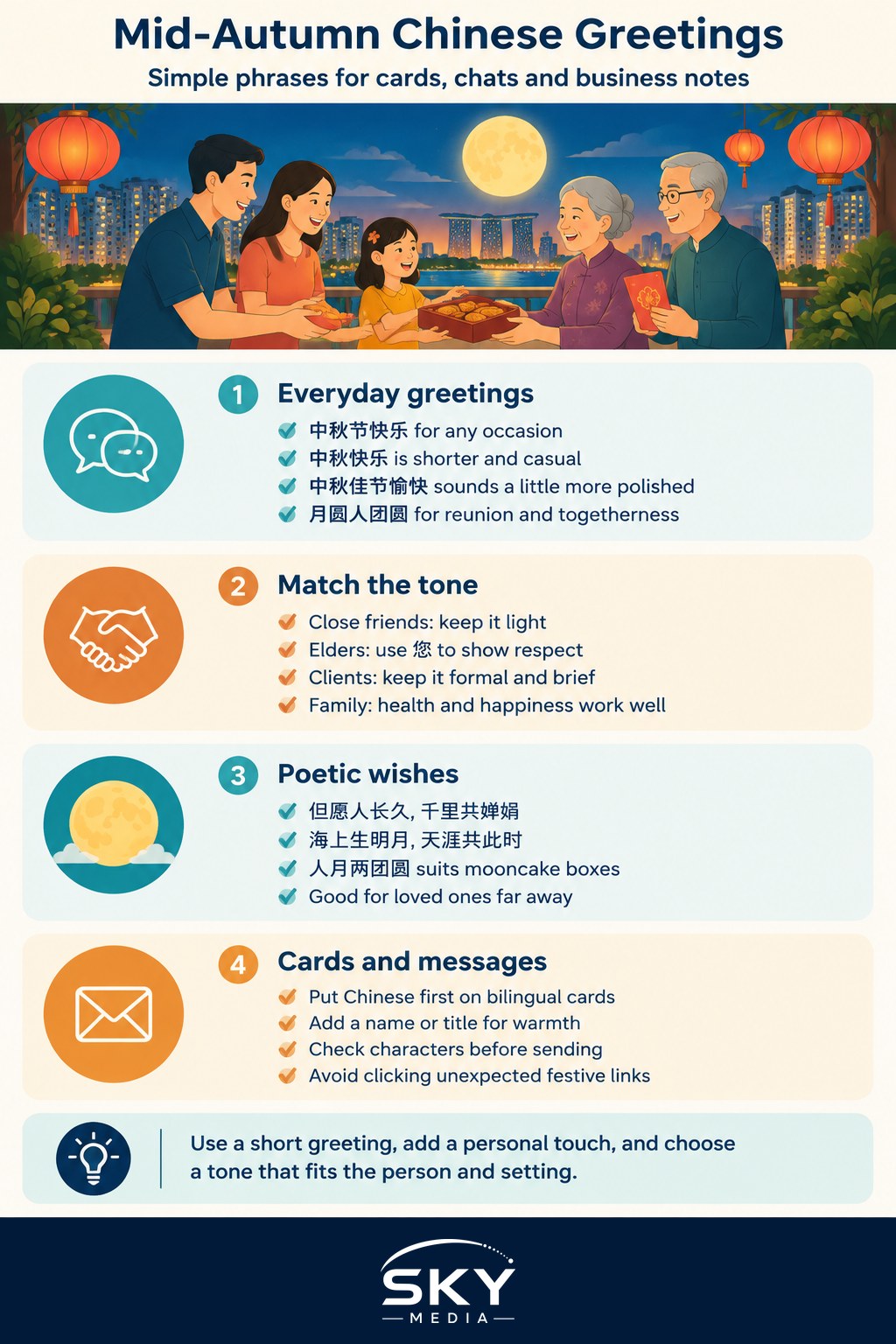
- 中秋节快乐 (Zhōngqiū jié kuàilè): Happy Mid-Autumn Festival. The standard, all-purpose greeting.
- 中秋快乐 (Zhōngqiū kuàilè): Happy Mid-Autumn. A shorter, slightly more casual version, ideal for text messages.
- 中秋佳节愉快 (Zhōngqiū jiājié yúkuài): Wishing you a pleasant Mid-Autumn Festival. 佳节 means “fine festival” and sounds a little more polished.
- 月圆人团圆 (yuè yuán rén tuányuán): The moon is full and the family is reunited. This captures the heart of the festival, which is about reunion.
- 花好月圆 (huā hǎo yuè yuán): Flowers in full bloom under a full moon. A poetic wish for harmony and happiness. It is also a popular wedding blessing, so it suits couples especially well.
- 阖家团圆 (hé jiā tuányuán): May the whole family be reunited. A warm wish for family gatherings.
- 阖家幸福 (hé jiā xìngfú): Happiness to your whole family.
You can combine a festival greeting with a general blessing. For example, 中秋快乐,身体健康 (Zhōngqiū kuàilè, shēntǐ jiànkāng) means “Happy Mid-Autumn, and good health to you”.
Formal or Casual: Which Greeting to Use When
The right greeting depends on who you are writing to. Mandarin has a polite form of “you”, 您 (nín), which shows respect, while 你 (nǐ) is everyday and friendly. Using 您 for elders, bosses and clients is a simple way to sound considerate.
| Who you are writing to | Tone | Suggested greeting | Meaning |
|---|---|---|---|
| Close friends, classmates | Casual | 中秋快乐!记得吃月饼哦 (Zhōngqiū kuàilè! Jìde chī yuèbǐng o) | Happy Mid-Autumn! Remember to eat your mooncakes |
| Parents, grandparents, in-laws | Warm and respectful | 祝您中秋快乐,身体健康 (Zhù nín Zhōngqiū kuàilè, shēntǐ jiànkāng) | Wishing you a happy Mid-Autumn and good health |
| Partner or spouse | Affectionate | 花好月圆,有你真好 (huā hǎo yuè yuán, yǒu nǐ zhēn hǎo) | A perfect moonlit night, and I am lucky to have you |
| Colleagues | Friendly and neutral | 中秋节快乐,阖家幸福 (Zhōngqiū jié kuàilè, hé jiā xìngfú) | Happy Mid-Autumn, and happiness to your family |
| Clients and business partners | Formal | 恭祝您中秋佳节愉快,事业顺利 (Gōngzhù nín Zhōngqiū jiājié yúkuài, shìyè shùnlì) | Respectfully wishing you a pleasant Mid-Autumn Festival and continued success in your work |
A few rules of thumb:
- Short and cheerful works for friends and group chats.
- Health and family wishes suit elders and relatives.
- Work and business wishes suit clients, but keep them sincere and brief.
Poetic Wishes for Family Far Away
Mid-Autumn has a long literary tradition, and some greetings come straight from classical poetry. These are lovely for relatives or friends living overseas, or for anyone who cannot make it home for the reunion.
- 但愿人长久,千里共婵娟 (dàn yuàn rén chángjiǔ, qiān lǐ gòng chánjuān): May we all live long, and though a thousand miles apart, share the same beautiful moon. These lines come from a famous poem by the Song dynasty poet Su Shi. They are perhaps the most quoted Mid-Autumn lines of all, and are perfect for loved ones abroad.
- 海上生明月,天涯共此时 (hǎi shàng shēng míng yuè, tiānyá gòng cǐ shí): A bright moon rises over the sea, and those at the ends of the earth share this moment. From a Tang dynasty poem by Zhang Jiuling, this suits friends in different countries.
- 人月两团圆 (rén yuè liǎng tuányuán): Both the moon and the people are whole and together. A common greeting in Cantonese-speaking communities too, often used on mooncake boxes.
If you are not confident with poetry, it is perfectly fine to pair a poetic line with a simple English note explaining why you chose it. Recipients usually appreciate the effort.
Business and Client Greetings
Many Singapore companies send mooncakes to clients, suppliers and partners. A short, formal Chinese greeting on the card adds a respectful touch. Common building blocks include:
- 值此中秋佳节之际 (zhí cǐ Zhōngqiū jiājié zhī jì): On the occasion of the Mid-Autumn Festival. A formal opening line.
- 感谢您一直以来的支持 (gǎnxiè nín yīzhí yǐlái de zhīchí): Thank you for your continued support.
- 生意兴隆 (shēngyì xīnglóng): May your business flourish.
- 事业顺利 (shìyè shùnlì): May your work go smoothly.
- 万事如意 (wàn shì rú yì): May everything go as you wish.
A complete card might read: 值此中秋佳节之际,感谢您一直以来的支持,恭祝您阖家幸福,万事如意。 This translates as: “On the occasion of the Mid-Autumn Festival, thank you for your continued support. We respectfully wish you and your family happiness and success in all things.”
For bilingual cards, put the Chinese greeting first and the English translation underneath. Have a native speaker check the characters before printing, since a single wrong character can change the meaning.
Writing Good Mid-Autumn Messages
Beyond picking the right phrase, a few habits make your messages feel personal rather than copied and pasted.
- Add the person’s name or title. Opening with 王老师 (Wáng lǎoshī, Teacher Wang) or 阿姨 (āyí, Auntie) feels warmer than a bare greeting.
- Mention something specific. A line about a mooncake flavour they love, or last year’s lantern walk, shows you are thinking of them.
- Mind the timing. Greetings are usually sent in the days leading up to the festival and on the day itself, which falls on the 15th day of the eighth lunar month.
- Be thoughtful with families in mourning. For a household that has recently lost someone, a gentle message such as 想念你们,保重 (xiǎngniàn nǐmen, bǎozhòng), meaning “thinking of you, take care”, may be kinder than an exuberant “happy” greeting.
- Check your characters. Phone keyboards sometimes suggest the wrong character for a pinyin input. Read your message once before sending.
Festive seasons are also a busy time for scammers who send fake e-cards, gift vouchers or “lucky draw” links. Do not click links in unexpected festive messages, even if they appear to come from a friend. Our guide to protecting yourself from phishing and scam messages explains the warning signs.
Putting It All Together
A simple formula works for almost any Mid-Autumn message: greeting, plus a personal touch, plus a wish. For example: “张阿姨,中秋快乐!谢谢您做的月饼,祝您身体健康。” (Zhāng āyí, Zhōngqiū kuàilè! Xièxie nín zuò de yuèbǐng, zhù nín shēntǐ jiànkāng.) This means: “Auntie Zhang, Happy Mid-Autumn! Thank you for the mooncakes you made, and wishing you good health.”
Whether you write a single line on WhatsApp or a careful card for a client, a few well-chosen Chinese words show respect for a festival that means a great deal to many Singaporean families. For more on how the festival is celebrated here, read our guides to the Mid-Autumn Festival in Singapore and celebrating Mid-Autumn Festival in Singapore.