
When Deepavali comes around, Singapore’s offices, void decks and group chats fill with warm wishes. If you want to greet Tamil-speaking colleagues, neighbours or friends properly, knowing a few Deepavali greetings in Tamil is a thoughtful touch that people genuinely appreciate. This guide gives you the common phrases with simple pronunciation, ready-to-use English messages for different situations, and a little etiquette so your greeting lands well.
Why a Greeting in Tamil Means Something
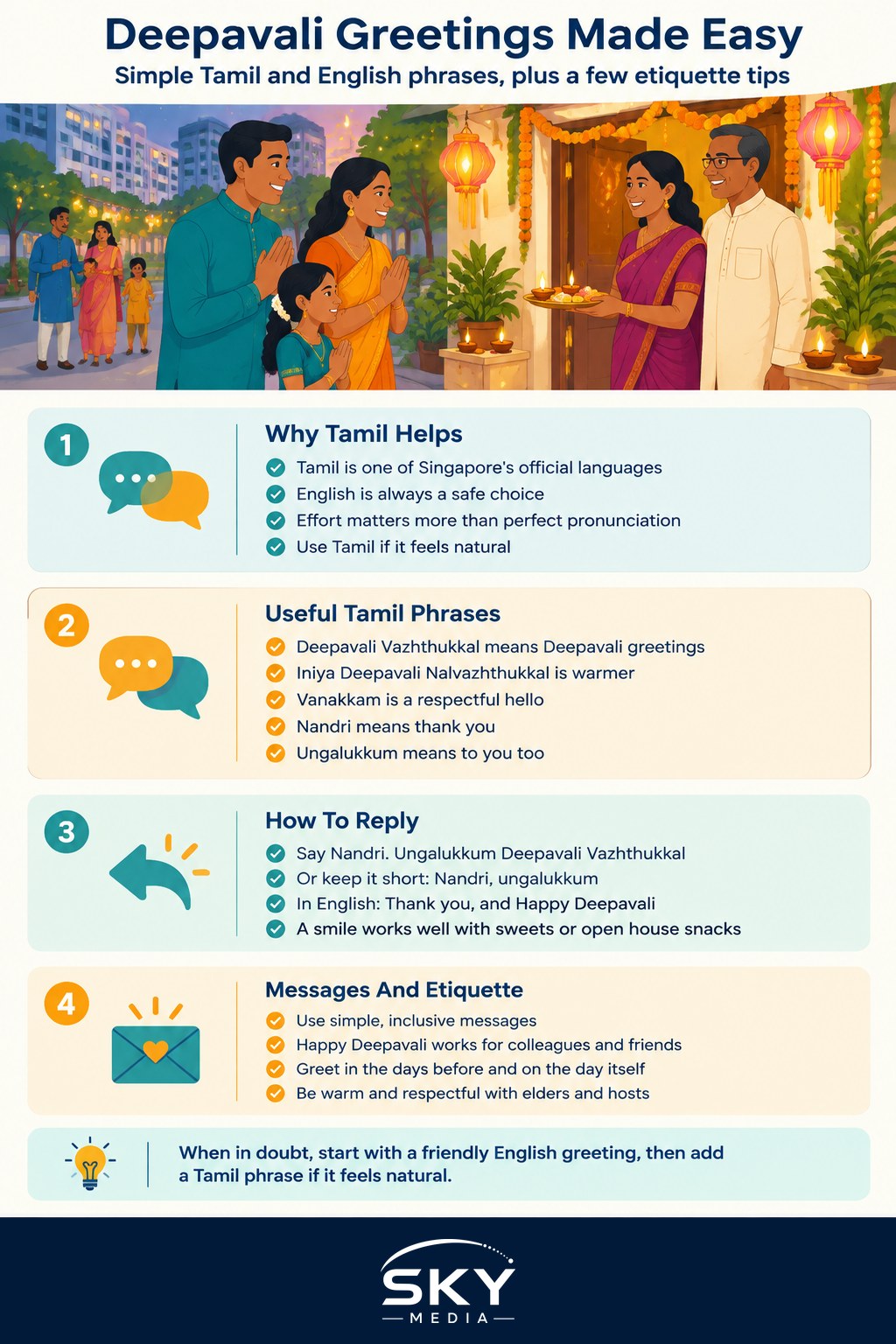
Deepavali, the Festival of Lights, is celebrated by many Hindus in Singapore, and also by some Sikhs and Jains in their own traditions. Tamil is one of Singapore’s four official languages and the mother tongue of a large part of the Indian community here, so you will hear Tamil greetings often in the weeks around the festival, especially in Little India.
That said, not every Indian Singaporean speaks Tamil. Families with roots in North India may say “Diwali” rather than Deepavali and greet in Hindi, Punjabi or other languages. English is always a safe and friendly choice. If you are unsure, start in English and add a Tamil phrase only if it feels natural. People tend to value the effort more than perfect pronunciation.
For background on the festival itself, see Deepavali in Singapore, explained.
Common Deepavali Greetings in Tamil
Pronunciation guides below are approximate, written for English speakers. Tamil has a sound, written ழ in Tamil script, that has no exact English match. It sits somewhere between “l” and “zh”, made with the tongue curled back. Saying a soft “l” is perfectly acceptable.
| Tamil (script) | Romanised | Approximate pronunciation | Meaning |
|---|---|---|---|
| தீபாவளி வாழ்த்துக்கள் | Deepavali Vazhthukkal | dee-pah-vah-lee vahl-thook-kahl | Deepavali greetings |
| இனிய தீபாவளி நல்வாழ்த்துக்கள் | Iniya Deepavali Nalvazhthukkal | ih-nee-yah dee-pah-vah-lee nahl-vahl-thook-kahl | Warm, good wishes for a happy Deepavali |
| வணக்கம் | Vanakkam | vah-nahk-kahm | Hello, a respectful greeting |
| நன்றி | Nandri | nahn-dree | Thank you |
| உங்களுக்கும் | Ungalukkum | oong-gah-look-koom | To you too |
A few notes on using them:
- “Deepavali Vazhthukkal” is the simplest and most widely used. If you learn only one phrase, learn this.
- “Iniya Deepavali Nalvazhthukkal” is a little more formal and warm, good for cards, messages to elders or a written note.
- “Vanakkam” is often said with palms pressed together. It works as an opener before your Deepavali wish.
- “Nandri” is useful when you are offered sweets or welcomed into a home.
Spellings in English letters vary. You may see “vazhthukal”, “valthukkal” or “vaazhthukkal”. They all mean the same thing.
How to Reply When Someone Greets You
If a colleague or neighbour says “Happy Deepavali” or “Deepavali Vazhthukkal” to you, even if you do not celebrate, a warm reply is easy:
- In Tamil: “Nandri. Ungalukkum Deepavali Vazhthukkal.” (Thank you, and Deepavali greetings to you too.)
- Shorter: “Nandri, ungalukkum.” (Thank you, to you too.)
- In English: “Thank you, and Happy Deepavali to you and your family.”
If you are a guest at an open house and someone offers you murukku or other festive snacks, “Nandri” with a smile is perfect.
English Deepavali Messages for Different People
Many people send messages by WhatsApp, email or card. Here are ready-to-use lines you can adapt.
For colleagues and clients
- “Wishing you and your family a happy and bright Deepavali.”
- “Happy Deepavali. May the Festival of Lights bring you joy, good health and success.”
- “Warm Deepavali wishes to you and your loved ones. Enjoy the celebrations.”
For a team or office group chat
- “Happy Deepavali to everyone celebrating. Enjoy the long weekend with your families.”
- “Deepavali Vazhthukkal to all our colleagues celebrating. Wishing you a joyful festival.”
For neighbours
- “Happy Deepavali from all of us next door. Thank you for being such lovely neighbours.”
- “Wishing your family a bright and happy Deepavali. Enjoy the festivities.”
For close friends
- “Deepavali Vazhthukkal. Save some murukku for me.”
- “Happy Deepavali. May your home be full of light, laughter and good food.”
For elders
- “Iniya Deepavali Nalvazhthukkal. Wishing you good health and happiness this Deepavali.”
Keep business messages simple and inclusive. Avoid assuming specific religious practices; “Festival of Lights”, “joy” and “family” are safe themes that fit most households.
Greeting Etiquette Worth Knowing
A few simple habits help your greeting feel respectful:
- Timing. Greetings are common in the days before Deepavali and on the day itself. A message on the morning of Deepavali is a nice touch.
- Do not assume. Not every Indian colleague celebrates Deepavali. Some are Muslim, Christian or of other faiths. A general “Happy Deepavali to everyone celebrating” in a group avoids awkwardness.
- Visiting homes. If you are invited to an open house, a greeting at the door plus “Nandri” when leaving is ideal. Many hosts appreciate guests removing shoes at the door, but follow your host’s lead.
- Gifts and cards. A short card with a Tamil greeting and an English message is a thoughtful pairing. For more on what to bring, see our guide to Deepavali gift etiquette.
- Mind your tone. Light humour about food is usually fine among friends, but keep messages to colleagues and elders warm and simple.
Tips for Getting the Pronunciation Right
- Break it into syllables. “Vazh-thuk-kal” is easier than trying the whole word at once.
- Stress is gentle. Tamil words tend to have even stress, so do not punch any one syllable hard.
- Double consonants are held slightly longer. The “kk” in “Vanakkam” and “Vazhthukkal” has a tiny pause.
- Ask a friend. Most Tamil speakers are happy to help you practise and enjoy hearing someone try.
If you want to go further than festival phrases, our guide to basic Tamil phrases for Singapore covers everyday expressions, and the Tamil community and heritage gives useful context on the language and culture.
Other Languages You May Hear
In multilingual Singapore, Deepavali greetings come in many forms:
- Malay: “Selamat Hari Deepavali”, often heard in announcements and from Malay-speaking friends.
- Hindi: “Shubh Deepavali” or “Happy Diwali”, used by many North Indian families.
- Mandarin: Chinese-speaking friends may say “屠妖节快乐” (tú yāo jié kuài lè), using the common Chinese name for Deepavali in Singapore.
- English: “Happy Deepavali” is understood by everyone and always appropriate.
Whatever language you use, a sincere greeting is what matters most. A simple “Deepavali Vazhthukkal” with a smile can brighten someone’s day.
Explore more: Deepavali in Singapore, explained · Basic Tamil phrases for Singapore · Deepavali gift etiquette · The Tamil community and heritage
Frequently Asked Questions
Is it rude for a non-Indian to greet someone in Tamil? Not at all. Most people are pleased by the effort, even when pronunciation is imperfect. A short phrase such as the simple festival greeting, said warmly, is enough. If you are unsure of the person’s language, begin in English and add the Tamil phrase only if it feels natural.
When is Deepavali and is it a public holiday in Singapore? Deepavali is a gazetted public holiday in Singapore, but its date moves each year because it follows the Hindu lunar calendar. Check the official list of public holidays on the Ministry of Manpower website for the current year before planning leave or sending greetings.
How should I greet someone whose family is in mourning? Keep it brief, gentle and sincere. Some families who have lost a loved one recently may choose not to celebrate, so a quiet message of care is safer than a cheerful festive blast. If you are unsure, ask a mutual friend or simply wish them well and good health.
What should I wear to a Deepavali open house? Neat, modest and slightly festive clothing is a good choice, and bright colours are common at celebrations. Many guests wear traditional Indian outfits if they have them, but smart casual is perfectly fine. Check with the host if you are unsure about dress, and follow their lead on shoes at the door.
Further reading: Hindu Deities Explained: Lakshmi, Ganesha and Rama at Deepavali