
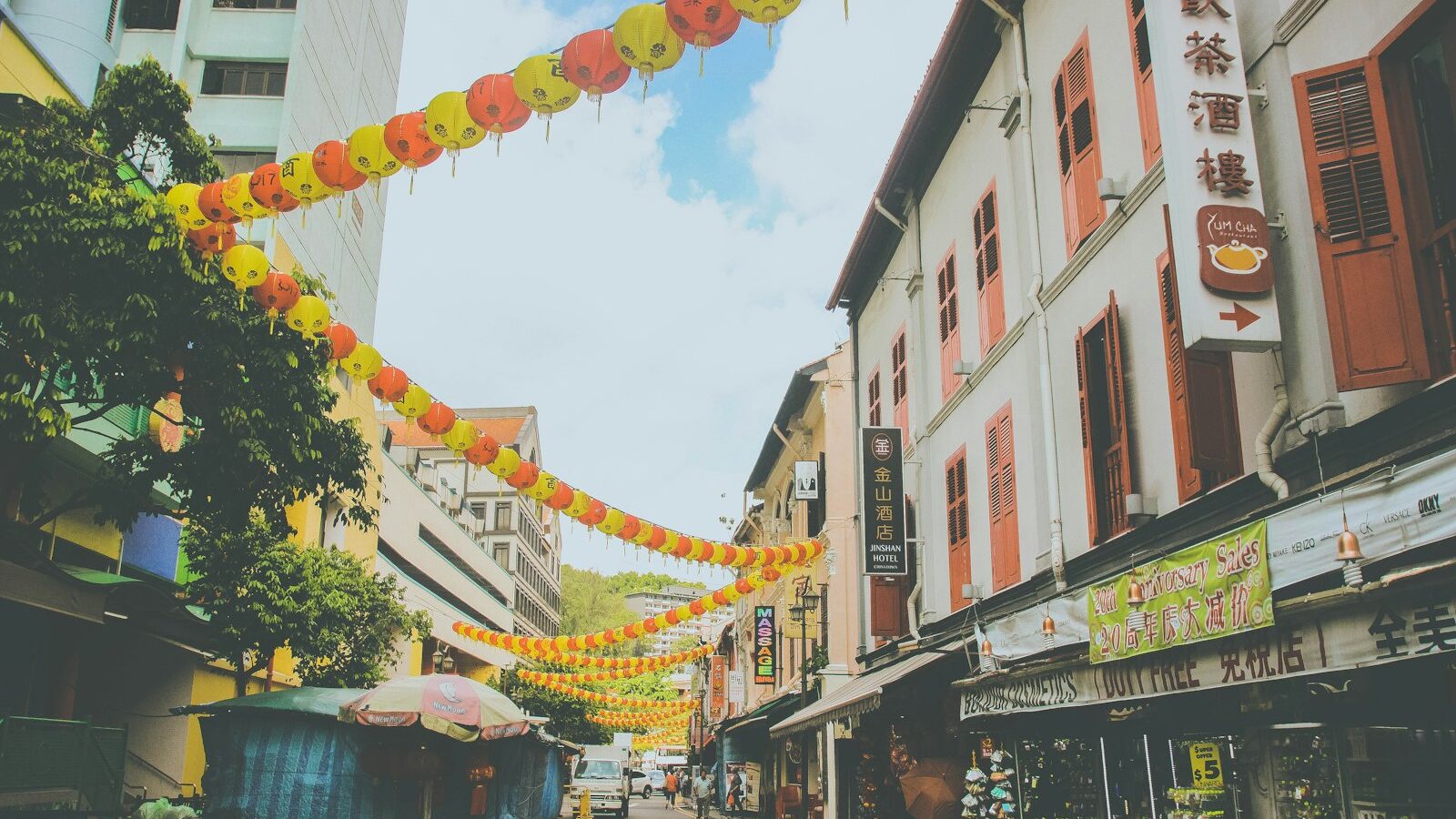
If you grew up celebrating Zhong Qiu in China, your first Mid-Autumn Festival in Singapore will feel familiar and slightly different at the same time. The moon is the same, mooncakes are everywhere and families still try to gather. But the rhythm of the day, the people celebrating and even the name of the festival can surprise you. This guide compares Mid-Autumn in Singapore vs China so you know what to expect and can enjoy the season like a local.
Customs differ between regions of China and between families in Singapore, so treat these as general patterns rather than fixed rules.
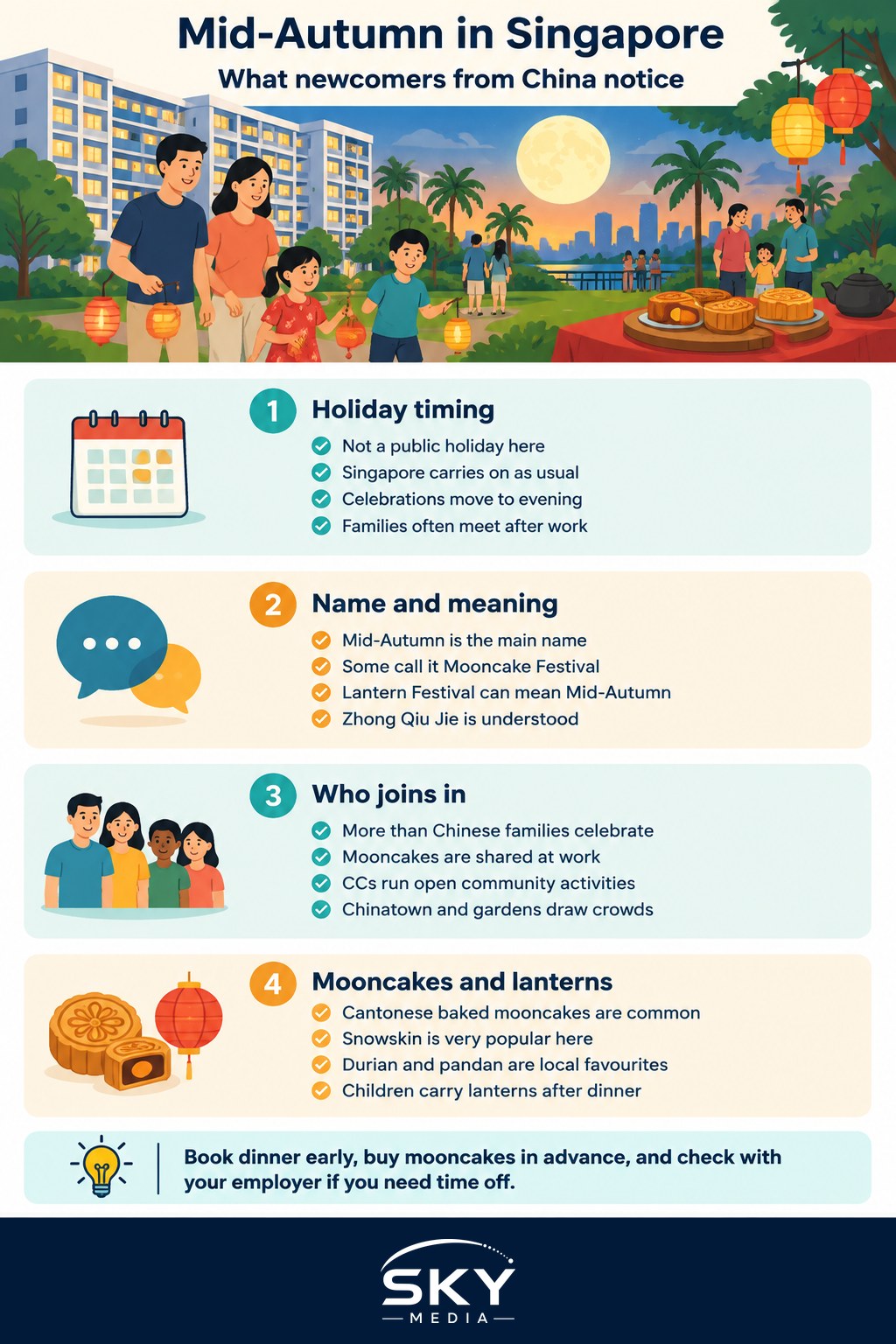
No Public Holiday, So the Celebration Moves to the Evening
The biggest difference newcomers notice is that Mid-Autumn is not a public holiday in Singapore. In mainland China it is a statutory holiday, and in some years it sits next to the National Day “Golden Week”, which creates a long break and heavy travel as people return to their hometowns.
In Singapore, offices, schools and shops run as usual on the day. That changes how people celebrate:
- Family dinners happen after work, or on the nearest weekend.
- Many families do not travel at all, because relatives often live within a short MRT or car ride.
- Lantern walks and moon-watching happen in the evening, when it is cooler.
- Some people simply buy mooncakes for parents in the weeks before and keep the day itself low-key.
Singapore’s public holidays are set by the Ministry of Manpower (MOM) and cover festivals from several communities, such as Chinese New Year, Hari Raya Puasa, Deepavali, Vesak Day and Christmas. If you are planning leave around the festival, check the current list on the MOM website and agree time off with your employer early.
The Name Can Confuse You
In China, “Lantern Festival” (Yuanxiao Jie) means the 15th day of the first lunar month, at the end of Chinese New Year. In Singapore, many people casually call Mid-Autumn the “Lantern Festival” or the “Mooncake Festival”, because lanterns are so central to how children celebrate here. Some Singaporeans also use the dialect or English names rather than Zhong Qiu.
So if a colleague invites you to a “lantern festival” event in September, they mean Mid-Autumn. In Mandarin, “Zhong Qiu Jie” is understood by everyone.
A Multiracial Festival, Not Only a Chinese One
Singapore is a multiracial society, and Mid-Autumn has become something many people join, not only Chinese families. You will notice:
- Malay, Indian and Eurasian colleagues happily sharing mooncakes in the office pantry.
- Halal-certified mooncakes sold widely, so Muslim friends can enjoy them too.
- Community centres (CCs), run under the People’s Association, organising lantern walks and children’s activities open to all residents.
- Large public light-ups, especially in Chinatown and at major gardens, attracting tourists and families of all backgrounds.
For a newcomer from China, this is a nice way to meet neighbours. Joining a CC lantern walk or a void deck gathering is easy, and nobody expects you to know the “right” way to do things. Our guide to the Mid-Autumn Festival in Singapore lists the kinds of events that usually run each year.
Mooncakes: Familiar Shapes, Different Favourites
You will find Cantonese-style baked mooncakes with lotus paste and salted egg yolk, just like in Guangdong and Hong Kong. But the mix of favourites is different, as the comparison below shows.
| Aspect | Mainland China (general pattern) | Singapore |
|---|---|---|
| Public holiday | Yes, a statutory holiday, sometimes linked to Golden Week | No, a normal working and school day |
| Typical travel | Many people return to their hometown | Little travel; family usually nearby |
| Popular mooncake styles | Strong regional styles, such as Cantonese, Suzhou flaky pastry, Beijing style and Yunnan ham | Cantonese baked, snowskin, Teochew flaky yam, and many modern flavours |
| Signature local flavours | Varies by province | Durian snowskin, pandan, and local-inspired fillings |
| Who celebrates | Mostly Han Chinese families | Chinese families plus friends from many communities |
| Name used | Zhong Qiu Jie | Mid-Autumn, Mooncake Festival or “Lantern Festival” |
A few details worth knowing:
- Snowskin is a big deal. Chilled snowskin mooncakes, often in bright colours, are very popular here, and durian snowskin is a Singapore favourite.
- Teochew mooncakes have a flaky, layered pastry and are often filled with yam (taro) paste. Look for them in heritage bakeries.
- Hotel mooncakes are a major gifting tradition. Hotels and big brands release new flavours each year, and boxes are given to clients and family.
- Less savoury variety. You may find fewer meat-filled styles such as the Suzhou fresh-meat mooncake or Yunnan ham mooncake. Some speciality shops stock them, but they are not as common as in China.
If you miss a particular regional style from home, ask at heritage bakeries or Chinese provision shops, or try making a small batch yourself with family.
Lanterns, Children and the Neighbourhood
In many Chinese cities, lantern displays exist but the night is centred on dinner and watching the moon. In Singapore, lanterns are a big part of the evening, especially for children. Expect to see:
- Kids carrying lanterns around HDB estates, parks and void decks after dinner.
- Battery-powered LED lanterns, which many parents prefer for safety in crowded spaces.
- Traditional paper lanterns with candles, still loved by some families, used carefully and away from dry vegetation.
- Schools and preschools holding lantern-making or storytelling sessions in the week of the festival.
If you have children, a home or void deck gathering is a lovely way to start. Our guide to hosting a Mid-Autumn lantern party covers the basics.
Practical Tips for Your First Mid-Autumn Here
- Book dinner early. If you want a restaurant meal on the night, popular Chinese restaurants fill up quickly, as do weekends near the festival.
- Buy mooncakes in advance. Prices often drop after the festival, but popular flavours sell out before it.
- Use the festival socially. Bringing a box of mooncakes to your new office team or neighbours is a friendly, low-pressure gesture.
- Video call home. With no holiday here, many China newcomers call family in the evening to watch the moon “together”. Singapore and China share the same time zone, which makes this easy.
- Respect public spaces. Clean up after lantern gatherings, follow any rules on candles or open flames in parks and estates, and keep noise reasonable late at night.
- Expect the weather. Evenings can be humid, and a passing shower may hide the moon. Bring water and a small umbrella.
Making the Festival Your Own
Many newcomers say their first Mid-Autumn in Singapore feels a little quieter because there is no long holiday and family may be far away. Others find it refreshing: shorter, more relaxed and shared with people from many backgrounds. Building your own traditions, such as a small dinner with friends, a walk to watch the moon rise or a lantern evening with your children, helps Singapore start to feel like home.
For more help adjusting to daily life, see our guide to settling in Singapore for newcomers from China.
Further reading: Halloween in Singapore Explained for Newcomers · Mid-Autumn Greetings in Chinese: Wishes for Cards and Messages