

Spotting a monitor lizard in Singapore for the first time can be startling. One moment you are walking along a park connector, and the next a reptile the length of a small child is crossing the path in front of you. For newcomers, it can feel like something out of a nature documentary.
The good news is that these animals are a normal part of Singapore’s urban wildlife. They live alongside canals, reservoirs, mangroves and parks, and most encounters end with the lizard simply walking away. This guide explains whether monitor lizards are dangerous, how to behave around them, and when to call for help.
If you are dealing with the small house geckos that chirp on your walls, that is a different situation entirely; see our guide on how to deal with lizards at home. For other encounters, see dealing with monkeys, otters and urban wildlife.
Which Monitor Lizards Live in Singapore
Two species are the ones most people see:
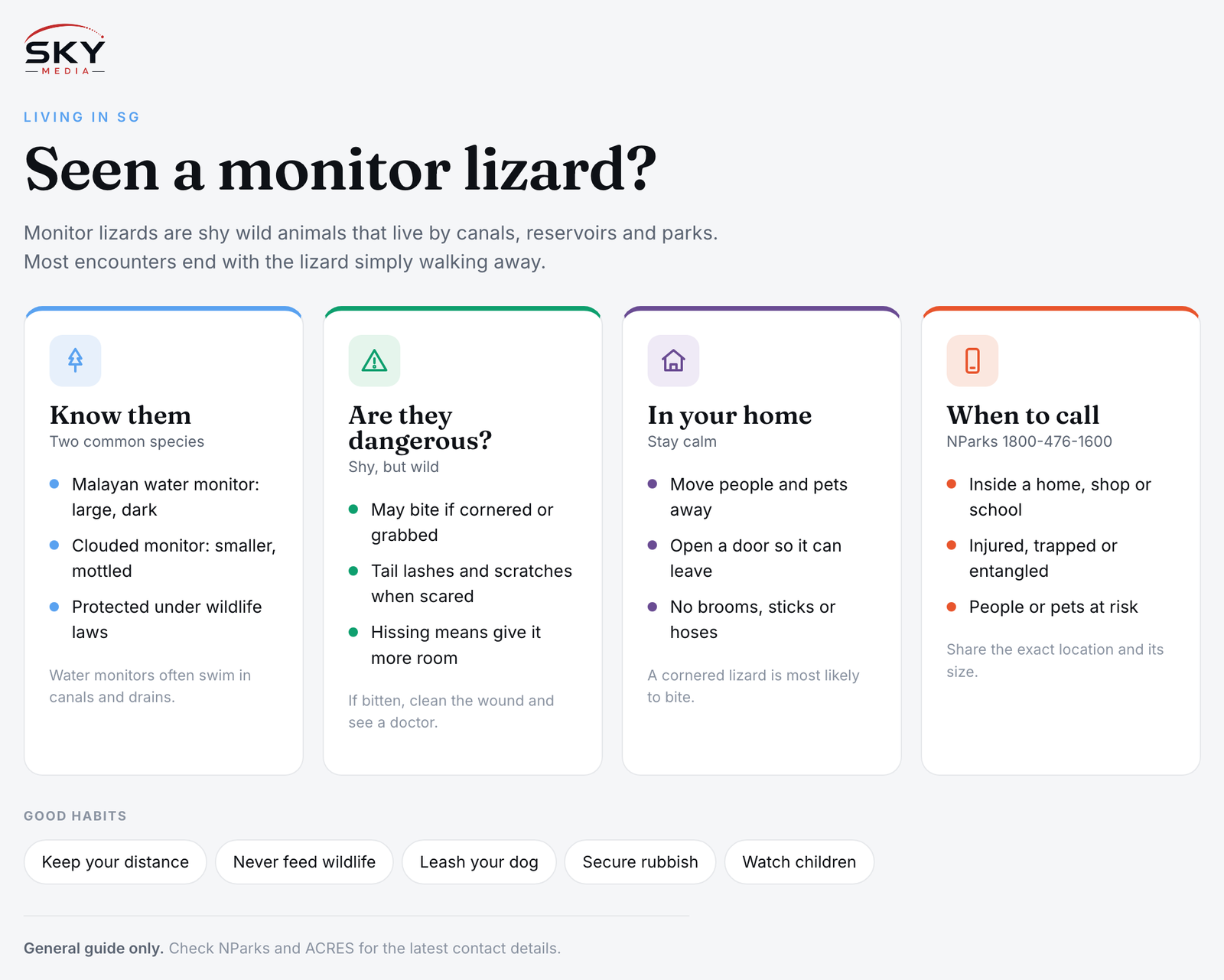
- Malayan water monitor: The larger and more common one. Usually dark grey to black, sometimes with faint yellowish bands. Adults can grow well over a metre including the tail. They are strong swimmers and are often seen in canals, drains, ponds and reservoirs, or basking on banks.
- Clouded monitor: Smaller and slimmer, with a lighter, mottled brown or grey pattern. It prefers wooded areas and is often seen climbing trees in parks and nature reserves.
Both have long forked tongues that flick in and out as they “smell” the air, long tails, and sharp claws. Both are wild animals protected under Singapore’s wildlife laws, which are administered by the National Parks Board (NParks).
Are Monitor Lizards Dangerous?
In everyday terms, monitor lizards are shy animals that would much rather avoid people. They are not interested in attacking humans, and they do not treat people as prey. Most of the time, a monitor lizard that sees you will freeze, then retreat to water or vegetation.
That said, they are large wild animals and deserve respect:
- Bites: A monitor lizard can bite if it is cornered, grabbed or harassed. Its bite can cause a deep wound, and any animal bite carries a risk of infection.
- Tail and claws: A frightened lizard may lash its tail or scratch while trying to escape.
- Hissing and puffing up: These are warning signs that the animal feels threatened. Give it more room.
If you are bitten or scratched, clean the wound and see a doctor or go to a clinic promptly. Seek emergency care for a serious wound. This is general information, not medical advice.
Pets are a more realistic concern. A curious dog that chases a monitor lizard may get bitten, and small pets left outdoors near waterways may be at risk. Keep dogs on a leash in parks and along canals.
What to Do When You See One
Use this simple rule: observe from a distance, give it space, and let it leave.
| Situation | What to do | What not to do |
|---|---|---|
| Lizard on a path or park connector | Stop, stay a few metres back, wait for it to move on, or walk around it widely | Do not step over it, poke it or block its route to water |
| Lizard basking near a canal or pond | Enjoy it from where you are; take photos without flash | Do not throw objects or try to chase it into the water |
| Lizard near children or pets | Calmly call children back and leash your dog | Do not let children approach, touch or feed it |
| Lizard inside a home, carpark or void deck | Keep people and pets away, leave an exit open, call for help | Do not try to catch, corner or trap it yourself |
A few more good habits:
- Never feed monitor lizards or other wildlife. Feeding changes their behaviour, draws them closer to people and is an offence under Singapore’s wildlife rules.
- Secure your rubbish. Bin chutes, food waste and pet food left out can attract wildlife into residential areas.
- Supervise young children near drains, canals and reservoir edges, which is wise for water safety anyway.
If a Monitor Lizard Gets Into Your Home or Block
Occasionally a monitor lizard wanders into a ground-floor unit, a landed house garden, a carpark or an HDB bin centre, usually searching for food or shelter. If that happens:
- Stay calm and keep your distance. Move people and pets into another room and close the door if you can do so safely.
- Give it a way out. Open a door or gate that leads outside, then step back. Many lizards will leave on their own once things are quiet.
- Do not use brooms, sticks or water hoses to force it out. A cornered lizard is the most likely to bite.
- Watch from a safe spot so you can tell responders where it went.
- Call for help if it does not leave, is in a high-traffic area, or seems stuck or injured.
If you live in an HDB block or condo, you may also inform your Town Council or management office, especially if the lizard is in a common area such as a void deck, bin centre or lift lobby.
When and How to Report a Monitor Lizard
You do not need to report every monitor lizard you see. Seeing one basking by a canal or crossing a park path is normal. Call for help when:
- The lizard is inside a home, shop, school or other building.
- It is in a crowded spot and people or pets are at risk.
- It appears injured, trapped, entangled in netting or fishing line, or unwell.
- Someone is harassing, harming or trying to catch it.
The main contact is the NParks Animal Response Centre at 1800-476-1600. You can also give feedback through NParks’ online channels. Animal welfare groups such as ACRES (Animal Concerns Research and Education Society) also respond to wildlife rescue cases. Check the NParks and ACRES websites for the latest contact details and hours, as these can change.
When you call, be ready to share:
- The exact location, including block number, landmark or park name.
- The approximate size of the lizard and what it is doing.
- Whether it looks injured or trapped.
- Whether people or pets are nearby.
Living Alongside Singapore’s Urban Wildlife
Monitor lizards are part of what makes Singapore’s green spaces feel alive. They help keep ecosystems in balance by eating fish, crabs, insects, small animals and carrion. Seeing one in a reservoir park or mangrove is a sign that the habitat is healthy enough to support larger animals.
For newcomers, the adjustment is mostly about expectations. Treat a monitor lizard the way you would treat any wild animal in a park: admire it, keep your distance, never feed it, and call NParks if one ends up somewhere it should not be. With those habits, encounters stay safe for you and for the lizard.
Frequently Asked Questions
Can a monitor lizard kill a small dog or cat? A monitor lizard is unlikely to hunt pets, but a bite from a cornered one can seriously hurt a small animal. Keep dogs leashed near canals and bring cats indoors at night. If your pet is bitten, take it to a vet promptly.
Is it legal to catch or keep a monitor lizard in Singapore? No. Monitor lizards are wild animals protected under Singapore’s wildlife laws, which NParks administers. Catching, harming or keeping one without permission can lead to enforcement action. If one is in a place it should not be, call NParks instead of dealing with it yourself.
Do monitor lizards climb into bins or hunt for food in estates? They can be drawn to food waste and open rubbish, especially near canals and ground-floor areas. Keep bin lids shut and do not leave pet food outside. Securing your rubbish is the simplest way to make your block less attractive to wildlife.
What is the difference between a monitor lizard and a crocodile at a canal? A monitor lizard has a slim body, a long forked tongue and a tail that is not heavily armoured, while a crocodile has a broad snout and bony ridges. If you cannot tell, keep well away and report it to NParks.
Should I take my kids to see monitor lizards in parks? Seeing them from a distance can be a good nature lesson. Keep children a few metres back, hold their hands near drains and water edges, and teach them not to touch or feed the animals. Leave if a lizard hisses or puffs up.
Official sources: National Parks Board (NParks)