

Turn on the tap and see yellow or brown water, or notice a strange smell, and it is natural to worry. Discoloured tap water in Singapore is usually a short-lived problem with a simple cause, such as recent maintenance on the water tank or pipes, or old plumbing inside the home. Still, it is worth knowing how to work out where the problem sits, what you can safely do yourself, and who is responsible for fixing it.
Singapore’s public water supply from PUB, the national water agency, is treated and monitored to drinking standards. When something looks or smells wrong at your tap, the cause is more often somewhere between the water main and your sink. This guide focuses on troubleshooting that problem. For general questions about drinking tap water and home water basics, see Tap Water Singapore: The Home Essentials Every Newcomer Asks About.
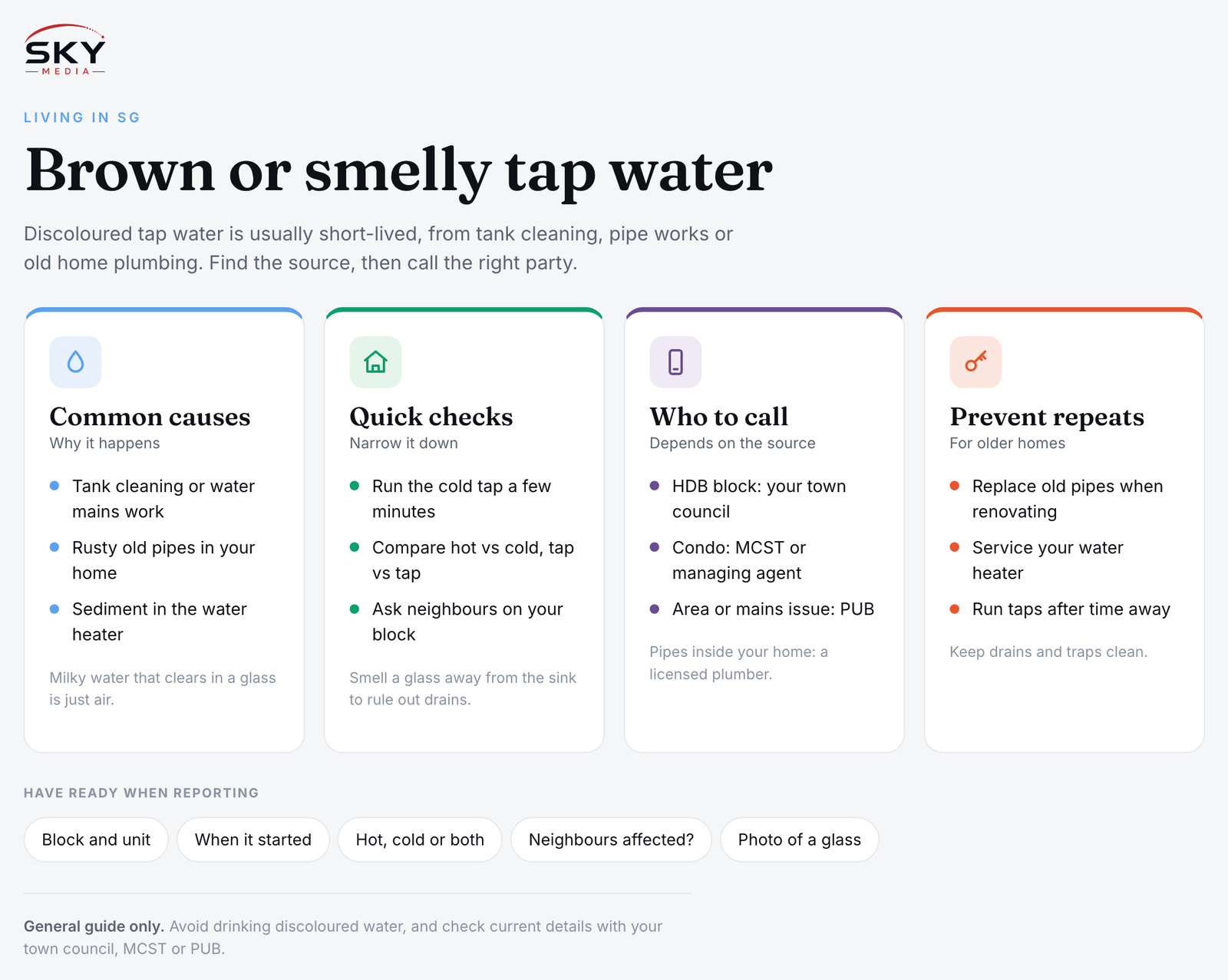
Common Causes of Brown, Cloudy or Smelly Water
Most cases fall into a handful of causes.
- Water tank cleaning or maintenance. HDB blocks and many condos store water in rooftop tanks, which are cleaned periodically. After cleaning or repair, sediment can be stirred up and water may run yellow or brown for a while. Notices are usually put up in lift lobbies beforehand.
- Work on water mains or a supply disruption. When pipes are repaired or the supply is restored after a shutdown, the sudden change in flow can dislodge deposits, giving brownish water for a short period.
- Old or corroded pipes in your home. Older flats and houses may still have galvanised iron pipes, which rust inside over time. Rusty water that appears mainly first thing in the morning or after a holiday often points to this.
- Your water heater. If only the hot water is discoloured or smells, sediment or corrosion in a storage heater is a likely culprit.
- Air in the pipes. Milky or cloudy water that clears from the bottom of a glass upwards is usually tiny air bubbles, often after maintenance. It is harmless.
- The smell is not from the water at all. A musty or sewage-like smell at the sink can come from the drain or a dry trap rather than the water itself.
Quick Checks You Can Do at Home
Before calling anyone, a few simple checks help you narrow down the source.
- Check for notices. Look in your lift lobby, block notice board or condo app for recent tank cleaning or water works.
- Run the cold tap. Let the cold kitchen tap run for a few minutes. If the water clears, the cause was probably temporary sediment.
- Compare hot and cold. If cold water is clear but hot water is brown or smelly, focus on the water heater.
- Compare taps. Is it every tap, or just one? A single tap suggests a local pipe, fitting or aerator issue.
- Ask a neighbour. If neighbours on the same block have the same problem, it is likely to be the building supply rather than your home.
- Do the glass test for smells. Fill a glass, walk away from the sink and smell it there. If the glass smells fine, the odour is coming from the drain.
- Check the aerator. Sediment can clog the mesh at the tap outlet. Our guide on how to clean a clogged tap aerator shows how.
While you troubleshoot, avoid drinking or cooking with water that is visibly discoloured, and hold off on laundry, especially whites, as rusty water can stain fabric.
What Different Colours and Smells Usually Mean
Use this as a rough starting point, not a diagnosis. If you are unsure, report it.
| What you notice | Likely cause | What to do |
|---|---|---|
| Yellow or brown water from all taps | Tank cleaning, mains work or supply disruption | Run cold tap; if it persists, contact your town council, MCST or PUB |
| Brown water mainly in the morning or after a trip | Rusty internal pipes in your home | Run tap until clear; consider a plumber to inspect old pipes |
| Only hot water is brown or smelly | Sediment or corrosion in the water heater | Get the heater serviced or checked by a qualified technician |
| Cloudy or milky water that clears in a glass | Air bubbles in the pipes | Harmless; let it settle |
| Mild chlorine-like smell | Disinfectant used in water treatment | Normal; chilling water or leaving it in a jug can reduce the smell |
| Musty or rotten smell only near the sink | Drain or sink trap | Clean the drain and trap; water itself is usually fine |
Who to Call: Town Council, MCST, PUB or a Plumber
Responsibility depends on where the problem is, which is why the checks above matter.
Town council (HDB flats). Town councils manage common property in HDB estates, including the water tanks and the pipes up to your unit. If your whole block or several neighbours have discoloured water, or the problem follows tank cleaning, contact your town council through its hotline or website. Many town councils run an essential maintenance service that can respond after office hours.
MCST or managing agent (condos). In private condos, the Management Corporation Strata Title (MCST), usually through its managing agent, looks after shared tanks and common pipes. Report the issue to the management office.
PUB. PUB is responsible for the public water supply and mains. Contact PUB if you suspect a problem with the public supply, such as discoloured water across an area, a burst main nearby, or water quality concerns that your town council or MCST cannot explain. PUB’s 24-hour contact details are on its official website. You can also use the OneService app to report municipal issues, which routes your case to the right agency.
A licensed plumber (your own pipes). Pipes and fittings inside your home, and your water heater, are generally the owner’s responsibility. If the problem is limited to your unit, a plumber can inspect old pipes or heaters. PUB maintains a list of licensed plumbers on its website, and using a licensed plumber is required for certain types of water service work. For more on home plumbing, see Water Heaters and Plumbing in Singapore Homes.
Exact responsibilities, contact numbers and procedures can change, so check the current details with your town council, MCST or PUB.
What to Have Ready When You Report It
A clear report helps whoever responds fix the problem faster. Have these to hand:
- Your address, block and unit number.
- When you first noticed the problem and whether it comes and goes.
- Whether it affects hot water, cold water or both, and which taps.
- Whether neighbours are affected.
- A photo of a glass of the water, ideally against a white background.
- Any recent notices about tank cleaning or water works.
Do not attempt to open or access rooftop water tanks or shared pipes yourself. These are managed by the town council or MCST for safety and hygiene reasons.
Preventing Repeat Problems in Older Homes
If discoloured water keeps coming back and the cause is inside your home, it may be time to look at your plumbing.
- Consider replacing old pipes during renovation. Many owners switch from old galvanised iron to modern materials when renovating kitchens or bathrooms. A contractor or plumber can advise on what is suitable for your home and on any approvals needed.
- Service your water heater. Storage heaters benefit from periodic checks to deal with sediment and corrosion. Follow the manufacturer’s guidance.
- Run taps after time away. After a holiday, let the cold taps run briefly before using the water.
- Keep drains and traps clean. This avoids smells being mistaken for a water quality problem.
If you ever feel unwell after drinking water that looked or smelled odd, see a doctor and report the water issue to PUB or your town council. In most homes, though, brown or smelly water is a temporary nuisance with a clear fix once you know who to call.
Official sources: PUB
Further reading: How to Handle a Water Shutoff in Your Building · Choosing and Installing a Home Water Filter