

Moving to Singapore from Bangladesh is a shorter journey than many relocations, with direct flights from Dhaka and a familiar tropical climate waiting at the other end. Still, the move changes a lot: how you get permission to work, how you rent a home, how your children go to school and how you send money back to family. This guide is written for Bangladeshi professionals and their families planning a long-term move, and it focuses on the practical steps that matter in the first few months.
Rules on passes and schools can change, so treat this as general information and always confirm the current details with the official Singapore agencies named below.
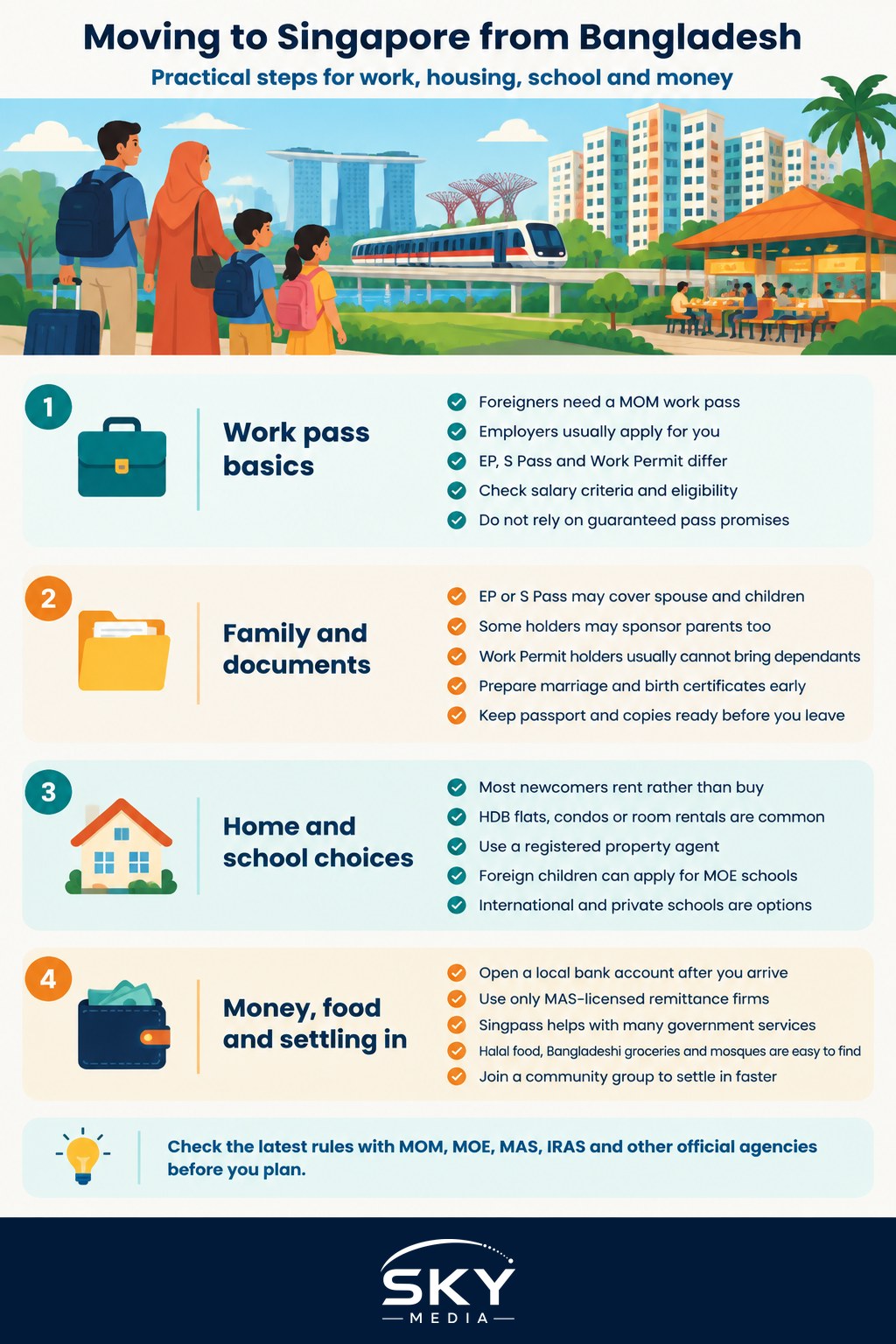
Work Passes: Getting the Right Permission to Work
In Singapore, foreigners need a work pass issued by the Ministry of Manpower (MOM) to work. Your employer usually applies on your behalf. The main categories are:
- Employment Pass (EP) for professionals, managers and executives. Applications are assessed against a qualifying salary and a points-based framework called COMPASS, which looks at factors such as salary, qualifications and the employer’s workforce profile.
- S Pass for mid-skilled staff, with its own salary criteria and quota limits for employers.
- Work Permit for workers in specific sectors such as construction, manufacturing, marine shipyard and process industries. Bangladesh is among the approved source countries for some of these sectors.
Each pass has its own rules about changing jobs, bringing family and what work you may do. MOM publishes current salary criteria and eligibility on its website and offers a self-assessment tool for EP and S Pass. Never pay an agent who promises a guaranteed pass; only MOM decides, and licensed employment agencies are listed on MOM’s site.
Before you leave Bangladesh, make sure your passport has plenty of validity, and keep certified copies of degree certificates, marriage certificates and children’s birth certificates. Some may need to be verified, and having them ready saves weeks later.
Bringing Your Family: Passes and Paperwork
If you hold an EP or S Pass and meet the salary criteria, you may be able to sponsor your spouse and children on a Dependant’s Pass, and in some cases parents on a Long-Term Visit Pass. Work Permit holders generally cannot bring dependants. The current thresholds are set by MOM, so check them before making family plans.
Documents that commonly come up include your marriage certificate and children’s birth certificates, sometimes with official English translations if they are in Bengali. Start gathering these early. The Bangladesh High Commission in Singapore can help with passport renewals and consular matters once you have arrived.
Comparing Life in Dhaka and Singapore
Many newcomers find Singapore both familiar and very different. Here is a quick comparison of everyday areas.
| Area | What you may be used to in Bangladesh | What to expect in Singapore |
|---|---|---|
| Housing | Larger family homes or flats, often with extended family | Smaller condos or HDB flats rented by the room or whole unit, at higher rents |
| Getting around | Rickshaws, CNGs, private cars and heavy traffic | Clean, punctual MRT and buses, paid with a card or phone; owning a car is very expensive |
| Food | Home-cooked Bangladeshi meals, local markets | Hawker centres with plenty of halal options, plus Bangladeshi and Indian groceries in certain areas |
| Paperwork | Many in-person visits | Most government services online through Singpass |
| Climate | Hot and humid, monsoon season | Hot and humid all year, with sudden heavy showers |
Finding a Home
Most newcomers rent. Your options are:
- HDB flats, public housing where you can rent a room or a whole flat. Foreigners can rent but generally cannot buy, and there are rules on minimum rental periods and occupancy.
- Condominiums, private apartments with facilities such as pools and gyms, usually at higher rents.
- Room rentals, which are popular when you first arrive alone and want to save money while you learn the city.
Use a registered property agent; you can check their registration on the Council for Estate Agencies (CEA) website. Read the tenancy agreement carefully, especially the diplomatic clause, security deposit and repair terms. If you want to keep costs down, our guide to moving to Singapore on a budget has more ideas.
Many Bangladeshi families like being near the Little India area for groceries and community, but others live all over the island, closer to their workplace or children’s schools. Because the MRT is so efficient, you do not need to live near the community to stay connected.
Schools for Your Children
Foreign children can apply to government (MOE) schools, usually through admission exercises for international students such as the AEIS (Admissions Exercise for International Students), which includes tests in English and Mathematics. Places are limited and fees for foreigners are higher than for citizens. Alternatively, many families choose international schools or private schools, which have their own fees and waiting lists.
English is the main language of instruction in Singapore schools, which many Bangladeshi children from English-medium schools adapt to quickly. Check MOE’s website for current admission timelines and fees, and apply early because popular schools fill up.
Food, Faith and Community
Muslim families will find life practical in Singapore. Halal certification is managed by MUIS (the Islamic Religious Council of Singapore), and halal-certified outlets are easy to find in hawker centres, food courts and malls. There are mosques across the island, and Ramadan and Hari Raya are part of the national calendar.
You will also find shops selling Bangladeshi groceries, fish, spices and sweets, especially in and around Little India. Bengali community groups, cultural associations and religious groups organise events for occasions such as Pohela Boishakh (Bengali New Year) and Eid. Joining one early can help with practical tips and with homesickness.
Hindu, Buddhist and Christian families from Bangladesh will also find places of worship and community in Singapore, which respects religious diversity by law and custom.
Money: Banking and Sending Money Home
Once you have your work pass, you can open a local bank account. Banks will ask for your passport and pass details, and sometimes proof of address. Your salary will be paid into this account.
Sending money to family in Bangladesh is something many newcomers do monthly. Use only remittance companies licensed by the Monetary Authority of Singapore (MAS); you can check the MAS Financial Institutions Directory. Avoid informal channels, which carry legal and fraud risks. Compare exchange rates and fees, which change often.
Tax in Singapore is administered by IRAS. If you are a tax resident, you will file an annual return, often pre-filled for employees. Read IRAS guidance on residency rules in your first year.
Settling In: First Month Checklist
- Collect your work pass card and register your address if required.
- Set up your Singpass account to use government services online.
- Get a local mobile number and an EZ-Link or contactless card for transport.
- Open a bank account and set up a licensed remittance channel.
- Register with a nearby clinic or polyclinic and check your company’s medical benefits.
- Explore your neighbourhood hawker centre and nearest mosque, temple or church.
- Connect with a Bangladeshi community group or colleagues who made the same move.
Families moving from other South and Southeast Asian countries face many of the same steps; you might find extra tips in our guides on moving to Singapore from Malaysia and moving to Singapore from Indonesia.
Moving to Singapore from Bangladesh is a big step, but with the right pass, careful paperwork and a supportive community, most families settle in within a few months. Start with MOM’s website for pass rules, keep your documents organised, and give yourself time to adjust.
Official sources: Ministry of Manpower (MOM) · ICA
Further reading: Moving to Singapore From Cambodia: A Guide for Workers, Students and Families · Filipino Professionals in Singapore: The OEC and Balik-Manggagawa Process