
If you are moving to Singapore as a Muslim family, you will find a well-established community, an official body that oversees Islamic affairs, and halal food in almost every neighbourhood. Muslims are one of Singapore’s main faith communities, and the call to prayer, Friday congregations and Hari Raya celebrations are part of everyday national life. This guide focuses on the practical side of settling in: checking halal status, finding a mosque near your new home, choosing between national schools and madrasahs, and keeping up religious life for your children.
Who Looks After Muslim Affairs in Singapore
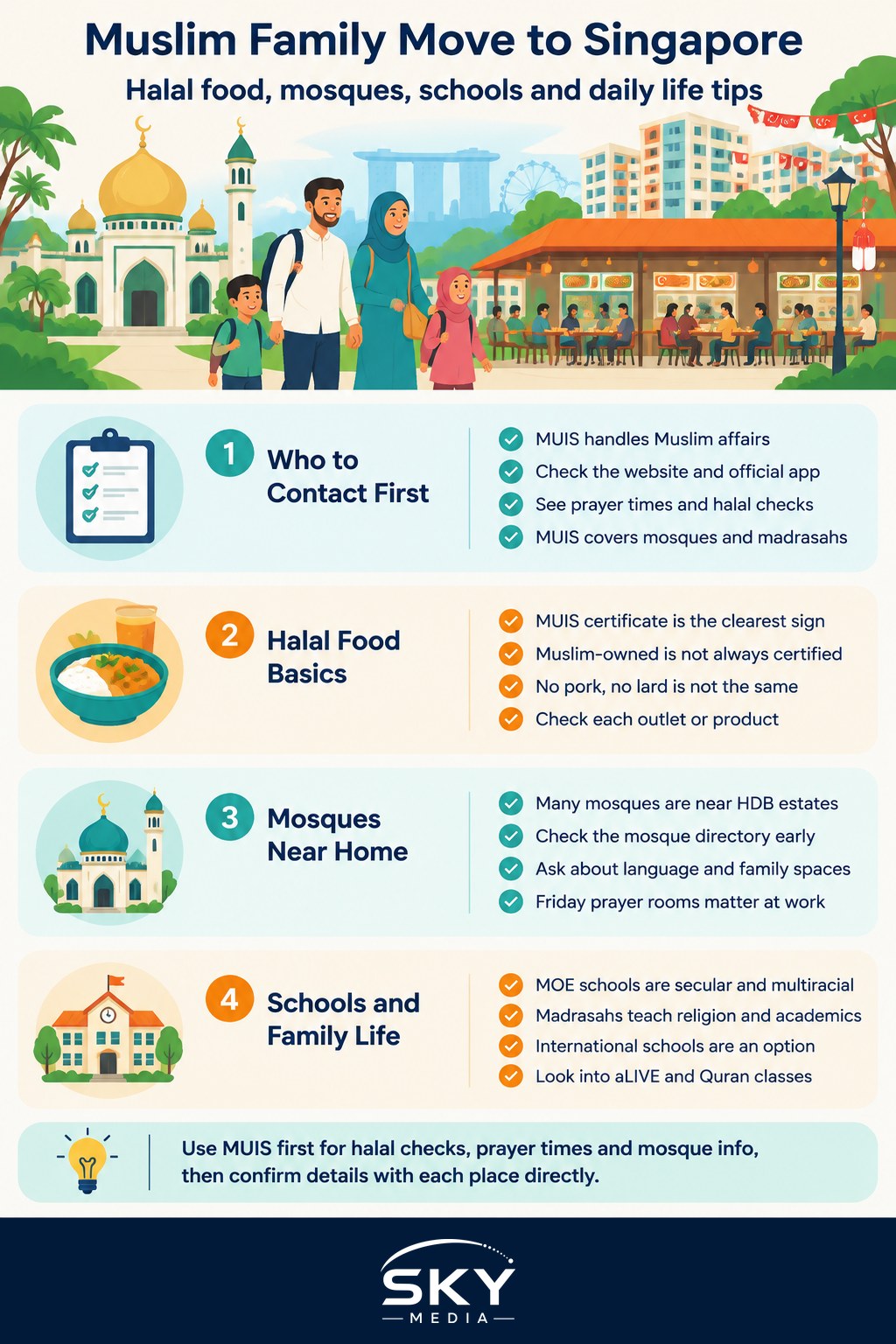
The Islamic Religious Council of Singapore, known by its Malay acronym MUIS (Majlis Ugama Islam Singapura), is the statutory board that advises on Muslim matters. For newcomers, MUIS is the most useful single reference because it:
- Runs the national halal certification system.
- Oversees the mosques and the full-time madrasahs.
- Manages zakat (obligatory charity) collection and Hajj arrangements for Singapore pilgrims.
- Publishes the prayer timetable and announces dates for Ramadan and the Hari Raya festivals.
The MUIS website and its official app are worth bookmarking in your first week. Details such as prayer times, programmes and registration windows are updated there, so check it rather than relying on secondhand advice.
Separately, the Syariah Court and the Registry of Muslim Marriages handle certain family law matters for Muslims under the Administration of Muslim Law Act. You are unlikely to need them on arrival, but it helps to know they exist.
Halal Food: How to Read the Signs
Halal food is easy to find, but the details matter. Our newcomer’s guide to halal food goes deeper; here are the essentials for daily life.
| What you see | What it means | What to do |
|---|---|---|
| MUIS halal certificate displayed | The premises or product is certified under the MUIS system | Generally the most reliable sign; check the certificate is current and matches the outlet’s name |
| “Muslim-owned” sign | The owner is Muslim, but the outlet may not be MUIS-certified | Many families are comfortable with this; decide based on your own practice |
| “No pork, no lard” sign | No pork is served, but other ingredients or alcohol may be used | Not the same as halal; ask or choose certified options |
| Halal logo on packaged goods | The product carries MUIS or a recognised foreign certification | MUIS publishes which overseas certification bodies it recognises |
Practical tips for the first months:
- Hawker centres usually have several Muslim-owned or halal-certified stalls, often grouped together. Look for the certificate on the stall front.
- Supermarkets generally keep pork and non-halal items in separate, labelled sections.
- Fast food and cafe chains vary. Some are certified across all outlets and some are not, so check each outlet.
- School canteens in national schools typically have at least one halal stall, and food rules are well understood by staff.
- Halal Chinese food is a pleasant surprise for many newcomers. See our guide to Xinjiang and halal Chinese food.
MUIS also offers a way to check whether an establishment’s certification is valid. Use it if you are unsure.
Finding a Mosque Near Your New Home
Singapore has mosques across the island, many in or near HDB estates, so most families can walk or take a short bus ride to Friday prayers. When choosing where to live:
- Check the nearest mosques on the MUIS mosque directory before signing a lease. Being close to a mosque makes daily congregational prayers and children’s classes far easier.
- Ask about programmes in your language. Many mosques run talks and classes in Malay and English, and some offer sessions in other languages. Check directly with each mosque.
- Look at women’s facilities and family spaces if these matter to you. Facilities differ between older and newer mosques.
- Visit the heritage areas. Kampong Glam, home to Sultan Mosque, and Geylang Serai are the historical heart of Malay-Muslim life and good places to shop for prayer items, modest wear and festival goods.
Many workplaces in Singapore are used to Muslim staff taking time for Friday prayers. Discuss arrangements with your employer early, and check whether your office building or nearby mall has a prayer room.
Schools: National Schools, Madrasahs and Religious Classes
Choosing a school is often the biggest decision for Muslim families. There are three broad routes.
1. MOE national schools. Most Muslim children in Singapore attend government schools run by the Ministry of Education (MOE). These are secular, multiracial schools. Malay can be taken as the Mother Tongue Language where eligible. Places for foreign students are subject to availability and MOE admission rules, so check the MOE website for the current process. School uniform rules are set by each school under MOE guidelines, so ask the school directly about modest-wear options for sports and daily wear.
2. Full-time madrasahs. Singapore has a small number of full-time madrasahs overseen by MUIS. They combine religious subjects, Arabic and the national academic curriculum. Admission has its own process and timeline, and places are limited, so contact MUIS or the madrasah early if you are interested. Ask about language of instruction, academic results pathways and fees.
3. International schools. Some families choose international schools, especially for shorter postings. Fees are significantly higher. Ask about halal food provision, prayer space and how the school handles Ramadan and Hari Raya.
For children in national or international schools, part-time religious education fills the gap. MUIS runs a weekend Islamic education programme for children and teens called aLIVE at many mosques, and private Quran classes are widely available. Our guide on moving schools mid-year helps if your arrival does not line up with the school calendar.
Ramadan, Hari Raya and Community Life
Ramadan in Singapore has a strong communal feel. Mosques often provide food for breaking the fast, and the Geylang Serai area hosts a well-known bazaar in some years. Working hours generally do not change for fasting staff, though many employers are understanding about schedules.
Two Islamic festivals are public holidays:
- Hari Raya Puasa (Eid al-Fitr), marking the end of Ramadan.
- Hari Raya Haji (Eid al-Adha).
Dates follow the Islamic calendar and are announced each year, so check the official public holiday list from MOM. During Hari Raya Puasa, families visit relatives and friends at open houses. Non-Muslim colleagues often enjoy being invited, which is a good way to build friendships.
A First-Month Checklist for Muslim Families
- Download the MUIS app or bookmark the website for prayer times and halal checks.
- Map the mosques within walking distance of shortlisted homes.
- Locate halal-certified hawker stalls, supermarkets and restaurants near home and work.
- Register children for school, then look into weekend religious classes.
- Ask your employer about Friday prayer arrangements and prayer rooms.
- Find a Muslim butcher or halal meat section for regular groceries.
- Join a mosque’s newcomer or community programme to meet other families.
Banking, insurance and investment products that follow Islamic principles are offered by some providers in Singapore. Compare them as you would any product, read the terms, and seek independent advice if you need it.
Settling In With Confidence
Singapore’s multiracial approach means Muslim families can practise their faith openly while living alongside neighbours of every background. Spend your first weeks learning the halal signs, finding your local mosque and connecting with a community programme, and daily life soon feels familiar.
Explore more: Moving Your Family Over After You Settle.
Further reading: Moving to Singapore With a Child Who Has Special Needs