

Moving to Singapore from Switzerland swaps one small, orderly, high-wage country for another, so many things will feel familiar: clean public transport, punctual services and a strong expectation that rules are followed. The differences that catch Swiss newcomers out are less obvious. Your three-pillar pension does not simply follow you, housing works very differently, and the cost picture shifts in ways a headline comparison will not show. This guide covers the Swiss-specific questions in the right order.
It is general information, not legal, tax or financial advice. Pension and tax outcomes depend on your canton, your pension fund and your personal situation, so confirm the details with the official bodies named below.
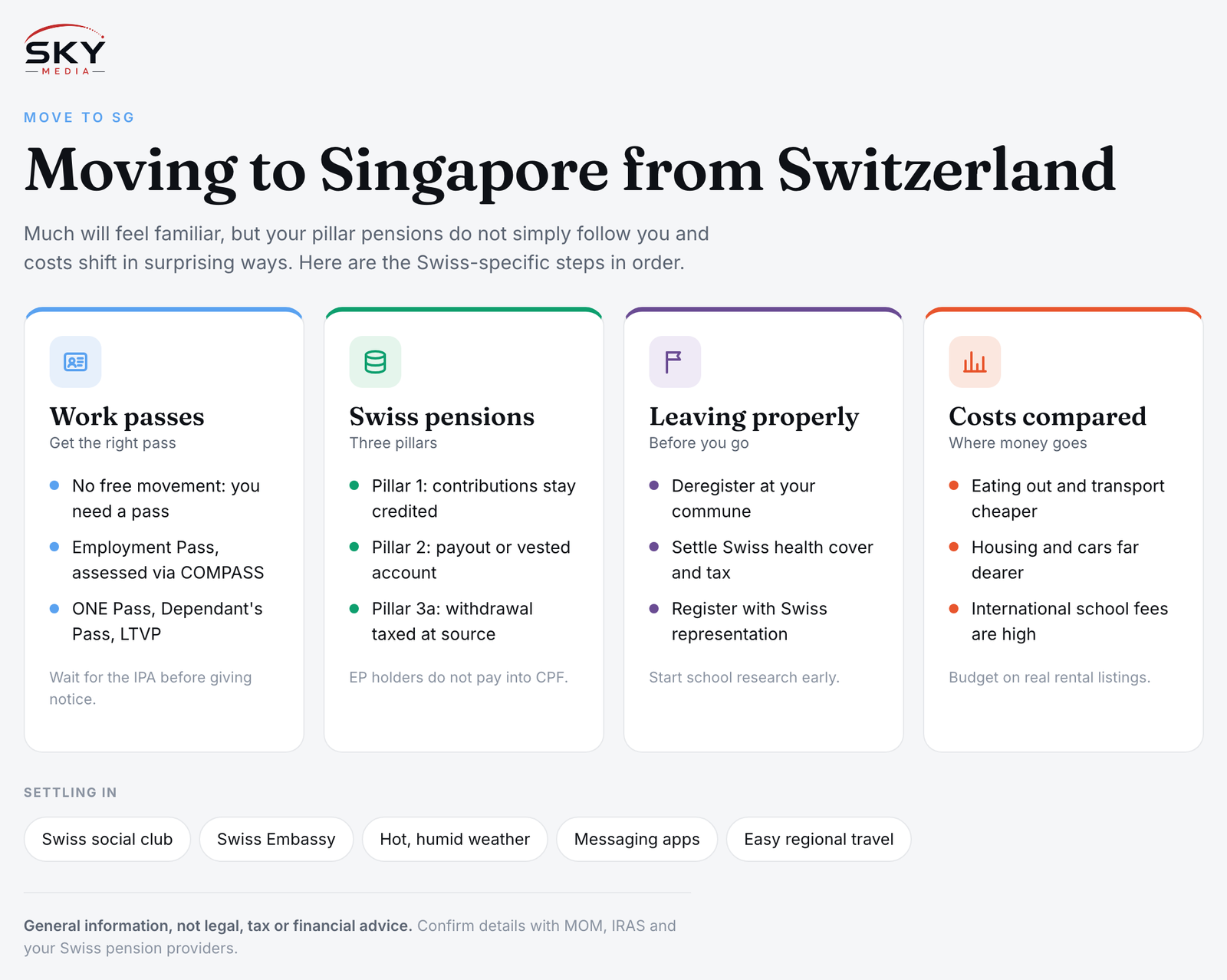
Getting the Right Pass Before You Pack
Switzerland and Singapore have no free-movement arrangement, so Swiss citizens need a pass like any other foreign professional. Work passes are issued by the Ministry of Manpower (MOM), and in almost every case your employer applies on your behalf.
- Employment Pass (EP): the main pass for professionals, managers and executives. Applications are assessed against a salary benchmark and, for most new applications, the COMPASS points framework, which looks at salary, qualifications, the employer’s workforce profile and other factors.
- Overseas Networks and Expertise (ONE) Pass: aimed at top talent in business, arts, sciences, research and sport, with more flexibility to work for several companies.
- Dependant’s Pass (DP) and Long-Term Visit Pass (LTVP): for spouses, children and in some cases parents of eligible pass holders. Whether a DP holder may work, or run a business, depends on MOM’s current rules for that pass, so check before your partner accepts a job or registers a company.
Criteria and salary thresholds are revised from time to time, so use MOM’s online self-assessment tool and ask your employer to confirm timing. Do not give notice on your Swiss flat until the In-Principle Approval (IPA) letter has been issued.
What Happens to Your Swiss Pillar Pensions
This is the part most Swiss movers underestimate. Switzerland’s system rests on three pillars, and each one behaves differently when you leave.
Pillar 1 (AHV/AVS, the state old-age insurance). Contributions you have already paid usually stay credited to your record and count towards a future Swiss state pension. Depending on your nationality and destination, you may be able to continue on a voluntary basis. Ask the Swiss Compensation Office (the central office that handles insured persons living abroad) what options apply to you before you go, because there can be deadlines after departure.
Pillar 2 (BVG/LPP, the occupational pension). When you leave your Swiss employer, your vested benefits must be transferred somewhere. Because Singapore is outside the EU and EFTA, people who leave Switzerland permanently are often able to ask for a cash payout of their pillar 2 assets, but the rules differ for the mandatory and extra-mandatory parts and depend on your situation. If you do not withdraw, the money moves to a vested benefits account or foundation. Ask your pension fund for its written conditions before deciding.
Pillar 3a (tax-advantaged private savings). Withdrawal on permanent departure is generally possible, but timing matters, because lump-sum payouts are taxed at source in Switzerland and the rate depends on the canton where the provider is based. Some people stagger withdrawals across different accounts and years.
Points to raise with a Swiss tax adviser and your pension providers:
- Whether to withdraw, leave the money invested or move it to a vested benefits foundation
- Which canton’s source tax will apply, and whether any of it can be reclaimed under the Switzerland-Singapore double tax agreement
- How a withdrawal interacts with your Singapore tax residency, since Singapore taxes income on a territorial basis with its own rules for foreign-sourced income
Remember that foreigners on an EP do not contribute to CPF (Central Provident Fund), Singapore’s national savings scheme for citizens and permanent residents. Your retirement saving in Singapore is therefore largely up to you, which makes the decision about your Swiss pillars more important, not less.
Leaving Switzerland Properly
Before departure, deregister at your commune (the Abmeldung or départ). This formally ends your Swiss residence for tax and registration purposes and is often needed by pension funds and insurers. Other steps that Swiss movers commonly handle:
- Cancel or suspend your compulsory Swiss health insurance once you have proof of departure, and arrange international or employer cover for Singapore
- Settle your final Swiss tax return for the year you leave
- Decide whether to keep a Swiss bank account; some banks restrict services for clients living abroad
- Register with the Swiss representation abroad so you can vote and receive consular services
If you are moving with children, start school research early. International school places in some year groups fill well in advance, and fees are a major budget line.
Switzerland vs Singapore: How Daily Costs Really Compare
Salaries in both places are high, but money goes to different places. Rather than trusting a single index, compare the line items that matter for your household. Prices change, so treat this as a guide to what to check rather than a list of figures.
| Cost area | Typical Swiss experience | What to expect in Singapore |
|---|---|---|
| Housing | Long-term unfurnished leases, often through agencies, with a deposit held in a blocked account | Mostly furnished or partly furnished condos on 1 to 2 year leases, with a security deposit and agent involvement; rent is often the single largest expense |
| Health insurance | Compulsory basic cover bought individually | No compulsory scheme for foreigners; rely on employer or private international cover, so check the policy carefully |
| Groceries | Expensive, especially meat and dairy | Imported Western brands can be costly, while hawker food and local produce are good value |
| Transport | Excellent rail, often with a GA or Half Fare travelcard | Cheap, efficient MRT and buses; owning a car is very expensive because of the Certificate of Entitlement (COE) system |
| Childcare and schooling | Public schools are free; international schools cost extra | Expat children usually attend international schools with significant fees, or local schools subject to places and fees for foreigners |
| Income tax | Federal, cantonal and communal tax, varying widely by place | Progressive personal income tax with comparatively modest rates for many earners; check IRAS for current rates |
Many Swiss households find eating out and transport cheaper, and housing, cars and international schooling far dearer. Budget on real rental listings, not averages.
Settling In and Finding the Swiss Community
Singapore has an established Swiss community, with a long-running Swiss social club, business networks through the chamber of commerce scene and informal groups for families and newcomers. The Embassy of Switzerland in Singapore can point you to community associations and consular services. French, German and Italian speakers will also find wider European groups and language-specific playgroups.
Some adjustments Swiss newcomers often mention:
- Weather: there are no seasons to plan around, only heat, humidity and sudden rain. Hiking is replaced by park connectors, nature reserves and early-morning outdoor exercise.
- Pace and service: things are efficient, but the style is more informal than in Switzerland. Messaging apps are used for almost everything, including with landlords and agents.
- Travel: Singapore’s airport makes regional trips easy, and when you fly home, our Switzerland from Singapore travel planning guide covers routes and timing.
Our guides for people moving to Singapore from Ireland and readers wondering what happens to a UK state pension after a move cover similar exit steps from a different system.
A Simple Order of Operations
- Secure the job offer and IPA letter from MOM.
- Get written statements from your pillar 2 fund and pillar 3a providers, then take tax advice on timing.
- Arrange school places and temporary accommodation in Singapore.
- Deregister with your commune and settle Swiss health insurance and taxes.
- Collect your pass, open a local bank account and sign a lease once you have viewed homes in person.
Moving to Singapore from Switzerland is very manageable when the pension and paperwork questions are answered before the shipping container is booked. Confirm the current rules with MOM, IRAS, your Swiss pension providers and the Swiss authorities, and you will arrive with fewer surprises.
Frequently Asked Questions
Can a Swiss citizen apply for Singapore permanent residency? Foreigners on certain passes can apply, but approval is not guaranteed and the assessment looks at factors such as your work, family ties and contribution. The Immigration & Checkpoints Authority (ICA) handles PR applications, so check its website for current eligibility before you plan around it.
Can I use my Swiss driving licence in Singapore? Rules on using a foreign licence, including how long you may drive on it and any conversion needed, are set by the Land Transport Authority. Check the LTA website for the current conditions before you drive. Also remember that owning a car here is very costly because of the COE system.
Can I bring my pet from Switzerland to Singapore? Often yes, but import conditions apply and take time to arrange. The Animal & Veterinary Service (AVS) under NParks sets the requirements, which depend on the species. Check them early, before booking flights or giving up your Swiss home, and speak to a vet about the paperwork.
Will I be taxed twice on income if I move from Switzerland? Not necessarily, because Switzerland and Singapore have a double tax agreement and Singapore taxes income on a territorial basis. Your outcome depends on your residency and the income involved, so get advice from a Swiss tax adviser and check IRAS for Singapore rules.
How long does it take to get an Employment Pass approved? Processing times change, so check MOM’s website for the latest estimate. Your employer applies on your behalf, and the In-Principle Approval letter comes first. Wait for it before giving notice on your Swiss flat or booking removals.
Further reading: Moving to Singapore From Nigeria: Passes, Documents and Community · Moving to Singapore From Russia: Passes, Banking and Settling In · Moving to Singapore From South Africa: Passes, Money, Schools and Community · Moving to Singapore From Belgium: A Practical Guide