

A past conviction does not automatically stop you from working or living in Singapore, but it does change how you should approach your application. If you are searching for how a criminal record affects a work pass in Singapore, the most important thing to understand is this: the forms ask you directly, and an honest, well-documented answer is always safer than leaving something out.
This guide explains the declaration questions you are likely to see on work pass and permanent residence (PR) applications, how the authorities generally assess past convictions, and how to prepare. It is general information, not legal advice. Rules and form wording can change, so always check the current requirements with the Ministry of Manpower (MOM) for work passes and the Immigration & Checkpoints Authority (ICA) for PR, and speak to a Singapore lawyer if your situation is complex.
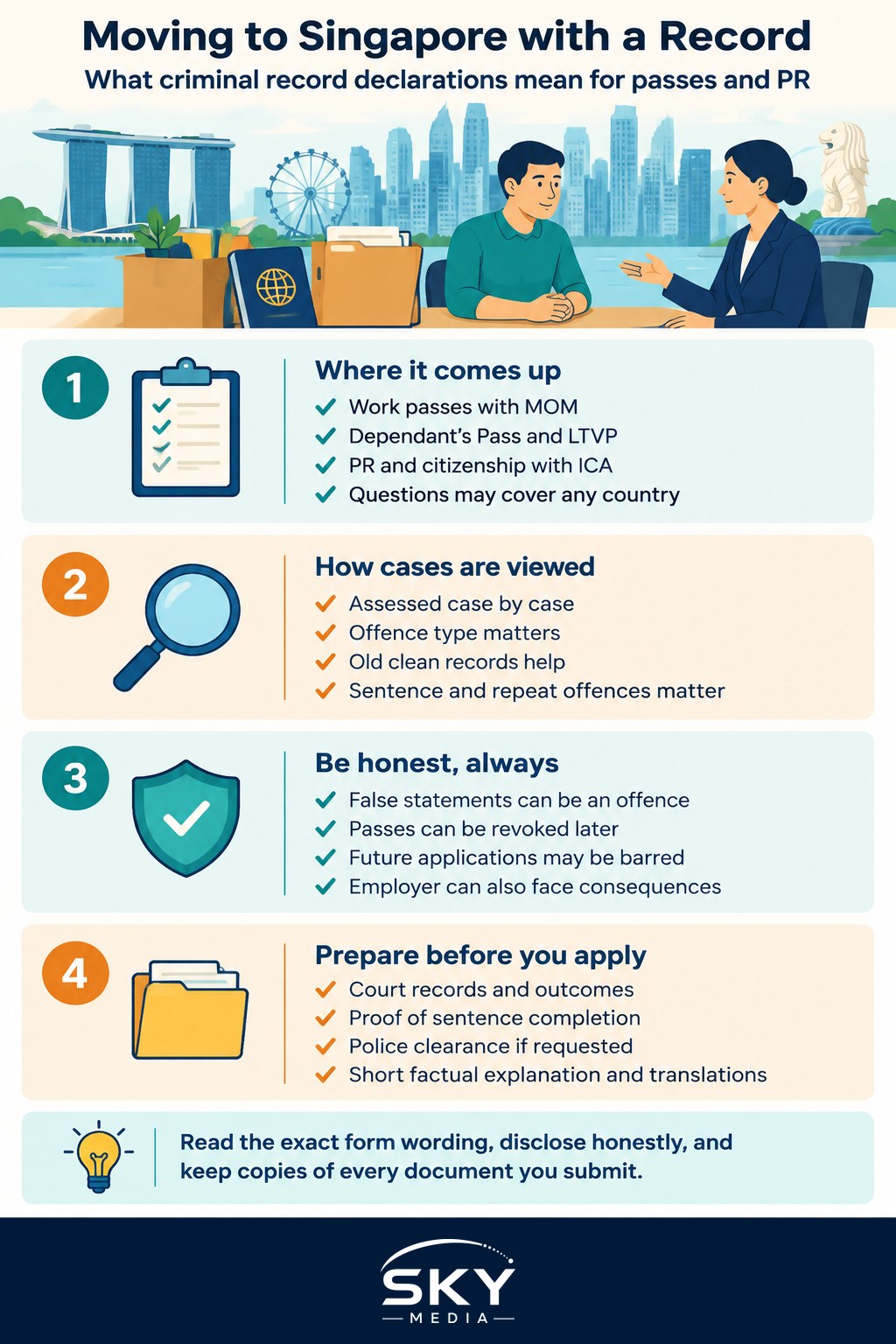
Which Applications Ask About Criminal Records
Several Singapore applications include background declarations. The ones newcomers most often meet are:
- Work pass applications to MOM, such as the Employment Pass, S Pass and Work Permit. Your employer or an appointed employment agent usually submits the application, but the declaration answers are about you, so you need to give them accurate information.
- Dependant’s Pass and Long-Term Visit Pass applications, which can also include background questions about the person applying.
- PR applications to ICA, which are more detailed and look at your overall background and history.
- Citizenship applications to ICA, for those further along the path.
The exact wording differs between forms and is updated from time to time. Typically, a declaration asks whether the applicant has ever been convicted of an offence in a court of law in any country, and sometimes whether they have been refused entry to or deported from any country. Read the precise question on the form you are completing, because the scope (any country, any time) is often wider than people expect.
How Past Convictions Are Generally Assessed
Neither MOM nor ICA publishes a simple list of convictions that lead to approval or rejection. Applications are assessed case by case, and the authorities have discretion. Factors that are commonly relevant in background assessments include:
- The nature of the offence. A minor traffic matter is viewed very differently from offences involving violence, drugs, fraud or harm to children.
- How long ago it happened. An old conviction with a clean record since is generally seen in a different light from a recent one.
- The sentence. Whether it was a fine, a community order or imprisonment can indicate how serious the court considered it.
- Pattern versus one-off. A single incident is different from repeated offences.
- Honesty in the application. This is the factor you control fully.
You will not usually be told exactly how much weight each factor carried. If an application is rejected, MOM or ICA may not give detailed reasons, and appeals follow their own processes. Our guide on what to do when your work pass is rejected covers the general appeal route.
Why Honesty Matters More Than the Conviction Itself
Making a false declaration on a work pass application is an offence under Singapore’s employment of foreign manpower laws, and false statements to ICA are also treated seriously. The consequences of being found out later can include the pass being revoked, being barred from future applications and prosecution. The employer can also face consequences if it knowingly submits false information.
In practice, an undeclared conviction that surfaces later is often far more damaging than the conviction would have been if declared at the start. Background information can come to light through supporting documents, police clearance requests, previous immigration records or other checks.
| Situation | What usually helps | What usually hurts |
|---|---|---|
| Old, minor conviction | Declare it, explain briefly, attach court papers | Omitting it because it “seemed too small” |
| Conviction later set aside on appeal | Declare as the form requires, attach the appeal outcome | Assuming it never needs mentioning |
| Record expunged or spent at home | Check whether the question still covers it, seek advice | Guessing without reading the form wording |
| Pending charges | Disclose if asked, get legal advice | Applying and hoping it resolves quietly |
Spent, Expunged and Foreign Records
Many countries have rules that make old convictions “spent” or expunged after a period, meaning you may not need to disclose them for local jobs. Singapore has its own spent record framework for Singapore records under the Registration of Criminals Act, but that framework applies to Singapore’s own records and its own rules.
Do not assume that a foreign record which is spent at home is automatically outside the scope of a Singapore declaration question. The answer depends on the exact wording of the question and how Singapore law treats it. This is a genuine grey area for many applicants, and it is exactly where a short consultation with a Singapore immigration or criminal lawyer is worth the cost. When in doubt, ask before you submit, not after.
Documents to Prepare
Gathering paperwork early makes the process smoother and helps you answer accurately:
- Court records showing the charge, the outcome and the sentence.
- Proof of completion of any sentence, fine payment or probation.
- A police clearance certificate or certificate of good conduct from your home country or countries where you have lived. MOM or ICA may request one, and some employers ask too. Processing times vary by country, so start early.
- Appeal or pardon documents, if relevant.
- A short, factual explanation of what happened, when and what has changed since. Keep it calm and specific, without excuses or long character arguments.
- Translations of any document not in English, done properly.
Keep copies of everything you submit. If you later apply for PR or renew a pass, you will want your answers to match what you declared before.
Talking to Your Employer
Because the employer usually files the work pass application, the person handling it in HR needs accurate information from you. That can feel awkward, but it is better to raise it early and privately with HR than to have the employer discover it mid-application.
- Ask HR who will see the information and how it will be stored.
- Provide documents directly to the person submitting the application.
- If you are already employed in Singapore and renewing, check whether anything has changed since your last application. Our guide to renewing your work pass in Singapore explains the renewal steps.
If your employer is relocating you from a China office or elsewhere, the same principles apply. Our overview of work passes for Chinese professionals in Singapore explains the pass types in plain terms, which is helpful context before you tackle the declaration section.
Convictions After You Arrive
Holding a pass does not end the matter. Pass holders are expected to obey Singapore law, and a conviction while in Singapore can lead to a pass being cancelled and to restrictions on future entry. Singapore treats offences such as drug use, violence, outrage of modesty and certain public order offences very seriously. If you are charged with anything while on a pass, get legal advice promptly and read about what to do if your work pass is cancelled so you understand the timelines that may apply.
A Practical Checklist Before You Apply
- Read every declaration question on the actual form, word by word.
- List every conviction, in any country, with dates and outcomes.
- Request police clearance certificates early.
- Get a Singapore lawyer’s view on any grey area, especially spent or expunged records.
- Answer truthfully, attach documents and keep a short explanation ready.
- Keep copies so future applications stay consistent.
A criminal record makes moving to Singapore harder, not necessarily impossible. Being upfront, organised and well advised gives your application the fairest hearing it can get. Always confirm the latest requirements on the MOM and ICA websites before you submit.
Official sources: ICA