

If your child loves music and is approaching secondary school or junior college, you may have heard of the Music Elective Programme. The music elective programme Singapore offers through the Ministry of Education (MOE) is one of the most structured ways for students to study music academically within the mainstream school system, right up to national examinations.
This guide explains what MEP is, where it is offered, how selection generally works, what students study, and how to decide whether it suits your child. Details such as participating schools, application windows and examination syllabuses are set by MOE and the Singapore Examinations and Assessment Board (SEAB) and can change, so always confirm current information on the MOE website and with the schools themselves.
What the Music Elective Programme Is
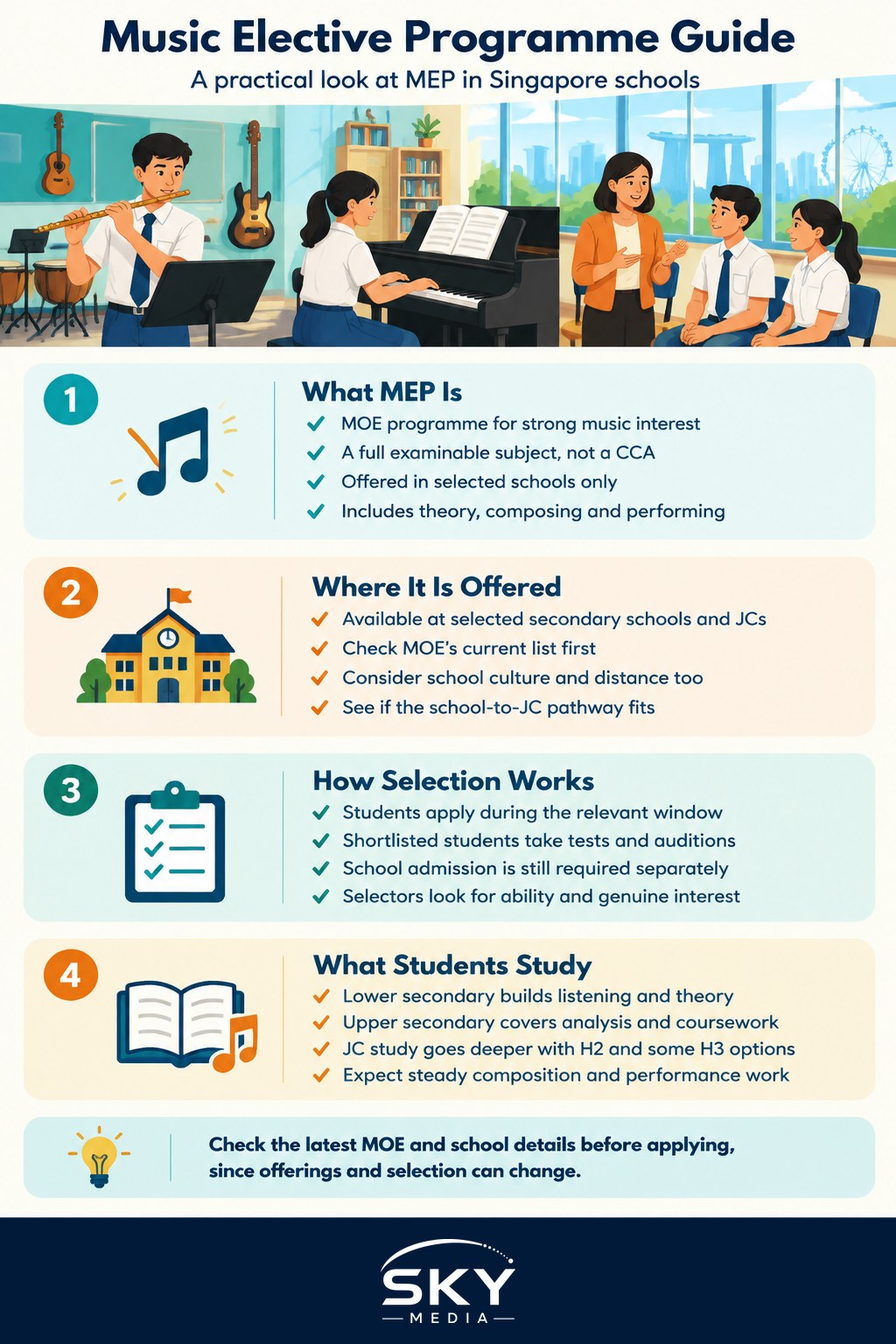
MEP is an MOE programme for students with strong interest and ability in music. It has run for decades and is offered at a limited number of secondary schools and junior colleges. Rather than treating music as a co-curricular activity (CCA), MEP makes music a full examinable subject studied in depth.
Students in MEP typically:
- Study music as an academic subject leading to a national examination
- Learn music history, analysis and a wide range of styles, often including Western classical, Asian and popular traditions
- Compose and arrange their own music, frequently using music technology
- Develop performance skills on their chosen instrument or voice
- Attend concerts, workshops, masterclasses and collaborations organised by the school or MOE
It is different from simply taking music lessons outside school or joining a band or choir. MEP is a commitment to music as part of your child’s formal education, alongside their other subjects.
Where MEP Is Offered
MEP is offered at selected secondary schools and junior colleges. The list is set by MOE and has changed over the years, so it is best to check MOE’s current list rather than rely on word of mouth or older forum posts.
When you look at participating schools, consider:
- The school as a whole. MEP is only one part of the school experience. Distance from home, school culture, other programmes and the overall academic fit still matter.
- The secondary to JC pathway. Some families want a continuous music pathway from secondary school into JC. Check which JCs currently offer MEP at A-Level.
- Related programmes. Some schools have other music or arts strengths, such as Applied Learning Programmes. Our guide to ALP and LLP programmes explains how these differ from an elective programme like MEP.
- Integrated Programme schools. Some MEP schools run the IP, where students skip the O-Levels. Music study is then structured differently. See our explainer on the Integrated Programme for how that route works.
How Selection Generally Works
Admission to MEP is selective. While the exact process and timing are set by MOE and may change, it generally involves:
- Expressing interest. Students apply for MEP during the relevant window, which for secondary school is usually linked to the transition from Primary 6, and for JC is linked to the post-O-Level admissions period.
- A selection exercise. Shortlisted students typically sit a music test and an audition or interview, where they may perform, take aural tests and talk about their musical interests.
- School posting. Students must also be admitted to a participating school through the normal posting or admissions process, which may include Direct School Admission (DSA) for some schools. Being selected for MEP does not on its own guarantee a place at a particular school.
Assessors usually look for musicality, aural ability, potential and genuine interest rather than only grade certificates. Formal graded exams can help show progress, but they are not the only evidence of ability. Check MOE’s guidance on whether a minimum standard of instrumental or theory grades is expected.
What Students Study at Each Level
The table below gives a broad view of the MEP pathway. Subject codes, syllabus content and examination formats are published by SEAB and updated periodically.
| Stage | Main qualification | What it typically involves | Points for parents to check |
|---|---|---|---|
| Lower secondary | No national exam yet | Building foundations in listening, theory, composing and performing | How MEP lessons fit the timetable and CCA load |
| Upper secondary | O-Level Music (MEP students usually take the more advanced music syllabus offered) | Listening and analysis, composition coursework, performance | Coursework deadlines and recital preparation |
| Junior college | A-Level Music, usually at H2, with H3 options in some cases | Deeper study of music history and analysis, extended composition, performance | How the subject counts in the subject combination and university admissions |
| Beyond JC | University, conservatoire or other pathways | Music degrees, music education, or non-music courses with music as a strength | Entry requirements of specific institutions |
Students taking music as an exam subject should expect a substantial coursework component. Composition portfolios and performance recordings or recitals require steady work across the year, not only last-minute effort.
Some MEP students may receive recognition in admissions, such as consideration for JC posting, but the rules for any such recognition are set by MOE and can change. Ask the school or check MOE directly rather than assuming a particular advantage.
Is MEP Right for Your Child?
MEP can be very rewarding, but it is a serious commitment. Talk honestly with your child about these questions:
- Do they love music for its own sake? MEP suits students who enjoy listening, analysing and creating, not only performing a favourite instrument.
- Are they curious about different genres? The syllabus usually covers styles beyond what students play at home.
- Can they manage the workload? MEP adds lessons, coursework and performances on top of other subjects and CCA.
- Do they want music in their future, or as a personal strength? Both are valid. Many MEP students go on to non-music careers while keeping music as a lifelong interest.
- How do they handle feedback and performance pressure? Assessment includes public performance and critique.
If your child is keen on music but not ready for an exam pathway, CCAs such as band, orchestra, choir or Chinese orchestra, or private lessons, may be a better fit. Holiday music camps and workshops can also test interest; our guide to holiday enrichment programmes covers how to choose one.
Preparing Without Pressure
If your child is considering applying, a few low-stress steps help:
- Encourage regular listening across many styles, and talk about what they hear.
- Keep up instrumental or vocal practice, focusing on enjoyment and musicality.
- Try simple composing, whether on paper, an instrument or free music software.
- Attend open houses and school performances to see the programme in action and ask current students about their experience.
- Read MOE’s official MEP information and note application dates early.
Avoid turning the audition into a source of anxiety. Selectors are generally looking for potential and enthusiasm, and a child who enjoys music will usually show it.
The Music Elective Programme offers students a rare chance to study music deeply within the school system, from secondary school through to A-Levels. For the right child, it builds not only musical skill but discipline, creativity and confidence. Check current details with MOE, visit the schools, and let your child’s genuine interest guide the decision.