

Few things make a home feel less like yours than the smell of someone else’s cigarette. In tightly packed blocks, a neighbour smoking at the HDB window, kitchen or corridor can send smoke straight into your bedroom, laundry or child’s room. It is one of the most common complaints in public housing, and it is tricky because the rules on where people can smoke are not as simple as many assume.
This guide focuses on secondhand smoke from neighbouring units: what the rules generally cover, how to raise the issue without starting a feud, where to get help, and what you can do inside your own flat. It is general information, not legal advice. Rules can change, so check the current position with the National Environment Agency (NEA) and other bodies named below.
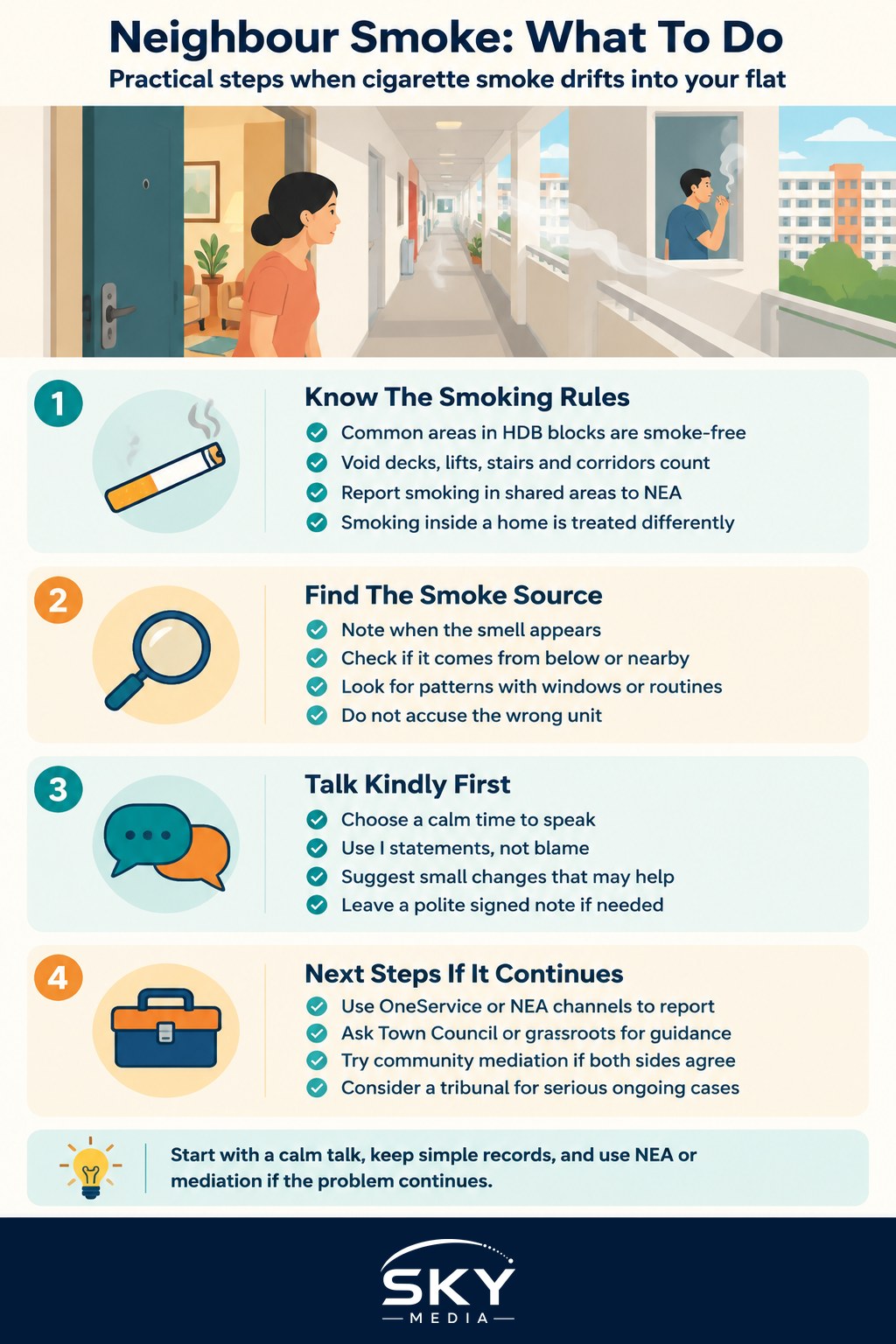
What the Rules Generally Cover
Singapore prohibits smoking in many public places, and this includes the common areas of residential blocks. In HDB estates, that generally means places such as:
- Void decks and lift lobbies
- Lifts and staircases
- Common corridors
- Multi-storey car park areas covered by the prohibition
NEA enforces these smoking prohibitions. If your neighbour is smoking in the shared corridor or at the staircase landing, that is a matter you can report.
Smoking inside a private home, including at the window of one’s own flat, has generally not been covered by the same prohibition. This is why many residents feel stuck: the smoke is reaching their flat, but the smoker may not be breaking a specific smoking law. The issue has been discussed publicly over the years, so check NEA’s website for the latest position rather than relying on old forum posts.
When smoking happens inside a unit, the matter usually falls into the territory of neighbour disputes, where the focus is on reasonable use of your home and on not causing unreasonable interference to others.
Step One: Work Out Where the Smoke Is Coming From
Before you knock on any door, be sure you have the right unit. Smoke travels in odd ways in HDB blocks.
- Note the times. Keep a simple log of when the smell appears: early morning, after meals, late at night.
- Check the route. Smoke can rise from a lower floor, drift along the corridor, or come through a shared air well near kitchens and service yards.
- Look for patterns. If it appears whenever a particular window opens or a certain neighbour returns home, you have a likely source.
- Avoid confrontation on a hunch. Accusing the wrong household is the fastest way to sour relations on your floor.
Step Two: Talk to Your Neighbour Kindly
Many smokers simply do not realise their smoke is reaching other homes. A calm, friendly conversation solves more cases than any complaint.
- Pick a good moment. Not when you are annoyed and not when they are rushing out.
- Use “I” statements. “The smoke comes into our bedroom at night and my kid has been coughing” lands better than “You are polluting our home.”
- Suggest specific changes. Smoking at a different window, closing a door, or avoiding certain hours can make a big difference.
- Leave a note if you cannot meet. A polite note signed with your unit, such as unit #08-15, is better than an anonymous one, which can feel hostile.
- Follow up warmly. If things improve, say thank you. It encourages them to keep it up.
Your Options if Talking Does Not Work
| Option | When it fits | What happens |
|---|---|---|
| Report smoking in common areas to NEA | The neighbour smokes in corridors, staircases, lifts or void decks | NEA may investigate and take enforcement action under its smoking rules |
| Seek help from the Town Council or grassroots | You want a neutral party to help or advise | They may advise you or point you to mediation services |
| Community mediation | Talking has failed and both sides are willing to sit down | A trained mediator helps you reach a voluntary agreement |
| Community Disputes Resolution Tribunals | Mediation fails and the interference is serious and ongoing | A tribunal can hear neighbour disputes and make orders |
Reporting to NEA. You can report smoking in prohibited common areas through official channels such as the OneService app or NEA’s own feedback channels. Give the location, times and any details you have.
Community mediation. The Community Mediation Centre, under the Ministry of Law, offers mediation for neighbour disputes. Mediation is voluntary and confidential, and agreements reached are made by the parties themselves. It is often the most practical route for smoke from inside a flat, because it focuses on finding workable compromises like smoking times or locations.
Tribunals. Under the Community Disputes Resolution Act, the Community Disputes Resolution Tribunals can hear certain neighbour disputes involving unreasonable interference. This is a formal step, usually after other efforts have failed, and outcomes depend on the facts. Check the official guidance on eligibility, process and fees, or seek legal advice if you are considering it.
For a broader look at managing conflict with neighbours, see our guide on handling neighbour disputes.
Keeping Smoke Out of Your Own Flat
While you work on the people side, these practical steps can reduce the smoke that reaches you:
- Time your ventilation. If you know your neighbour’s habits, close the affected windows at those times and open others for airflow.
- Use an air purifier. A purifier with a true HEPA filter and an activated carbon layer can help with particles and odours. Place it in the room most affected and change filters as the maker recommends.
- Check gaps and seals. Draught strips on windows and the main door can reduce smoke drift. If you are planning works, our guide to renovating your HDB flat covers what usually needs approval.
- Rethink the layout. Moving a cot or bed away from the affected window can help sensitive family members.
- Add plants for comfort, not as a fix. Indoor plants make a room pleasant but will not remove smoke. Our guide to green living in an HDB flat has more realistic ideas for a fresher home.
- Dry laundry indoors at smoking times. Clothes on corridor or window racks can pick up the smell.
Protecting Vulnerable Family Members
Secondhand smoke can be a particular concern for babies, young children, pregnant women, older people and anyone with asthma or other breathing problems. If someone in your home has symptoms such as persistent coughing, wheezing or breathing difficulty, see a doctor or polyclinic. Mentioning a health concern, calmly and without exaggeration, can also help your neighbour understand why you are raising the issue.
Staying Neighbourly Through It All
A smoke problem can drag on for months, and resentment builds easily. Try to keep perspective:
- Separate the habit from the person. Your neighbour may be stressed, unwell or trying to quit.
- Keep records factual, not emotional, in case you need mediation later.
- Avoid public shaming in estate chat groups or social media. It rarely helps and can backfire.
- Recognise small improvements, which often lead to bigger ones.
Dealing with a neighbour smoking in HDB flats takes patience. Start with a kind conversation, use mediation when needed, report common-area smoking to NEA, and make practical changes at home. Most cases end not with a ruling, but with two households agreeing on something they can both live with.
Official sources: National Environment Agency (NEA)