

If you are an NTUC union member and you pay for courses out of your own pocket, NTUC UTAP is one of the easiest pieces of money to leave on the table. The Union Training Assistance Programme (UTAP) reimburses part of the course fees you pay yourself, on top of the government subsidies and SkillsFuture Credit you may already be using. Some members only discover it after the claim window has closed.
This guide explains who qualifies for UTAP, how the yearly claim limit works, how it fits alongside SkillsFuture, and the small details that decide whether a claim goes through. Amounts and rules are reviewed from time to time, so always confirm the current terms on NTUC’s official website or app before you sign up for a course.
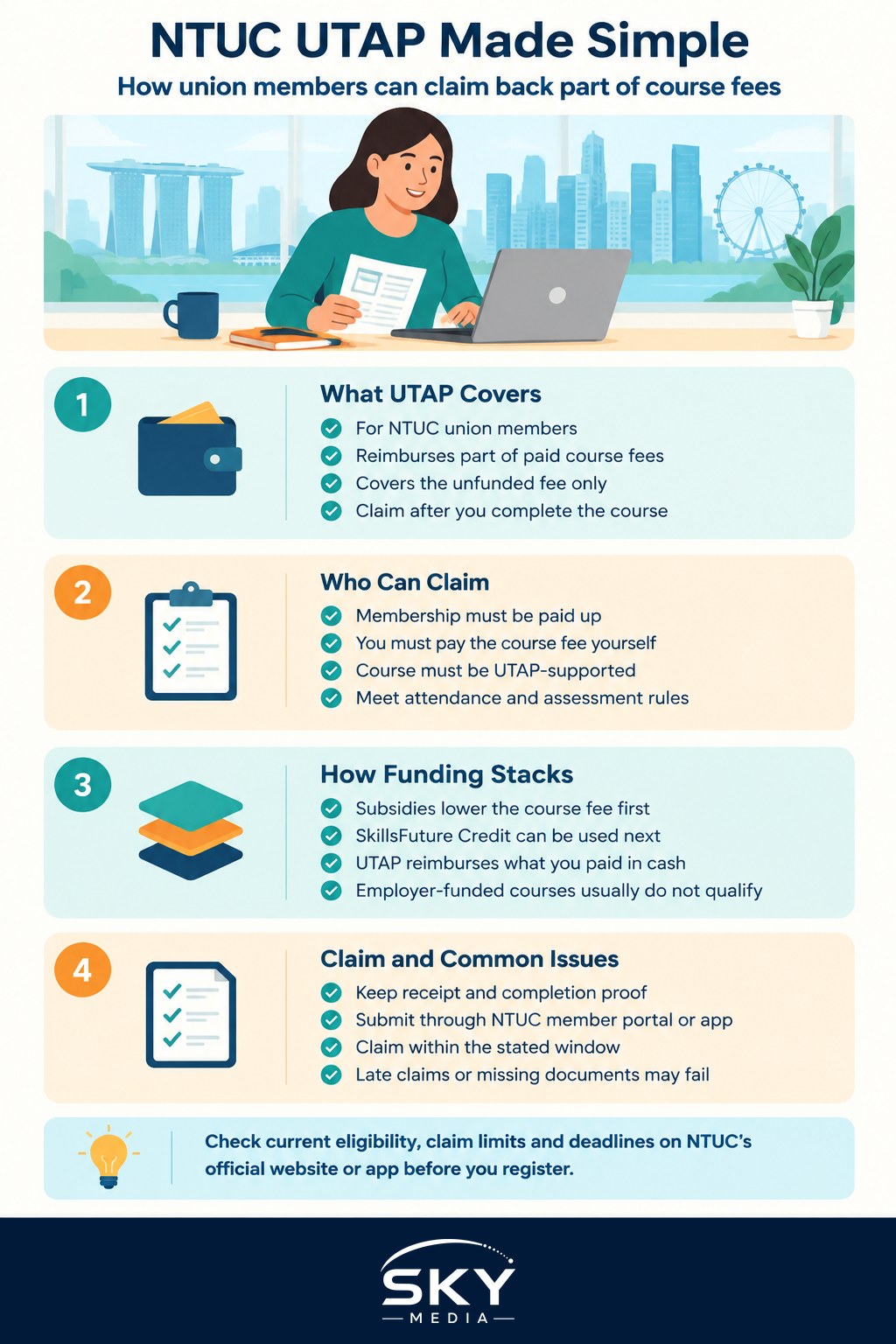
What NTUC UTAP Is and Who Runs It
NTUC is the National Trades Union Congress, Singapore’s national federation of trade unions. Membership comes with a set of benefits, and UTAP is the training one. It is designed for a specific gap: the part of a course fee that is left over after government funding, which you pay personally.
A few points make UTAP different from other funding:
- It is a reimbursement, not an upfront discount. You pay the training provider first, complete the course, then submit a claim to NTUC.
- It applies to the “unfunded” fee. UTAP looks at what you actually paid after subsidies, not the full sticker price.
- It is tied to your membership. You need to be a paid-up member when the course starts and when you claim.
- It only covers supported courses. Many SkillsFuture-eligible and WSQ (Workforce Skills Qualifications) courses are supported, but not every course is. NTUC lists eligible courses through its own portals, including the course listings run by NTUC LearningHub and partner providers.
If you are not yet a member, the article on joining the NTUC and unions as a newcomer explains how membership works and what it costs in general terms.
UTAP Eligibility: The Conditions That Matter
NTUC sets out the eligibility criteria on its website, and they can change. In general, members are expected to meet conditions along these lines:
- Be an NTUC union member (ordinary branch or union member, depending on the scheme rules) with membership dues fully paid up for the period required.
- Pay the course fee yourself. If your employer sponsored the course or reimbursed you, the fee is no longer “unfunded” for you, and UTAP usually does not apply.
- Take a supported course. Check that the course appears as UTAP-eligible before you register. Do not assume that any SkillsFuture-listed course qualifies.
- Meet the attendance requirement set by the provider and NTUC, and sit for any assessment that is part of the course.
- Submit the claim within the stated window after the course ends, with proof of payment and completion.
Foreigners working in Singapore can join some unions and enjoy member benefits, but scheme eligibility is set by NTUC. If you hold a work pass, confirm with NTUC directly whether UTAP applies to you before relying on it.
Claim Limits and How the Yearly Cap Works
UTAP reimburses a portion of your unfunded course fee, subject to an annual cap per member. NTUC has historically offered a higher cap for older members, reflecting the push to help mid-career workers upskill. Because the percentage and the dollar caps are reviewed periodically, check the figures on NTUC’s site rather than relying on an old forum post or a colleague’s memory.
Some practical points about the cap:
- It resets each calendar year (or the period NTUC defines). Unused amounts usually do not roll over.
- Several short courses can share one year’s cap.
- The claim amount cannot exceed what you paid. UTAP is calculated on your actual out-of-pocket fee, after all other funding.
Stacking UTAP With SkillsFuture and Other Funding
The most useful thing to understand is the order in which funding applies. Most supported courses in Singapore follow a similar sequence. The broader article on funding and subsidies for training in Singapore covers each scheme in more depth; here is how UTAP slots in.
| Funding layer | What it does | Who applies it | When you see it |
|---|---|---|---|
| Course fee subsidy (SWDA funding) | Reduces the full fee for eligible Singapore Citizens and PRs | Training provider, at registration | On your invoice |
| Enhanced subsidies (e.g. for mid-career learners) | Further reduces the fee for eligible groups | Training provider, at registration | On your invoice |
| SkillsFuture Credit | Lets you pay part or all of the nett fee from your credit balance | You, via the MySkillsFuture portal | When you pay |
| NTUC UTAP | Reimburses part of what you paid in cash after the above | You, by claiming from NTUC | After the course |
A few stacking rules of thumb:
- SkillsFuture Credit and UTAP are not double-dipping. UTAP typically looks at the amount you paid in cash. If SkillsFuture Credit covered the fee fully, there may be nothing left for UTAP to reimburse.
- Choosing how much credit to use is a strategy question. Some members prefer to pay part of a fee in cash and claim UTAP, keeping more SkillsFuture Credit for a later, pricier course. Whether that works depends on current rules, so check how NTUC calculates the claim before you decide.
- Employer funding usually blocks UTAP. If your company is claiming absentee payroll funding or paying the fee for you, the course is employer-sponsored, and you should not also claim UTAP.
- Keep everything in writing. Your invoice should show the original fee, the subsidy, any SkillsFuture Credit used and the nett amount paid. That breakdown is what NTUC uses.
How to Make a UTAP Claim Step by Step
The exact screens change as NTUC updates its digital services, but the flow usually looks like this:
- Check eligibility before registering. Confirm the course is UTAP-supported and that your membership is active and paid up.
- Register and pay the provider. Use your SkillsFuture Credit at this stage if you plan to.
- Attend and complete the course. Meet the attendance threshold and sit for any assessment. Keep your certificate or statement of attainment.
- Gather your documents. Typically the official receipt or tax invoice showing the amount you paid, and proof of completion.
- Submit the claim online through the NTUC member portal or app, within the claim window.
- Track the outcome. Reimbursement is credited to the account you provide. If a claim is rejected, the reason is usually a missing document, an expired window or an unsupported course.
Common Reasons UTAP Claims Get Rejected
Most failed claims fall into a handful of patterns:
- Membership lapsed at the start of the course or at the point of claiming, often because a GIRO deduction failed or a job change interrupted payroll deduction.
- Course not on the supported list. A course from a reputable provider is not automatically eligible.
- Claim submitted late. The window is fixed, and it is easy to forget after a busy few weeks.
- Receipt lacks a fee breakdown. Ask the provider for an invoice that shows subsidies and the nett paid.
- The employer paid. Even partial company sponsorship can change eligibility.
- Withdrawn or incomplete course. If you drop out, you usually cannot claim. The guide on how to withdraw from a course properly covers what to do if plans change.
Making UTAP Part of a Learning Plan
UTAP works best when you plan a year of learning rather than a single course. List the two or three skills you want to build, check which courses are UTAP-supported, decide how much SkillsFuture Credit to use on each, and set a reminder for each claim deadline the day the course ends.
UTAP is a modest benefit per course, but over several years it adds up, and it rewards members who treat learning as a habit. Before you commit to any course, confirm current eligibility, claim limits and deadlines with NTUC, as they can change.
Explore more: WSQ Courses Explained
Frequently Asked Questions
Can I claim UTAP if my employer paid part of the course fee? Usually not. Employer sponsorship or reimbursement means the fee is no longer unfunded for you, and even partial company funding can change eligibility. Confirm how NTUC treats your case before claiming.
Should I pay with SkillsFuture Credit or cash to maximise UTAP? UTAP typically looks at what you paid in cash, so paying fully with SkillsFuture Credit may leave nothing to reimburse. Some members pay part in cash and keep credit for a pricier course later. Check how NTUC calculates the claim first.
Can foreigners with a work pass use NTUC UTAP? Foreigners can join some unions and enjoy member benefits, but UTAP eligibility is set by NTUC. If you hold a work pass, ask NTUC directly whether the scheme applies to you before signing up for a course.
Does unused UTAP money carry over to the next year? Unused amounts usually do not roll over, because the annual cap resets each calendar year or the period NTUC defines. Several short courses can share one year’s cap, so plan your learning around it.
What happens to my UTAP claim if I drop out of the course? If you withdraw or do not complete the course, you usually cannot claim. UTAP needs proof of payment and completion, plus the attendance and any assessment set by the provider and NTUC.
Official sources: SkillsFuture (SWDA)