

Many parents know about the Ministry of Education’s financial assistance for school fees and textbooks. Fewer know about The Straits Times School Pocket Money Fund, a long-running community fund that gives children from lower-income families a little money each month for daily school needs such as recess meals and transport. If your family’s budget is stretched, the school pocket money fund can take some pressure off, and applying is done quietly through your child’s school.
This guide explains what the fund is, who it is meant for, how support is typically given, and how to apply. It does not cover the MOE Financial Assistance Scheme (FAS) in detail, which is a separate government scheme for fees, uniforms and books.
Eligibility criteria, amounts and application windows are set by the fund and can change. Always confirm the current details with your child’s school or on the fund’s official page.
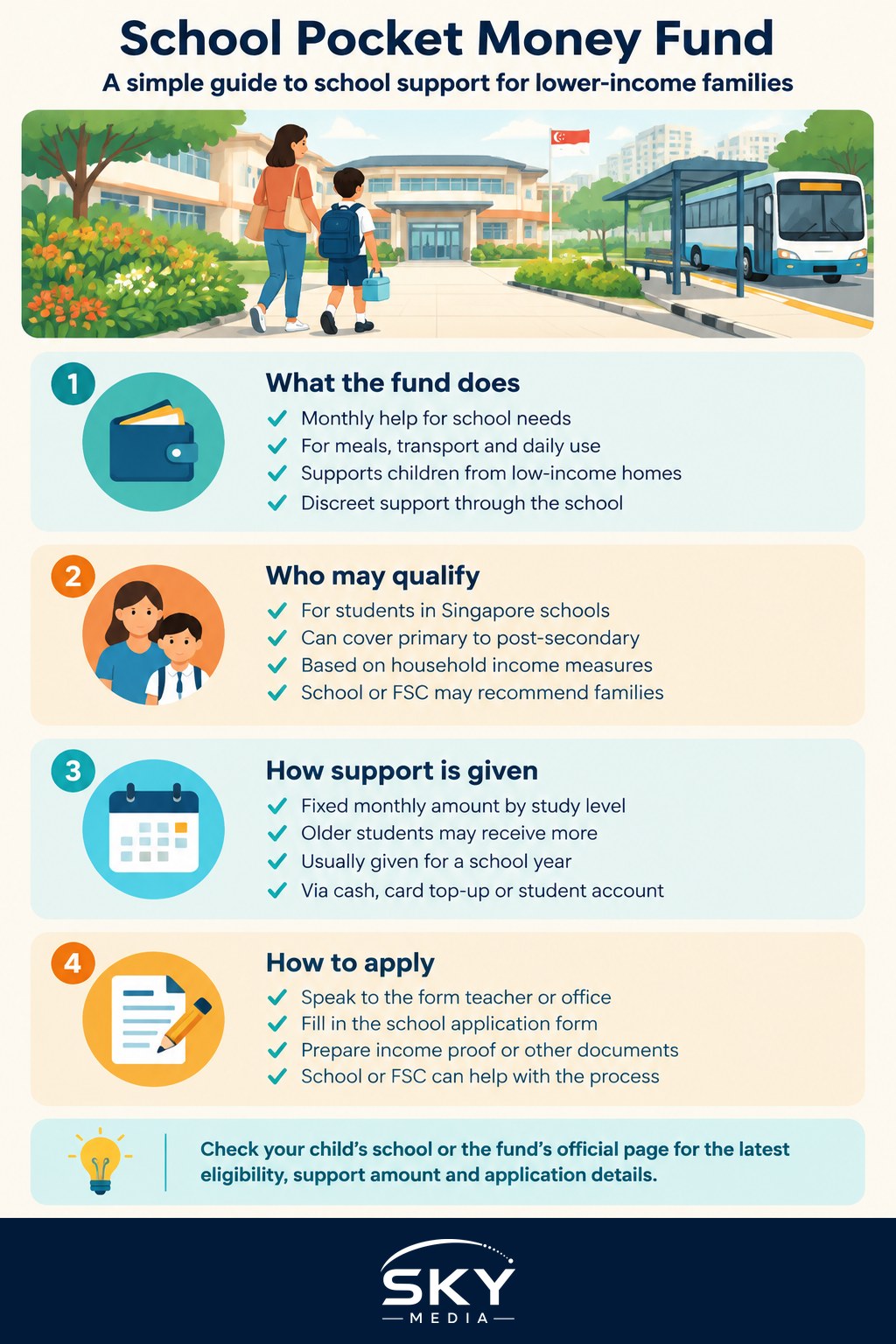
What the Fund Is and Why It Exists
The Straits Times School Pocket Money Fund (often shortened to STSPMF) is a charity initiative started by The Straits Times newspaper and supported by donations from readers, companies and the wider public. Its purpose is simple: to make sure children from low-income households can go to school with some money in their pocket, so they can buy food during recess, pay for transport, and take part in school life without feeling left out.
Unlike a bursary that pays the school directly, pocket money is meant for the child’s day-to-day use. Many schools hand it out in a way that is discreet, so classmates are not aware of who receives it.
Who Can Qualify
The fund is aimed at students from lower-income families who are studying in Singapore schools and institutions. Broadly:
- Students at different levels. The fund has supported students from primary school through to secondary and post-secondary levels, such as Institute of Technical Education (ITE), polytechnic and junior college students. Check whether your child’s institution is covered for the current year.
- Household income criteria. Eligibility is based on gross household income and per capita income (total household income divided by the number of family members). The fund publishes the current thresholds, and the school will apply them.
- Assessed by the school or a social service agency. Teachers, school counsellors or social workers at Family Service Centres (FSCs) may identify and recommend students who need help, even if the family has not asked.
Being on the MOE FAS does not rule your child out, and receiving pocket money does not usually affect other assistance, but ask the school to confirm how the two work together for your family.
How Much Support Children Receive
The fund gives a fixed monthly amount that differs by level of study, with older students generally receiving more because their transport and meal costs are higher. Support is usually given for a period such as a school year, and families can be reassessed for the following year. The fund’s official page and the school will tell you the current amount for your child’s level. We do not list figures here because they are reviewed from time to time.
How the money reaches your child varies by school. Common methods include a monthly cash or card top-up through the school’s general office, a transfer into a student account, or payment via a stored value card. Ask the school which method it uses so you know when to expect it.
How to Apply Through Your Child’s School
The application process is designed to be simple and private. Typical steps:
- Speak to the school. Approach your child’s form teacher, the school counsellor or the general office and say you would like to apply for the School Pocket Money Fund. Some schools include it in the same pack as the MOE FAS form at the start of the year.
- Fill in the application form. The school will give you the form or tell you where to get it.
- Prepare supporting documents. You will usually need proof of household income, such as recent payslips, CPF contribution history or a letter from your employer. If you are not working, you may be asked for a declaration or other documents.
- Submit and wait for the outcome. The school assesses the application and lets you know the result. If successful, it will explain how and when the pocket money will be given.
If you are working with a Family Service Centre or social worker, they can also help you apply or write a supporting note.
School Pocket Money Fund Versus Other Help
| Type of help | What it covers | Who runs it | How to apply |
|---|---|---|---|
| School Pocket Money Fund | Monthly pocket money for meals, transport and daily school needs | Community fund started by The Straits Times | Through your child’s school or a social service agency |
| MOE Financial Assistance Scheme | School fees, textbooks, uniforms, meals at some levels, transport subsidies | Ministry of Education | Through the school, usually with one application form |
| School-based assistance | Ad hoc help for trips, enrichment or devices | Individual schools | Ask the form teacher or counsellor |
| Community and FSC support | Wider family needs, such as food, bills or counselling | Social service agencies | Visit or call your nearest Family Service Centre |
Tips for Parents Applying
- Apply early. Schools often process applications at the start of the year, but many accept them during the year if your circumstances change, for example after a job loss or illness.
- Be honest and complete. Missing documents are the most common reason for delays. If you cannot get something, explain why on the form.
- Tell the school if things change. If your income drops or rises, let the school know, as it may affect your child’s eligibility.
- Talk to your child about it. Explain that the money is for school needs like food and transport. It is a good moment to build simple budgeting habits. Our guide on how to start pocket money for kids has age-appropriate ideas.
- Keep it private. Schools handle these cases sensitively. You do not need to share your application with other parents.
Helping Your Family Budget Beyond School
Pocket money support helps with the daily costs of school, but it works best as part of a wider plan. Writing down monthly essentials, setting aside a small buffer when possible, and knowing where to turn in an emergency can make a big difference. Our article on building an emergency fund offers simple steps that work even on a tight budget.
If you are struggling with bills, food or stress at home, you do not have to manage alone. Your child’s school counsellor and your nearest Family Service Centre can point you to other help, from food support to financial counselling. Asking for help is a sensible step for your child’s wellbeing, and these funds exist precisely so that money worries do not stand in the way of a child’s education.
Supporting the Fund as a Donor
If your family is doing fine, you might consider giving instead. The fund relies on public donations, and its official page explains how to donate. Some companies also match employee donations, so check with your HR department. Every contribution helps a child go to school with a full stomach and the confidence to join in with their classmates.
Frequently Asked Questions
Can Permanent Resident or foreign students get the School Pocket Money Fund? Eligibility, including any citizenship or residency conditions, is set by the fund and can change. Ask your child’s school or check the fund’s official page for the current criteria before applying. The school can also tell you about other help your child may qualify for.
What if I am self-employed or my income changes month to month? Explain your situation to the school, since income is assessed from documents and irregular earnings are common for gig and self-employed parents. Bring whatever proof you have, such as bank statements or CPF records, and ask what the school accepts.
What can I do if my pocket money application is not approved? Ask the school or counsellor why, and whether you can reapply if your circumstances change. You can also ask about the MOE Financial Assistance Scheme, school-based help and your nearest Family Service Centre, which can point you to other support.
Can my child get the fund if they attend a special education or private school? The fund covers different types of institutions at different levels, and the list can change. Ask your child’s school or check the fund’s official page for the current year. A social worker at a Family Service Centre can also help you find out.
Can the pocket money be used for tuition or school trips? It is meant for daily school needs such as recess meals and transport rather than large expenses. For trips, enrichment or devices, ask the school about school-based assistance. The school can explain which scheme covers which cost.
Official sources: Ministry of Education (MOE)
Further reading: School Booklists in Singapore: Buying Textbooks and Supplies Before Term · Can Teachers Accept Gifts? School Gift Rules Parents Should Know