

If you rent out your flat or condo, or let out rooms in it, there is a limit on how many people can live there. Singapore’s maximum occupancy rental rules exist to prevent overcrowding, protect neighbours and keep homes safe. Landlords who exceed the cap can face penalties, and the rules differ depending on whether your home is an HDB flat or a private property regulated by URA.
This guide centres on those occupant limits: who sets them, how they are applied and what landlords should check before signing up tenants. It is general information. The numbers and conditions are set by HDB (the Housing & Development Board) and URA (the Urban Redevelopment Authority), they have been adjusted before, and they can change again, so always confirm the current rules on the official websites before you let your property.
Why Occupancy Caps Exist
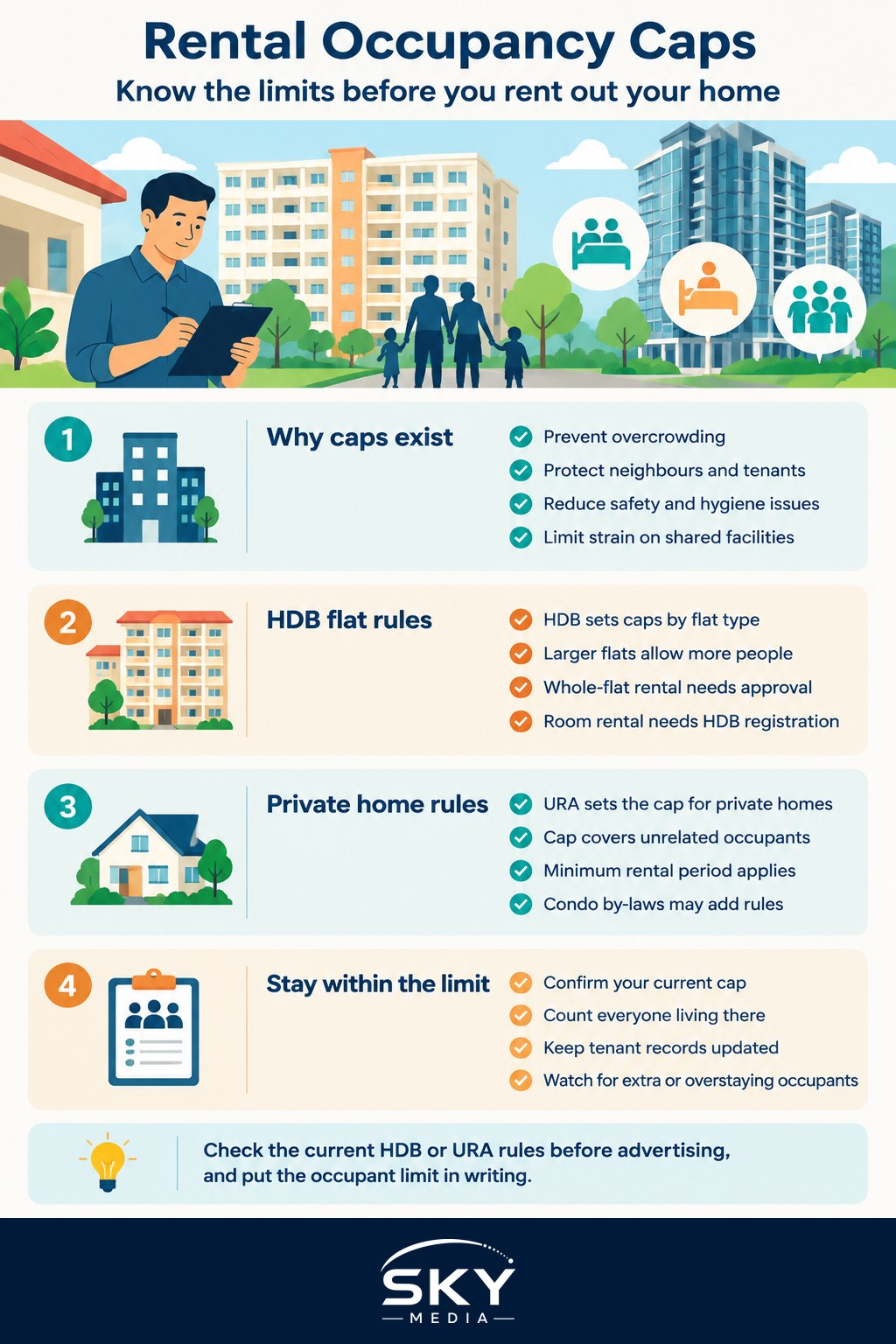
Occupancy caps balance two needs: owners who want rental income and the wider community that lives with the effects of overcrowded units. Too many people in one home can mean:
- Strain on shared facilities such as lifts, rubbish chutes and car parks.
- Noise, hygiene and fire safety concerns.
- Disputes with neighbours and the management corporation.
- Poorer living conditions for the tenants themselves.
A cap gives everyone a clear, enforceable line.
HDB Flats: How the Occupancy Cap Works
For HDB flats, HDB sets a maximum number of occupants that depends on the flat type. Larger flats are allowed more occupants than smaller ones. For several years HDB’s published caps have been six occupants for 3-room flats and nine for 4-room and larger flats, but HDB has adjusted these limits in the past, so check its current table before you rent.
Points landlords often miss:
- The cap usually covers everyone living in the flat, not only tenants. If you live there and rent out rooms, your household generally counts towards the limit. Check HDB’s definitions to see exactly who is included.
- Approval or registration is required. Renting out a whole flat requires HDB approval, and renting out rooms requires registration with HDB within a set period. Our guide to applying for HDB approval to rent out your flat walks through the process.
- Eligibility rules apply too. You generally must have met the Minimum Occupation Period (MOP) before renting out the whole flat, and there are quotas on renting to non-citizens in each neighbourhood and block.
- Minimum rental period. HDB sets a minimum rental period, so short-term stays such as holiday rentals are not allowed.
Private Homes: How URA’s Occupancy Cap Works
For private residential properties, including condos, apartments and landed homes, URA sets the cap. For many years the limit has been six unrelated persons per unit. URA has at times introduced temporary changes, including a higher limit for larger homes, so check its website for the current cap and any conditions such as minimum unit size.
Key points:
- “Unrelated” matters. The cap is framed around unrelated occupants. How family members and the owner are counted is set out in URA’s guidelines, so read them before assuming.
- Minimum rental period. URA requires private homes to be rented out for at least a minimum period, which rules out short-term rentals of a few days or weeks. Check URA’s current requirement.
- Condo by-laws may add rules. Your MCST (management corporation strata title, the body that manages a condo) can have by-laws on tenants, access cards and use of facilities. These do not override URA’s cap but can add practical requirements.
- Landed homes are not exempt. Large landed houses are still subject to the cap, and converting them into dormitory-style lodging needs separate approval.
HDB vs URA Rules at a Glance
| Area | HDB flats | Private homes (URA) |
|---|---|---|
| Who sets the cap | HDB | URA |
| How the cap is set | By flat type, larger flats allow more occupants | A fixed number of unrelated occupants per unit, with past temporary changes for larger homes |
| Who counts | Generally all occupants, including the owner’s household | Unrelated persons, as defined in URA’s guidelines |
| Approval before renting | HDB approval for whole flat, registration for room rental | No URA approval for normal rental, but MCST by-laws may apply |
| Short-term stays | Not allowed, minimum rental period applies | Not allowed, minimum rental period applies |
| Where to check | HDB website and My Flat Dashboard | URA website |
Practical Steps for Landlords
Staying within the cap is mostly about planning and record-keeping.
- Confirm your current cap. Look up the HDB or URA rules for your property type and size before advertising.
- Count everyone. Include yourself, family members, helpers and tenants where the rules require it, and plan your rooms around the limit.
- State the occupant limit in the agreement. Specify who may live in the home and prohibit extra occupants or subletting without your written consent.
- Keep tenant records. Hold copies of passes or IDs and the tenancy agreement, and update HDB registrations when tenants change.
- Watch for unauthorised occupants. Overstays by friends or relatives can tip you over the limit. Visit or inspect periodically, with reasonable notice.
- Avoid short-term platforms. Listing rooms by the night or week breaches minimum rental rules.
- Respond to complaints quickly. If neighbours or the MCST raise concerns, check your occupancy and fix problems early.
For a broader view of finding tenants, setting rent and handling handovers, read A Landlord’s Guide to Renting Out Your Property.
What Happens If You Exceed the Cap
Both HDB and URA investigate complaints and can take enforcement action. Outcomes depend on the case and the current rules, but possible consequences for owners include fines, being required to reduce the number of occupants and, for HDB flats in serious cases, losing the right to rent out the flat or even having the flat compulsorily acquired. Tenants may also have to move out at short notice, which is disruptive for everyone.
Because the penalties can be heavy, do not rely on what other landlords say or on old forum posts. Check the official rules, and ask HDB or URA directly if your situation is unusual, such as a home shared by an extended family plus tenants.
Renting Out Rooms While You Live There
Many owners let a spare room while living in the home. This is a common way to offset mortgage costs, but the occupancy cap still applies, and your own household usually counts towards it in an HDB flat. Before advertising a room:
- Work out how many people already live there.
- Confirm how many more are allowed.
- Register the tenants with HDB if you live in a flat.
- Set clear house rules on guests and overnight stays.
Our guide to renting out a room in your home covers house rules, pricing and choosing tenants in more detail.
Keeping Your Rental Compliant
Occupancy caps are one of the simplest rules to get right and one of the costliest to get wrong. Know whether HDB or URA governs your home, confirm the current limit, count every occupant and put the limit in writing in your tenancy agreement. A compliant rental is easier to manage, keeps neighbours on side and protects your income over the long term.
Further reading: The HDB Non-Citizen Quota for Renting Out Your Flat · Renting Out Your Condo to Corporate Tenants · Is Airbnb Legal in Singapore? Short-Term Rental Rules Explained