
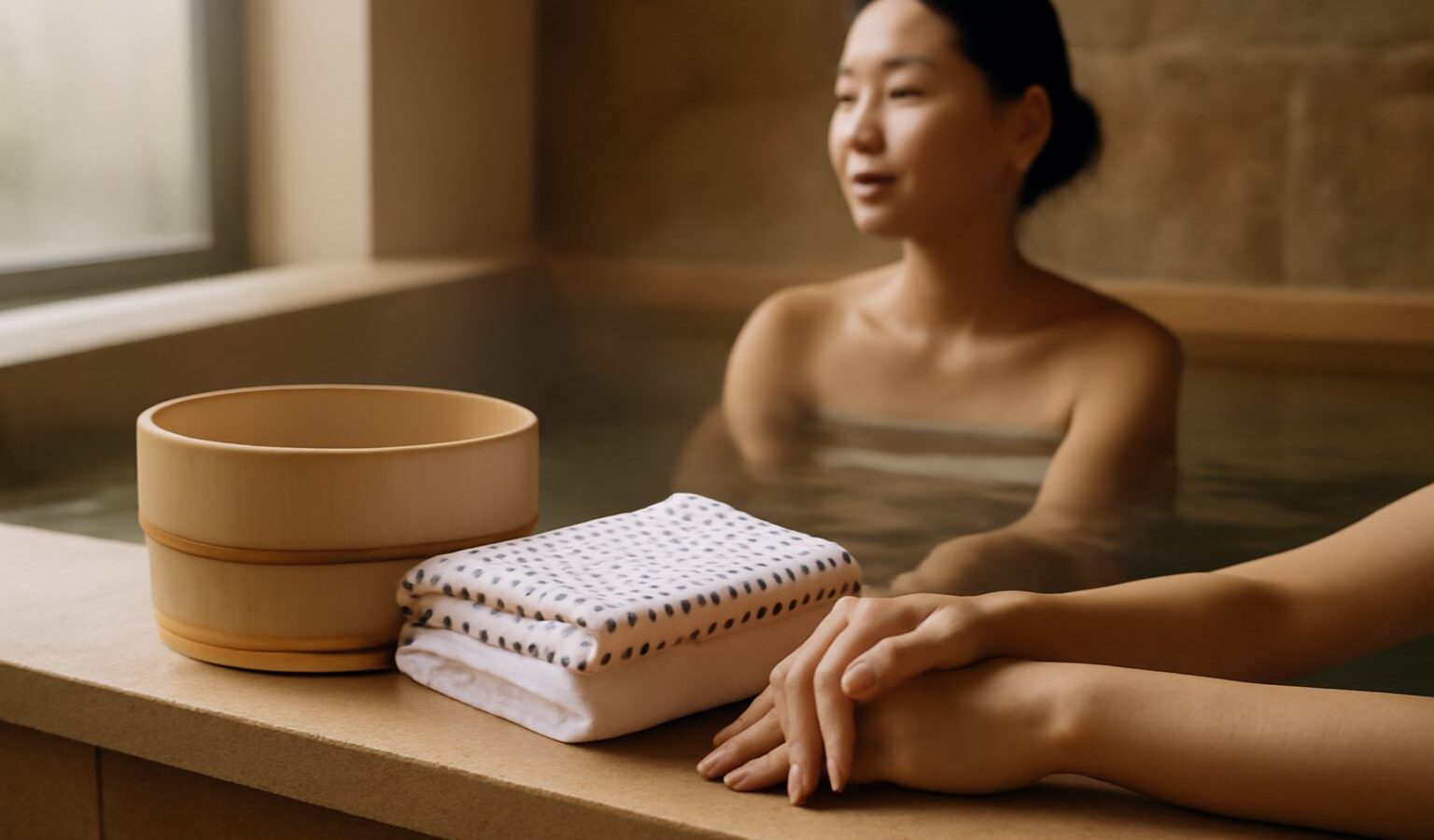
A soak in a natural hot spring is one of the great pleasures of travelling in Japan, but for first-timers the unwritten rules can feel intimidating. Good onsen etiquette is really just a few simple habits built around cleanliness and consideration for others. Once you understand how a public bath works, you can relax and enjoy it like a local. This guide walks you through the essentials so you arrive calm and confident.
How a public bath actually works
An onsen is a bath fed by natural hot spring water, while a sento is a public bathhouse using ordinary heated water. The etiquette is much the same for both.
The layout is usually consistent. You enter, pay or check in, and remove your shoes where indicated. Baths are almost always separated by sex, marked by curtains, commonly red or pink for women and blue for men. Inside is a changing room with baskets or lockers for your clothes, then the bathing area itself, which has a row of washing stations and one or more communal soaking pools.
The golden principle: the pools are for soaking clean bodies only. All washing happens before you get in, not in the bath.
The single most important rule: wash first
Before you enter any communal pool, you must clean yourself thoroughly at the washing stations. These have a stool, a bucket or basin, a handheld or fixed shower and soap. Sit down, wash your entire body and hair, and rinse off every trace of soap. Sitting keeps you from splashing your neighbours.
Only once you are properly clean and rinsed do you enter the soaking pool. This is non-negotiable and is the heart of onsen etiquette.
Nudity is normal
You bathe completely naked. Swimwear is not worn in the pools, and this applies to everyone. Baths are separated by sex precisely so that nudity is comfortable and unremarkable. It can feel daunting the first time, but everyone is in the same situation and nobody is looking. Treating it as ordinary, because it is, is the most respectful approach.
You are usually given, or can bring, a small towel. It is used to wash and for a little modesty as you walk. It should not go into the bath water. Most people fold it and rest it on their head or place it at the pool’s edge.
If the idea of a shared bath still feels like a step too far, look for facilities offering a private or reserved bath, sometimes attached to guesthouses and inns. These let you enjoy the same mineral water in your own time, and they remove the nudity question entirely. Many travellers use a private bath for their first soak to build confidence, then move on to the communal pools once they know the rhythm.
Tattoos: check before you go
Tattoos are still associated with organised crime in parts of Japanese culture, and many traditional onsen historically ban visitors with visible tattoos. Attitudes are gradually relaxing, especially in tourist areas, but the situation varies widely from place to place.
If you have tattoos, plan ahead. Options include:
- Looking for tattoo-friendly onsen, which are increasingly common in travel hubs.
- Covering a small tattoo with a waterproof patch or cover sticker if the facility allows it.
- Booking a private bath, sometimes called a family bath or reserved bath, so the question does not arise.
Check the individual establishment’s policy rather than assuming, since rules differ by venue.
Hygiene and the small courtesies
Beyond washing first, a handful of habits keep the shared water pleasant for everyone.
- Tie up long hair so it does not touch the water.
- Keep your small towel out of the pool.
- Do not swim, splash, dunk your head or make waves.
- Enter and move slowly and quietly; onsen are for calm.
- Do not wash or add soap in the soaking pool.
- Rinse the stool and area at your washing station for the next person.
Do’s and don’ts at a glance
| Do | Don’t |
|---|---|
| Wash and rinse fully before soaking | Get into the pool dirty or soapy |
| Bathe naked as everyone does | Wear swimwear in the pools |
| Keep your small towel out of the water | Dip the towel or your hair in the pool |
| Speak quietly and move calmly | Swim, splash or be loud |
| Check the venue’s tattoo policy first | Assume every onsen allows tattoos |
| Drink water and rest if you feel faint | Soak far too long or when unwell |
Staying comfortable and safe
Onsen water is hot, often hotter than a normal bath, and the mineral content can be strong. Ease in gradually, keep your soak to a sensible length, and step out to cool down if you feel light-headed. Drink water before and after to stay hydrated. Very hot water may not suit everyone, including young children, older bathers, or anyone who is pregnant or managing a health condition, so use your judgement and rest between soaks.
When you finish, many people prefer to pat the mineral water off rather than rinse it away, as it is thought to be good for the skin, but a light rinse is fine too. Dry off in the washing area before stepping back into the changing room so you do not drip everywhere.
Bathe with respect and enjoy
None of this is complicated once it clicks. Wash before you soak, bathe naked without fuss, keep your towel and hair out of the water, mind the tattoo rules, and stay quiet and considerate. Do that, and you will blend in comfortably.
An onsen is a place of quiet, restorative calm that has been part of Japanese life for centuries. Approach it with a little humility and respect for the customs, and a first-timer’s nerves quickly give way to one of the most memorable and relaxing experiences a trip to Japan can offer.
Explore more: First-time traveller tips for Singapore · Packing tips for tropical and cold trips · Pre-travel checklist for Singapore