

Options have become far easier to access through online brokers, and many Singapore investors now see them advertised alongside stocks and ETFs. But options work very differently from buying shares. Before you start options trading in Singapore, it helps to understand what calls and puts are, how they make or lose money, and why some strategies carry far more risk than they appear to.
This guide is general information, not financial advice. Options are complex products, and you can lose money quickly. Read your broker’s product disclosures, and consider speaking to a licensed financial adviser if you are unsure.
What an Option Is
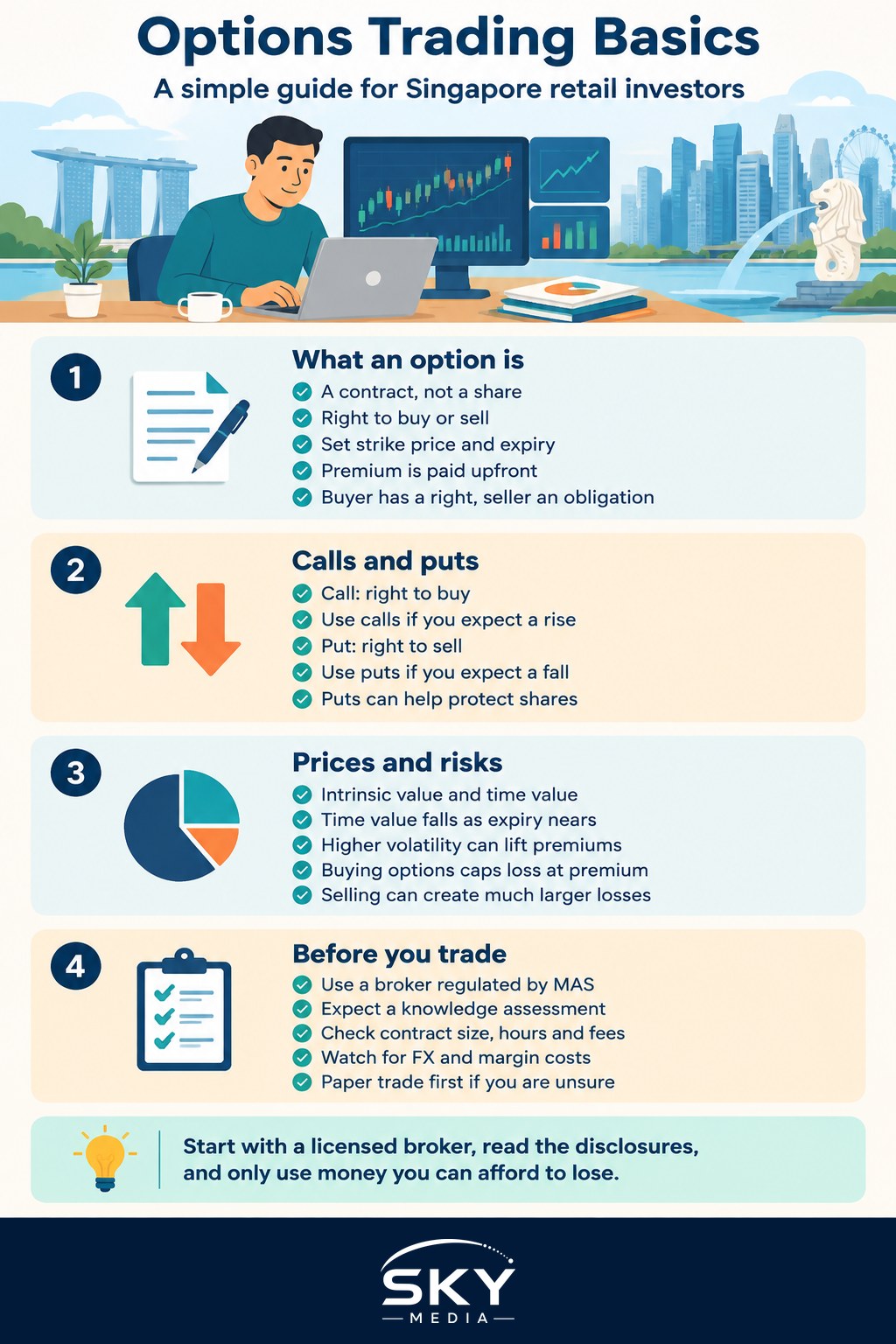
An option is a contract that gives the buyer the right, but not the obligation, to buy or sell an underlying asset, such as a stock or an ETF, at a set price before or on a set date.
A few terms you will see everywhere:
- Underlying: the asset the option is based on, such as a share.
- Strike price: the price at which you can buy or sell the underlying.
- Expiry date: the date the option ends. After that, it is worthless if not used.
- Premium: the price you pay to buy the option. The seller receives it.
- Contract size: many exchange-listed stock options, including US-listed ones, cover 100 shares per contract. A premium quoted as $2 can mean $200 for one contract.
- American vs European style: American-style options can be exercised any time before expiry. European-style ones only at expiry.
Every option has two sides: a buyer (holder) and a seller (writer). The buyer pays a premium for a right. The seller collects the premium and takes on an obligation.
Calls and Puts Explained
There are two basic types of options.
Call options
A call gives the buyer the right to buy the underlying at the strike price. You might buy a call if you expect the price to rise.
Example in general terms: a share trades at $50, and you buy a call with a strike of $55. If the share rises well above $55 before expiry, the call gains value. If it stays below $55, the call may expire worthless and you lose the premium you paid.
Put options
A put gives the buyer the right to sell the underlying at the strike price. You might buy a put if you expect the price to fall, or to protect shares you already own.
If you own a share at $50 and buy a put with a strike of $45, you have a floor: if the share falls sharply, the put gains value and offsets some of the loss.
What makes up the premium
An option’s price usually reflects two things:
- Intrinsic value: how much the option is “in the money” right now.
- Time value: the extra value for the chance of a favourable move before expiry. It shrinks as expiry approaches, a process called time decay.
Volatility also matters. When markets are jumpy, premiums tend to be higher.
Common Strategies and Their Risks
The table below compares four basic positions. The risk profile depends on whether you are buying or selling.
| Position | When it is used | Maximum loss | Maximum gain |
|---|---|---|---|
| Buy a call | Expect the price to rise | The premium paid | Potentially large if the price rises a lot |
| Buy a put | Expect a fall, or to protect shares | The premium paid | Large, up to the strike minus premium if the price falls to zero |
| Sell a covered call (own the shares) | Earn income on shares you hold | Similar to owning the shares, less the premium received | Limited to the premium plus gains up to the strike |
| Sell a put | Willing to buy shares at a lower price | Large, if the price falls sharply | Limited to the premium received |
The key lesson: buying options limits your loss to the premium, while selling options can expose you to much larger losses. Selling a call without owning the shares (a “naked call”) can in theory have unlimited losses, which is why many brokers restrict it.
Why Options Are Risky for Beginners
Options can be useful, but beginners often get caught by:
- Leverage. A small premium controls a much larger amount of shares. That magnifies both gains and losses. Our article on CFD trading and how leverage can hurt you explains why leverage is dangerous for retail investors.
- Time decay. Even if you are right about the direction, the move must happen before expiry. Many bought options expire worthless.
- Assignment. If you sell options, you may be required to buy or sell shares, sometimes at an awkward time.
- Margin calls. Selling options often requires margin. If the market moves against you, the broker may ask for more money or close your positions.
- Complex strategies. Spreads, straddles and other multi-leg trades can be hard to understand and expensive to unwind.
- Currency risk. Many popular options trade in US dollars, so exchange rates affect your returns.
What to Check Before Options Trading in Singapore
Before you begin, consider these steps:
- Use a licensed broker. Check that the broker is regulated by the Monetary Authority of Singapore (MAS) using the MAS Financial Institutions Directory.
- Expect a knowledge check. In Singapore, options are generally treated as Specified Investment Products (SIPs). Brokers usually need to assess whether you have the relevant knowledge or experience, through a review such as the Customer Account Review (CAR) or Customer Knowledge Assessment (CKA), before allowing you to trade them.
- Understand the market. Some options trade on SGX, while many retail investors trade US-listed options through their brokers. Trading hours, contract sizes and fees differ.
- Read the fees. Commissions, exchange fees, platform fees and FX conversion costs add up, especially for small trades.
- Know your tax position. Singapore generally does not tax capital gains, but frequent trading may be treated as income. Check IRAS guidance or speak to a tax professional.
- Start small. If you try options, use money you can afford to lose. Paper trading on a demo account can help you learn.
Where Options Fit in Your Portfolio
For most long-term investors, the core of a portfolio is usually diversified, low-cost investments. Our guides on ETFs explained for Singapore investors and Irish-domiciled ETFs cover that foundation.
Options can play a smaller role, for example:
- Hedging a portfolio with protective puts.
- Generating income with covered calls on shares you already hold.
- Taking a defined-risk view by buying calls or puts with a small amount of money.
Whatever you do, avoid using options as a quick way to get rich. Most losses come from overconfidence and oversized positions.
Key Takeaways
- Options give the buyer a right, and the seller an obligation.
- Calls profit from rising prices, puts from falling prices.
- Buyers can lose the premium; sellers can lose much more.
- Leverage, time decay and margin calls are the main risks.
- In Singapore, check your broker is MAS-licensed and expect a knowledge assessment.
Options trading in Singapore is open to retail investors, but it rewards preparation. Learn the basics, start small, and make sure you understand the risks before you place your first trade.
Frequently Asked Questions
How much money do I need to start trading options? There is no single figure, because it depends on your broker, the contract size and the strategy. Many US-listed contracts cover 100 shares, so one contract can be far larger than the premium suggests. Check your broker’s requirements and only use money you can afford to lose.
Do Singapore brokers let beginners trade options straight away? Usually not. Options are generally treated as Specified Investment Products, so brokers typically assess your knowledge or experience through a review such as the Customer Account Review or Customer Knowledge Assessment before allowing you to trade them.
Why do so many bought options expire worthless? Because of time decay. The time value of an option shrinks as expiry approaches, so even if you guess the direction right, the move has to happen before the expiry date. Strike price, volatility and timing all need to work in your favour.
Are profits from options taxed in Singapore? Singapore generally does not tax capital gains, but frequent trading may be treated as income, which would be taxable. Whether your activity counts depends on the facts, so check IRAS guidance or speak to a tax professional.
Can I practise options trading without risking real money? Yes, a paper trading or demo account lets you practise placing orders and watching how premiums and time decay behave without risking cash. It is a sensible first step, and reading your broker’s product disclosures before going live also helps.
Official sources: MoneySense