
That small room in newer flats is one of the most useful spaces you have, but also one of the most misused. Getting your HDB storeroom Singapore layout right means storing more, finding things faster, and keeping everything in good condition, all while respecting the rules that make this room special. In many flats the storeroom doubles as the household shelter, and that changes what you can and cannot do to it. This guide covers the rules to follow, practical ways to organise the space, and how to keep damp and pests at bay so your belongings last.
Before you start hanging shelves or drilling hooks, it is worth understanding why the household shelter is different from an ordinary cupboard. Getting that clear first will save you from costly mistakes and keep the room doing its important job.
Respecting the Household Shelter Rules
In many newer HDB flats, the storeroom is a household shelter, designed to offer protection in an emergency. Because of this, HDB sets specific rules about what you may do to it, and these are there for a serious reason rather than to make life difficult. The most important principle is simple: do not hack, drill into or alter the shelter walls, ceiling, floor or door. These elements are built to protect you, and damaging them undermines that purpose.
That means no drilling holes to mount shelves or hooks on the shelter walls, and no removing or modifying the heavy shelter door or its seals and fittings. The ventilation openings must be kept clear and never blocked or sealed, and the door should remain functional and unobstructed so it can be closed properly if ever needed. If you want to know exactly what is and is not allowed for your flat, HDB is the authority to check with, and it is always better to ask than to assume.
The practical takeaway is that you should organise the household shelter using freestanding storage rather than anything fixed to its surfaces. Standalone shelving units, stackable boxes and mobile racks give you plenty of capacity without touching the protective structure at all.
Smart Storage Without Drilling
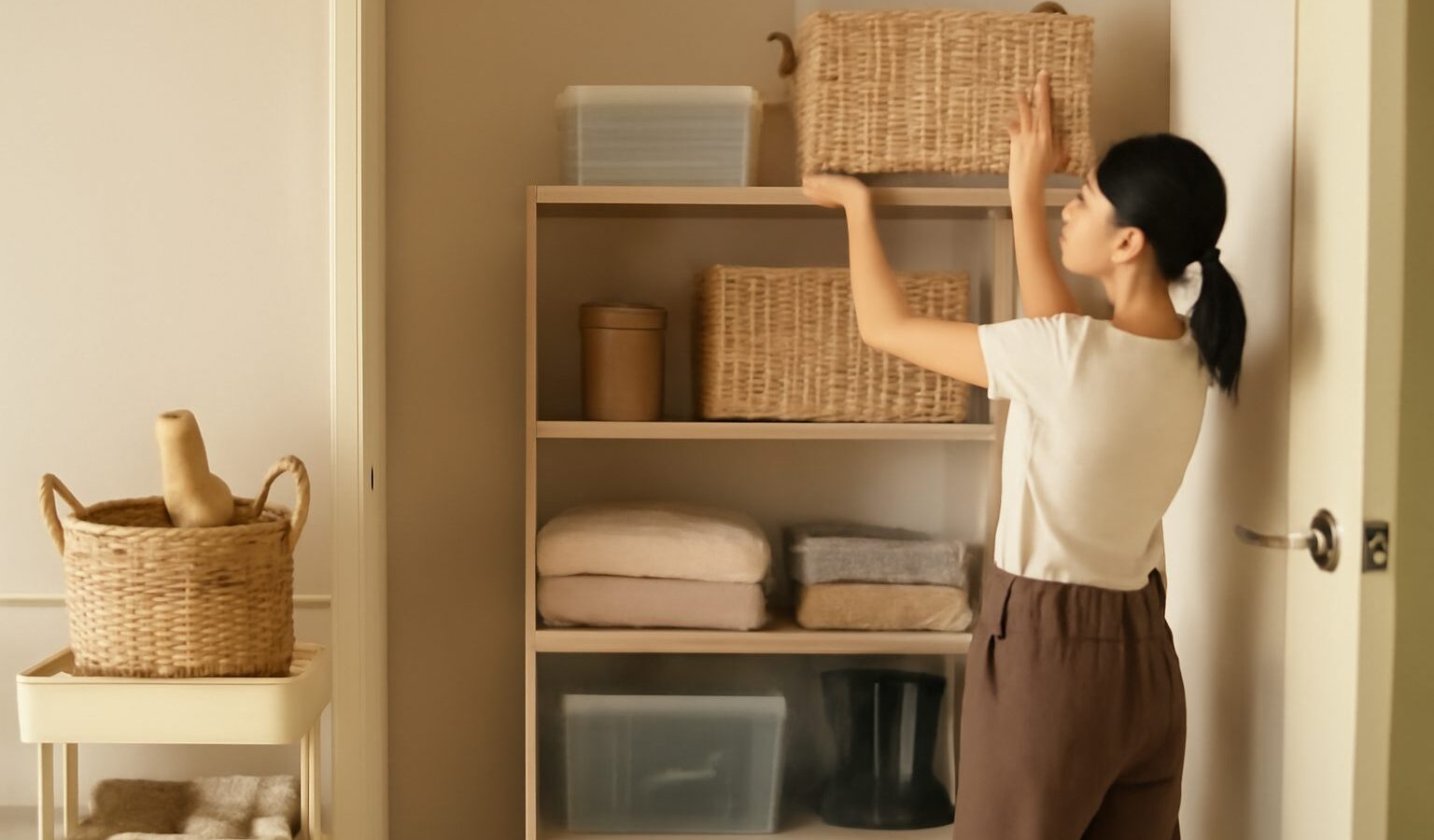
Working within the rules is easy once you shift to a freestanding mindset. Choose sturdy, freestanding shelving that sits against the wall without being fixed to it, and use a mix of open shelves for frequently used items and closed boxes for the rest. Clear or labelled boxes make a huge difference, because a storeroom you cannot see into quickly becomes a place where things are lost rather than stored.
Think in zones. Keep everyday items near the door at a comfortable height, and put rarely used things, such as seasonal decorations or luggage, higher up or further back. Heavy items belong low down so the stacks are stable and safe to lift. Vertical space is your friend in a small room, so tall shelving that reaches towards the ceiling makes the most of a compact footprint without cluttering the floor.
Here is a simple way to plan what goes where.
| Zone | Best for | Why |
|---|---|---|
| Near the door, waist height | Everyday items, tools, cleaning kit | Easy to reach without moving things |
| Lower shelves | Heavy boxes, appliances | Keeps stacks stable and lifting safe |
| Upper shelves | Seasonal and rarely used items | Frees prime space for daily use |
| Freestanding rack | Luggage, bulky odd shapes | Flexible and easy to reposition |
A few finishing touches keep things tidy. Keep a narrow walking path clear so you can actually reach the back, resist the urge to stack right up against the ventilation openings, and do a quick clear-out once or twice a year so the room does not silently fill with things you no longer need.
Keeping Damp and Pests Away
Singapore’s humidity is the storeroom’s biggest enemy, and a closed room with little airflow can turn damp without you noticing. The first defence is ventilation. Keep the shelter’s ventilation openings clear as required, open the door now and then to let air circulate, and avoid packing the room so tightly that air cannot move at all. Where the space allows, leave a small gap between boxes and the wall.
Moisture-control products help too. Silica gel packs, dehumidifying tubs and moisture absorbers placed among your boxes soak up excess humidity, and they are cheap and easy to replace. Store items dry in the first place, as putting away anything even slightly damp invites mould, and keep documents and fabrics in sealed containers rather than loose on open shelves. Avoid stacking cardboard boxes directly on the floor if you can, since a raised base keeps them clear of any moisture that settles low down.
Pests are the other concern, drawn by food traces, paper and dark, undisturbed corners. Never store food or anything with a food smell in the storeroom, as this is the quickest way to attract ants, cockroaches or worse. Keep the room clean, seal boxes properly, and check periodically for any signs of pests so you can act early. Reducing the amount of loose cardboard and paper also helps, as these are favourite nesting materials.
It also pays to review what you keep in there from time to time. Storerooms have a way of quietly filling with things we mean to deal with later, from empty appliance boxes kept for a warranty that has long expired to bags of items we no longer use. A short sort-out every few months, deciding what to keep, donate or throw, stops the room from becoming a dumping ground and keeps the useful space free for what actually matters. If you find you are running out of room despite your best efforts, that is a sign to declutter rather than to cram, since an overstuffed shelter is harder to keep dry, harder to search, and less able to serve its protective purpose.
With the rules respected, a sensible layout and a little humidity control, your storeroom becomes a genuinely useful part of the home rather than a black hole for clutter. You will store more, find things in seconds, and keep your belongings in good shape, all while the household shelter stays ready to do its important job.
Explore more
Using Self-Storage
Dealing With Humidity
Setting Up Your HDB Home
Reducing Waste at Home