
If your child’s spectacle prescription keeps climbing every year, someone at the optometrist or eye clinic may have mentioned ortho-k lenses for children. Orthokeratology, usually shortened to ortho-k, is one of several myopia control options available in Singapore. It is also the one parents ask the most questions about, because it involves a child sleeping in rigid contact lenses every night.
This guide focuses only on ortho-k: how the lenses work, which children tend to suit them, what daily life looks like, the hygiene rules that matter most, and what goes into the price. It is general information, not medical advice. Your child’s optometrist or ophthalmologist is the right person to decide whether ortho-k is suitable. For the bigger picture on short-sightedness, see our guide to managing your child’s myopia.
How Overnight Ortho-K Lenses Actually Work
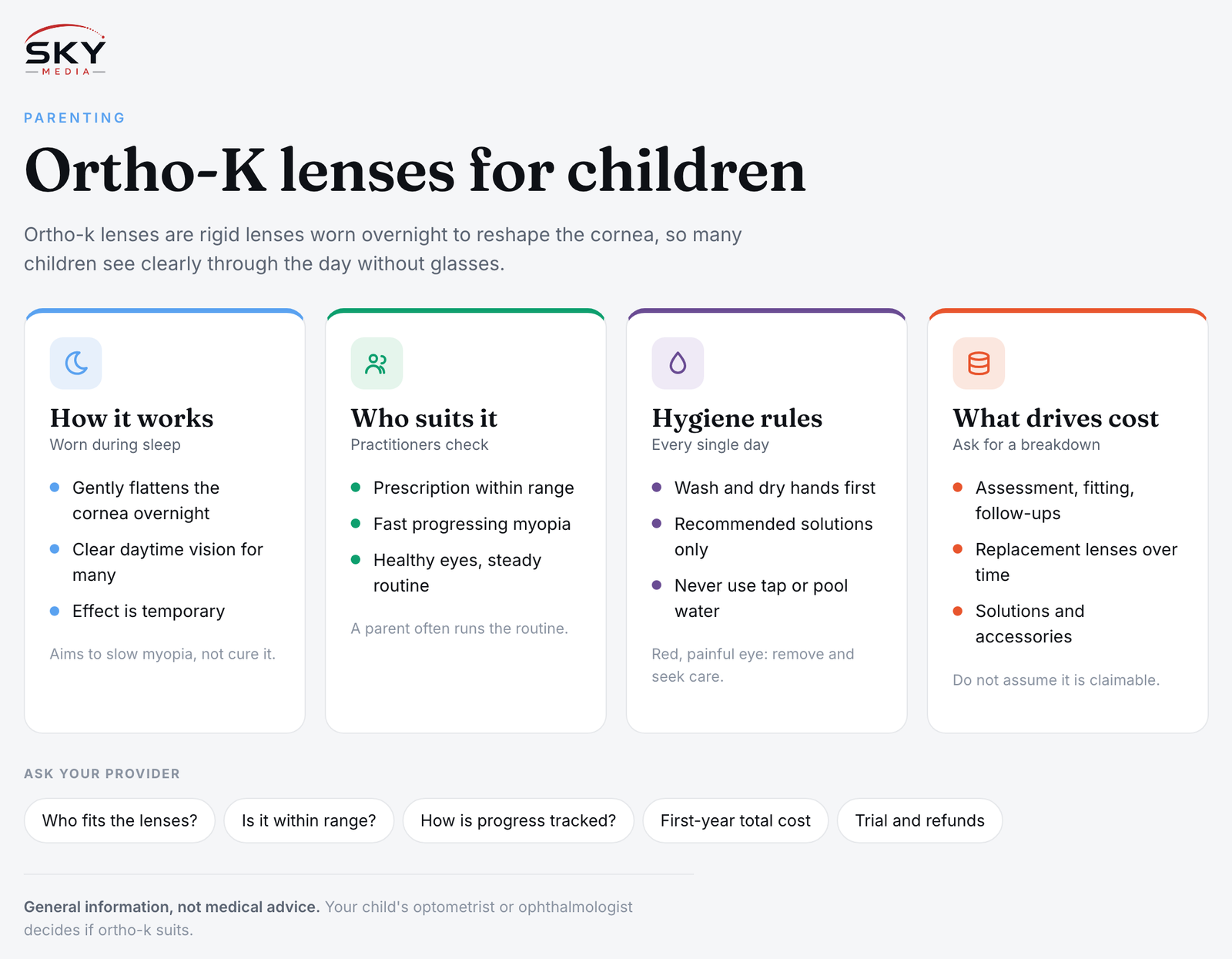
Ortho-k lenses are specially designed rigid gas-permeable lenses. Unlike normal soft contact lenses, which correct vision while they are in the eye, ortho-k lenses are worn only during sleep.
Overnight, the lens applies gentle, even pressure that temporarily flattens the central part of the cornea, the clear front surface of the eye. When your child removes the lenses in the morning, the reshaped cornea focuses light more clearly, so many children can see well through the school day without spectacles or daytime contact lenses.
A few points parents often miss:
- The effect is temporary. The cornea gradually returns to its original shape if the lenses are not worn. Stopping ortho-k means going back to spectacles.
- It is designed to slow progression, not cure myopia. Ortho-k is used in myopia control because research suggests it may slow how fast the eyeball lengthens in some children. Results vary from child to child, and your eye care practitioner will track whether it is working.
- Fitting is custom. The lenses are designed from detailed measurements of your child’s cornea, usually taken with a corneal topography scan. A poorly fitted lens will not shape the eye properly and can cause discomfort.
Which Children Tend to Suit Ortho-K
There is no single age at which ortho-k becomes appropriate. Eye care practitioners generally look at a combination of factors before suggesting it:
- Prescription range. Ortho-k works best within certain levels of short-sightedness and astigmatism. Very high prescriptions may not be fully corrected.
- Rate of progression. A child whose myopia is increasing quickly is often the reason families start looking at myopia control at all.
- Eye health. Children with frequent eye infections, significant allergies or dry eye may not be good candidates.
- Maturity and routine. This is the big one. Someone has to insert, remove and clean the lenses correctly every single day. For younger children, that someone is you.
Ask yourself honestly whether your household can sustain a strict nightly and morning routine for years, including during holidays, school camps and sleepovers.
Ortho-K Compared With Other Myopia Control Options
Ortho-k is not the only route. Your practitioner may suggest one of the following instead, or in combination. Which option suits a child depends on their eyes, age and lifestyle, so treat this table as a starting point for your conversation rather than a recommendation.
| Option | How it is used | Daytime vision aid needed? | Main things to weigh |
|---|---|---|---|
| Ortho-k lenses | Rigid lenses worn overnight only | Usually not | Strict hygiene, nightly routine, infection risk if care slips |
| Myopia control spectacle lenses | Special spectacle lenses worn during the day | Yes, the spectacles themselves | Simple to use, but must be worn consistently |
| Myopia control soft contact lenses | Soft lenses worn during the day | The lenses themselves | Daily handling by the child, suits older children |
| Low-dose atropine eye drops | Drops prescribed by a doctor, usually at night | Yes, spectacles still needed | Prescription only, side effects discussed with the doctor |
Whatever you choose, outdoor time and sensible screen habits are still part of the picture. The Health Promotion Board and HealthHub publish child eye health guidance that is worth reading alongside any treatment plan.
Daily Life With Ortho-K: The Routine and the Hygiene Rules
The most serious risk with any overnight contact lens is a corneal infection called microbial keratitis. It is uncommon, but it can harm vision, and poor lens hygiene raises the risk. This is why practitioners spend so much time on care instructions at the first fitting.
A typical routine looks something like this, though you should always follow the exact steps your practitioner gives you:
- Bedtime. Wash and dry hands thoroughly, check the lens for chips or cracks, then insert with the recommended solution.
- Morning. Remove the lenses as instructed, often after using lubricating drops.
- Cleaning. Clean and store the lenses using only the solutions recommended for rigid lenses. Replace the case regularly.
- Never use tap water. Water, including tap water and swimming pool water, can carry organisms that cause serious eye infections. Lenses and cases should not be rinsed with it.
Warning signs to act on straight away include a red eye, pain, light sensitivity, discharge or blurry vision that does not clear. Remove the lenses and contact your practitioner or seek urgent eye care. Do not wait to see if it settles by itself.
It also helps to keep a spare pair of spectacles at the current prescription. If a lens is lost, damaged or paused because of an eye irritation, your child still needs to see the whiteboard at school.
What Ortho-K Costs and What Drives the Price
Ortho-k is generally more expensive upfront than spectacles, and prices vary widely between practices, so we will not quote figures here. Instead, ask each provider for a written breakdown covering these items:
- Initial assessment. Eye examination, corneal scans and a check that your child’s eyes are healthy enough.
- Fitting and lens design. Some practices bundle the first pair of lenses with the fitting. Others charge separately.
- Follow-up visits. Expect several review visits in the first weeks, then regular check-ups after that. Ask how many are included.
- Replacement lenses. Rigid lenses do not last forever, and children’s prescriptions change. Ask how often lenses are typically replaced and what a replacement pair costs.
- Solutions and accessories. Cleaning solutions, cases and removal tools are an ongoing monthly expense.
- Lost or broken lens policy. Children lose things. Find out whether the practice offers any replacement arrangement.
Ortho-k is usually treated as an elective optical service, so do not assume it is claimable. Check directly with your health insurer or your employer’s HR on any outpatient or optical benefits before committing, and confirm in writing.
Questions to Ask Before You Commit
When you meet an optometrist or ophthalmologist about ortho-k for your child, these questions help you compare providers fairly:
- Who will do the fitting, and are they registered with the relevant professional board?
- Is my child’s prescription within the range ortho-k can reliably correct?
- How will you measure whether myopia progression is actually slowing?
- What is the follow-up schedule, and what happens if my child gets a red eye on a weekend?
- What is the total cost over the first year, and what are the recurring costs after that?
- Can we have a trial period, and what is refundable if my child cannot adjust?
Optometrists in Singapore are registered with the Optometrists and Opticians Board, and you can ask to see their registration. For complex eye conditions, your child may be referred to an ophthalmologist, either in a public hospital or a private clinic.
Is Ortho-K Right for Your Family?
Ortho-k suits families who are organised, can commit to the hygiene routine, and have a child whose prescription and eye health fall within the range their practitioner is comfortable treating. It is less suitable if mornings and bedtimes are chaotic, or if your child strongly resists having lenses put in.
Many families start with a thorough eye check, talk through all the myopia control options, and choose the one their child is most likely to stick with.
For other ways to plan your child’s education and related spending, see how Edusave accounts work and what they can pay for.
Frequently Asked Questions
At what age can my child start ortho-k lenses? There is no single age. Eye care practitioners look at prescription range, how fast myopia is progressing, eye health and, crucially, whether the child and family can sustain the daily routine. For younger children, a parent must handle the lenses. Ask your optometrist or ophthalmologist.
Can my child swim or shower while wearing ortho-k lenses? The lenses are worn only during sleep, so swimming and showering happen without them. Keep water away from the lenses and case, because tap water and pool water can carry organisms that cause serious eye infections. Follow your practitioner’s exact instructions.
What if my child stops ortho-k, will the myopia come back? The cornea gradually returns to its original shape when lenses are not worn, so your child will go back to spectacles. Ortho-k slows progression rather than curing myopia. If you want to pause or stop, discuss the plan with your practitioner first.
Can my child skip a night of ortho-k lenses? Skipping nights reduces the effect, so vision may be blurrier the next day. Keep a spare pair of spectacles at the current prescription. If a night is missed because of irritation, remove the lenses and speak to your practitioner rather than pushing through.
How long do ortho-k lenses last before replacement? Rigid lenses do not last forever, and children’s prescriptions change. The replacement interval depends on lens wear and your child’s eyes, so ask your practitioner how often they are typically replaced and what a replacement pair costs, including lost or broken lens arrangements.