
Otah, also spelled otak-otak, is a spiced fish cake wrapped in leaves and cooked until it sets into something soft, fragrant and slightly smoky. You have probably eaten it from a hawker stall or alongside nasi lemak. This otah recipe walks you through making it at home: building the rempah (spice paste), getting the texture right, wrapping it in leaves and cooking it either on a grill or in a steamer.
Otah is forgiving once you understand the three parts: a well-cooked paste, a fish mixture that binds, and a wrapper that holds everything together while it cooks.
The Two Main Styles of Otah
Before you start, decide which style you want. Both use similar ingredients, but the result is quite different.
- Grilled, thin otah. Usually wrapped in strips of coconut leaf or banana leaf, pinned with toothpicks, then grilled over charcoal. The parcels are flat and slim, so they cook fast and pick up char and smoke. This is the type often linked to Muar in Johor and sold by the stick.
- Steamed, thick otah. Usually a larger, softer custard-like block wrapped in banana leaf and steamed. Some versions are baked. The Nyonya-style versions often include more coconut milk and eggs, giving a silky texture.
If you have no grill, start with the steamed style. You can still finish the parcels in a hot pan or air fryer for a little smokiness.
Ingredients for the Rempah and Fish Mixture
This makes about 15 to 20 thin grilled parcels or 6 to 8 thicker steamed ones.
For the rempah
- 10 to 15 dried chillies, soaked in hot water and deseeded for less heat
- 2 to 3 fresh red chillies
- 8 to 10 shallots
- 3 to 4 cloves garlic
- 2 stalks lemongrass, white part only, sliced
- A thumb of galangal (lengkuas)
- A thumb of fresh turmeric, or 1 tsp turmeric powder
- 4 to 6 candlenuts (buah keras)
- 1 tsp toasted belacan (shrimp paste), optional but traditional
- 3 to 4 tbsp cooking oil
For the fish mixture
- About 500 g firm white fish fillet, such as Spanish mackerel (batang) or another mild, firm fish, skin and bones removed
- About 150 to 200 ml thick coconut milk
- 1 to 2 eggs
- 4 to 6 kaffir lime leaves, very finely shredded
- A small handful of daun kaduk (wild betel leaves) for the steamed style, optional
- 1 tsp sugar, salt to taste
- 1 tbsp cornflour or tapioca starch, to help it set
For wrapping
- Banana leaves, or young coconut leaves for the grilled style
- Toothpicks or short bamboo skewers
You can find banana leaves, galangal, turmeric and candlenuts at most wet markets and many supermarkets. If you shop at a wet market, our guide to making sayur lodeh at home uses many of the same aromatics, so it is worth buying a little extra.
Making the Spice Paste Properly
The rempah decides whether your otah tastes rich or raw. Take your time here.
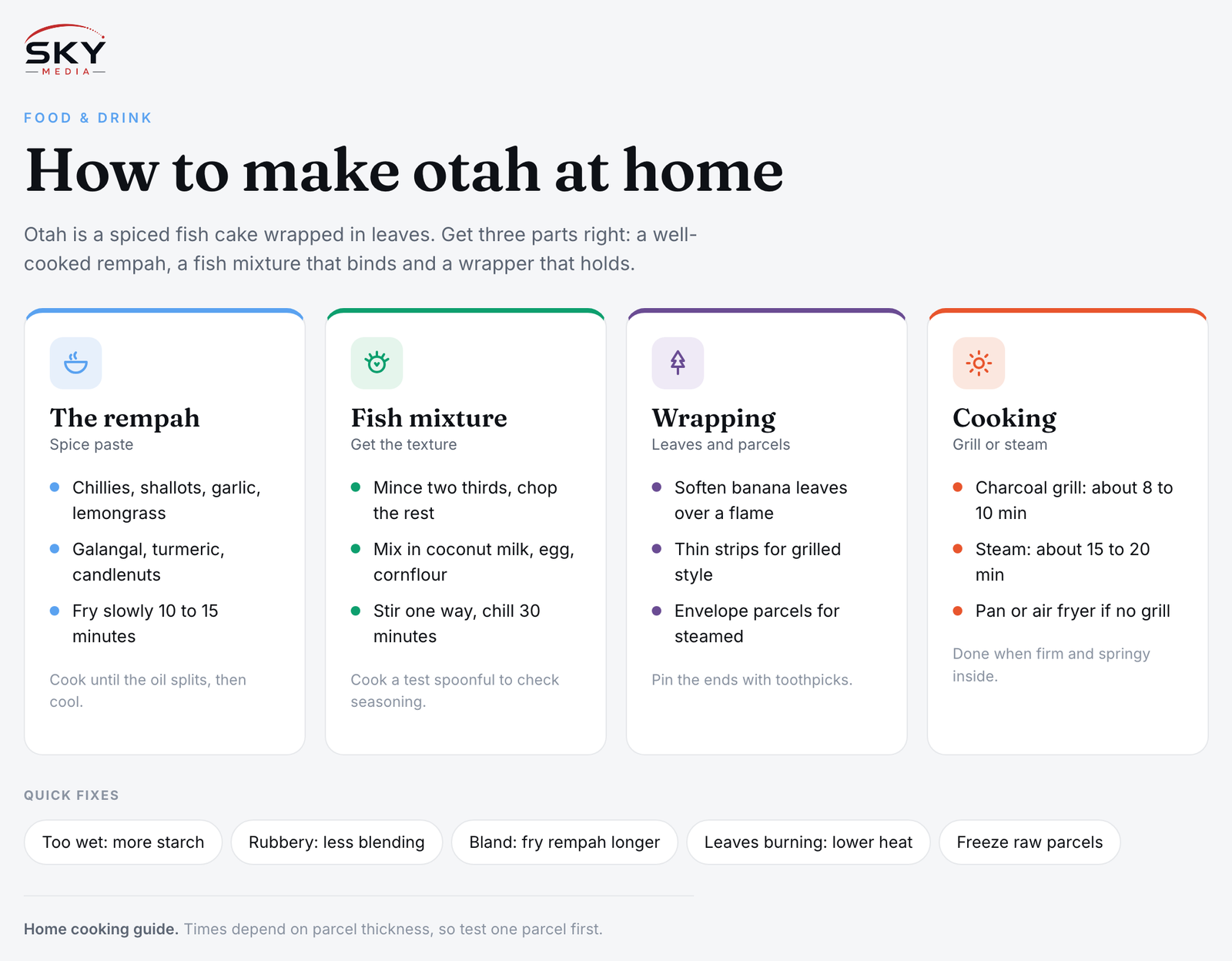
- Blend. Put all the rempah ingredients except the oil into a blender with a splash of water. Blend to a smooth paste. A slightly coarse paste is fine for grilled otah; aim for smoother for steamed.
- Fry slowly. Heat the oil in a wok over medium-low heat. Add the paste and stir often for 10 to 15 minutes.
- Look for “pecah minyak”. This Malay term means the oil splits from the paste. The paste darkens, smells sweet rather than sharp, and oil pools at the edges. That is when it is cooked.
- Cool completely. Spread it on a plate. Adding hot paste to raw fish and eggs will start cooking them unevenly.
The same technique is the base of many Malay and Peranakan dishes. If you want to practise on something larger, our guide to making beef rendang at home uses a similar long, slow fry.
Preparing the Fish Mixture
Texture is where homemade otah usually goes wrong. You want something that holds together but is still soft.
- Mince part, chop part. Pulse about two thirds of the fish in a food processor until it becomes a sticky paste. Chop the rest by hand into small pieces. This gives bite as well as bounce.
- Combine. Mix the fish paste with the cooled rempah, coconut milk, eggs, cornflour, sugar, salt and lime leaves. Stir firmly in one direction for a couple of minutes. This helps the mixture become springy.
- Fold in the chopped fish and the shredded daun kaduk if using.
- Test the seasoning. Cook a teaspoon in a small pan or microwave, taste, then adjust salt, sugar or chilli.
- Rest. Cover and chill for 30 minutes. A cold mixture is easier to wrap.
For a thin grilled style, keep the mixture slightly firmer by using less coconut milk. For a custardy steamed style, use more coconut milk and the second egg.
Wrapping, Then Grilling or Steaming
Preparing the leaves
Wipe banana leaves clean, then soften them by passing them briefly over a gas flame or dipping in hot water until glossy and pliable. This stops them tearing. Cut them into rectangles roughly 20 cm by 15 cm for steamed parcels, or narrower strips for grilled ones.
Wrapping
- Grilled style: Spread 2 tbsp of mixture in a thin line down the centre of a strip. Fold both long sides over to form a flat parcel, then pin each end with a toothpick.
- Steamed style: Place 3 to 4 tbsp in the centre. Fold the long sides over, then tuck the short ends under, like a small envelope. Secure with a toothpick, or line a small heatproof dish with leaf and fill it.
Cooking methods compared
| Method | How to do it | Rough time | Result |
|---|---|---|---|
| Charcoal grill | Medium heat, turning a few times | About 8 to 10 minutes for thin parcels | Smoky, slightly charred, firm |
| Steaming | Over rapidly boiling water, covered | About 15 to 20 minutes for thick parcels | Soft, moist, custard-like |
| Pan or griddle | Dry non-stick pan, medium heat, pressing lightly | About 8 to 12 minutes | Some char, good if you have no grill |
| Air fryer | Medium-high, turning halfway | About 10 to 12 minutes | Drier, lightly crisp leaf edges |
The otah is cooked when it feels firm and springy in the centre and no longer looks wet when you peek inside. Times depend on parcel thickness, so test one first.
Serving, Storing and Troubleshooting
Serve otah warm with plain rice, nasi lemak, or slices of bread, which is a popular simple breakfast. Leftovers keep in the fridge for a day or two in a covered container. You can also freeze raw wrapped parcels and grill or steam them from frozen, adding a few minutes.
Common problems and fixes:
- Too wet or falling apart: too much coconut milk, or not enough starch or stirring. Add a little more cornflour and chill the mixture longer.
- Rubbery: over-processed fish or overcooking. Keep some hand-chopped fish and pull the parcels off as soon as they set.
- Bland: under-fried rempah or too little salt. Always do a test piece.
- Leaves burning before the inside cooks: heat is too high, or parcels are too thick for grilling. Lower the heat or switch to steaming.
Once you have the rempah down, otah is a great dish for gatherings. It pairs well with other make-ahead dishes, such as those in our guide to hosting a popiah party at home.
Further reading: How to Make Ngoh Hiang at Home: Five-Spice Meat Rolls · How to Make Murukku at Home: A Step-by-Step Recipe · Otah: A Guide to the Grilled Favourite