
Pull into any petrol station here and you will see several nozzles, several prices and a lot of marketing. For many drivers, choosing between petrol grades Singapore stations sell comes down to habit: whatever the last owner used, or whatever the pump attendant suggested. Yet the right choice is usually simple once you understand what the numbers mean and what your car actually needs.
This guide explains RON ratings, the difference between regular and premium fuels, and how to decide whether paying more at the pump makes sense for your car.
What the RON Number Actually Means
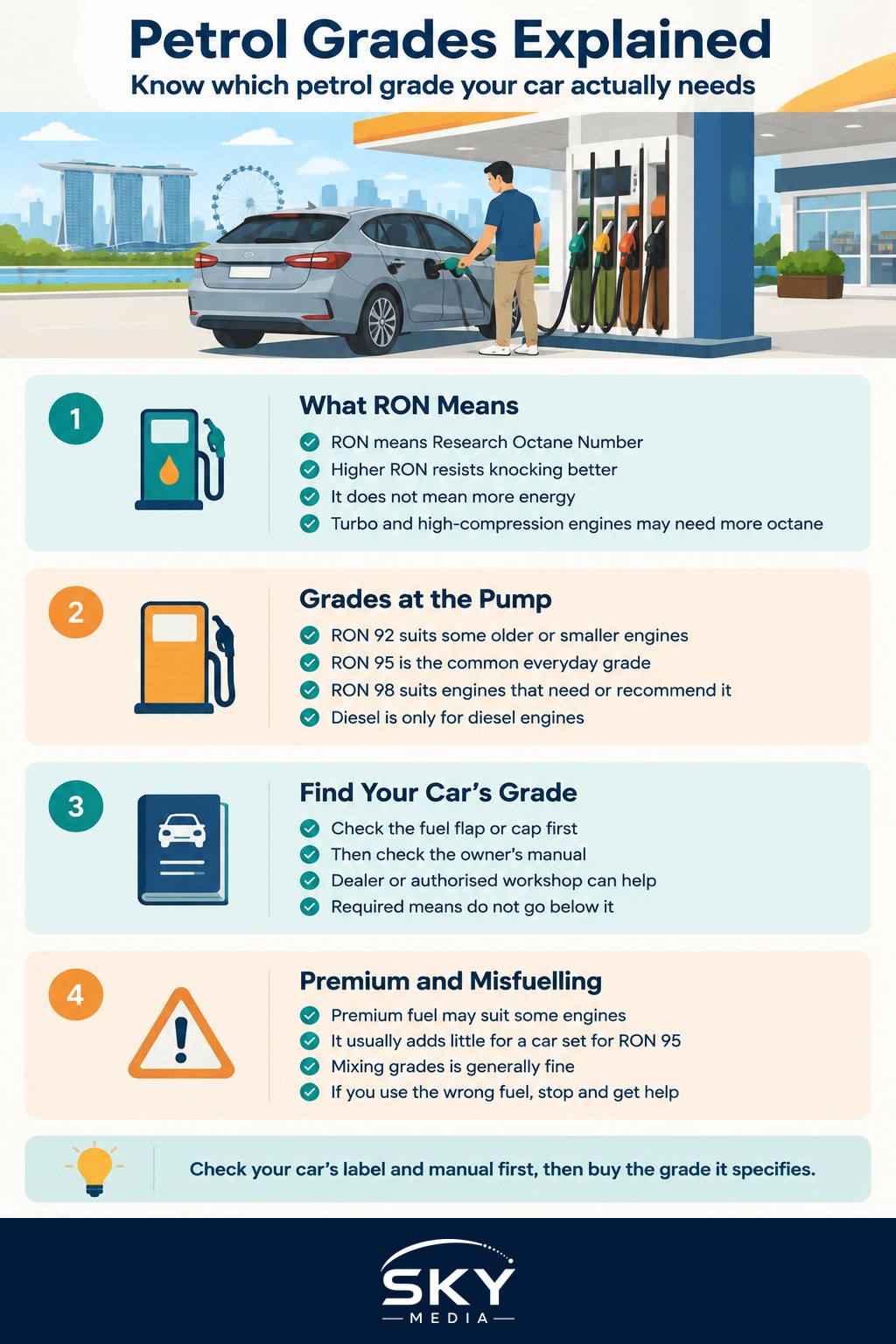
RON stands for Research Octane Number. It measures how well a petrol resists “knocking”, also called detonation or pinging. Knocking happens when the fuel and air mixture in a cylinder ignites too early or unevenly, instead of burning smoothly after the spark plug fires. Over time, heavy knocking can damage engine parts.
A higher RON means the fuel is more resistant to knocking. It does not mean the fuel contains more energy or will automatically make any car faster. That is the most common misunderstanding about petrol grades.
Engines with higher compression ratios or turbochargers squeeze the mixture harder and run hotter, so they are more prone to knocking. These engines are often designed to need a higher RON fuel. Many everyday engines are designed to run happily on a lower grade.
Modern cars have knock sensors that adjust ignition timing if they detect knocking. This protects the engine, but it can reduce power and efficiency if the fuel is lower than the engine was designed for.
The Grades You Will See at the Pump
In Singapore, petrol is commonly sold in these broad types, although not every brand or station offers every grade:
- RON 92: a lower-octane regular grade, suitable for some older or smaller engines whose maker allows it.
- RON 95: the standard grade that many mainstream cars are designed for.
- RON 98: a higher-octane grade for engines that require or recommend it.
- Premium or branded performance fuels: usually high-octane petrol with additional detergents or additive packages, marketed by each fuel brand under its own name.
Diesel is a completely different fuel for diesel engines and is never interchangeable with petrol. Prices differ between grades and brands and change often, so check the board at the station or the brands’ own channels for current prices.
Here is a quick summary:
| Grade | Typical use | Key point |
|---|---|---|
| RON 92 | Some older or small engines that permit it | Only use if your manual allows it |
| RON 95 | Most everyday petrol cars | Usually the default if your manual says 95 minimum |
| RON 98 | High-compression and many turbocharged engines | Use if your manual requires or recommends it |
| Premium branded fuel | Owners who want added detergents or the highest octane | Benefit depends on the engine; not essential for most cars |
| Diesel | Diesel engines only | Never put in a petrol car |
How to Find the Right Grade for Your Car
The answer is printed for you. Check, in this order:
- The fuel filler flap or cap. Many cars have a label stating the minimum octane, such as “RON 95 or higher”.
- The owner’s manual. Look in the fuel or specifications section. Pay attention to the wording.
- The dealer or authorised workshop, if the label and manual are missing, which can happen with older used cars.
The exact wording in the manual matters:
- “Required” or “minimum” means use at least that grade. Going below it risks knocking, lost performance and possible engine damage over time.
- “Recommended” means the engine can run on a lower grade but may deliver its rated power and efficiency only on the recommended one. Running a grade lower than recommended is usually safe, but you may notice a small drop in performance.
- A single figure with no qualifier usually means that is the grade the engine was set up for.
If your car is a parallel import, the manual may refer to octane standards from another market. Some markets quote octane using a different scale, so a figure that looks low may actually match a higher RON. When in doubt, ask a workshop familiar with that model.
Is Premium Petrol Worth It?
For a car designed for RON 95, switching to RON 98 or a premium fuel usually brings little or no measurable benefit in power or fuel economy. The engine’s computer is tuned for 95, and once knocking is not an issue, extra octane does not add energy. You will mostly be paying more for the same drive.
Premium fuel makes more sense when:
- Your manual requires RON 98 or higher. This is common with performance cars and many turbocharged engines. Using the right grade here is about protecting the engine and getting the power you paid for.
- Your manual recommends a higher grade and you value the full rated performance.
- You value the additive package. Branded premium fuels often include extra detergents meant to keep injectors and valves cleaner. Regular grades sold in Singapore also contain detergents, so the practical difference varies. If this matters to you, read what each brand says about its fuel and judge for yourself.
What premium fuel will not do is fix a poorly maintained engine. Regular servicing, correct engine oil and properly inflated tyres matter far more for efficiency and engine life. Our guide to understanding engine oil grades explains another number on your maintenance checklist.
Mixing Grades and Common Myths
- Mixing grades is fine. Topping up RON 98 on top of half a tank of RON 95 simply gives a blend somewhere in between. It will not harm a car that accepts both.
- Switching back and forth is fine for cars that accept both grades.
- Higher octane does not clean a dirty engine overnight. Additive benefits, where they exist, build over many tanks.
- “My car feels smoother on premium.” It might, for engines that benefit from higher octane. For others, the difference is often expectation. Track your fuel consumption over several tanks before deciding.
What to Do If You Use the Wrong Fuel
Mistakes happen, especially in a borrowed or rental car.
- Lower grade than required (for example 95 in a car that needs 98): Do not panic. Drive gently, avoid hard acceleration and heavy loads, and refill with the correct grade as soon as you can. Listen for knocking or pinging, and see a workshop if you hear it or see a warning light.
- Diesel in a petrol car, or petrol in a diesel car: Do not start the engine. If you have already started driving, stop safely and switch off. Contact your insurer’s roadside assistance or a tow service and have the tank drained. Running the engine on the wrong fuel can cause expensive damage.
Check your motor insurance policy wording to see whether misfuelling is covered and what roadside support you have.
Spending Smartly at the Pump
Once you know your car’s correct grade, stick with it and focus your savings elsewhere: compare fuel card and credit card discounts, drive smoothly and keep the car well maintained. Our guide to saving on petrol in Singapore covers those practical steps in more detail. If you are weighing up your next car altogether, EV vs petrol cars in Singapore compares running costs and lifestyle fit.
The simplest rule holds for most drivers: use the grade your manufacturer specifies, and do not pay extra for octane your engine cannot use.
Frequently Asked Questions
Does petrol go bad if the car sits unused for months? Yes, petrol can degrade over time, losing some of its ability to burn cleanly, especially if the tank is partly empty and exposed to humid air. A car left idle for a long period may start roughly or run poorly. If it has sat for many months, a workshop can advise whether to drain old fuel.
Do hybrid cars need premium petrol? Not by default. A hybrid still has a petrol engine with its own octane requirement, and that is stated in the manual or on the fuel flap. Many hybrids are designed for regular grades, but some models specify higher octane, so follow what the maker states.
Should I change the petrol grade as my car gets older? Generally no. Keep using the grade your manual specifies, since an older engine does not suddenly need a higher octane. Knock sensors adjust timing if fuel is not ideal. If you hear pinging, notice a drop in performance or see a warning light, have a workshop check the car rather than switching grade on a guess.
Should I use a higher petrol grade in my motorcycle? Use the grade your motorcycle’s manual or fuel cap label specifies. Many everyday bikes are designed for a standard grade, and a higher octane gives no extra power if the engine does not need it. Performance bikes with high compression may require a higher grade, so check the owner’s manual.
Why do petrol prices at the pump differ between stations? Prices vary because each fuel brand sets its own pump prices and runs different promotions, and station costs also differ. The headline price on the board may not be what you pay once card discounts or loyalty rewards apply. Compare the net price per litre after your card benefits.
Further reading: Should You Use Petrol Additives in Singapore?