

When a parent takes several medicines a day, the hardest part is often not the medicine itself but keeping track of it. Was the morning tablet taken? Is the evening one still in the strip? A well set up pill box for elderly parents, paired with a simple daily routine, takes the guesswork out of these questions for both your parent and the rest of the family.
This guide focuses on the practical side: choosing an organiser, filling it correctly, building habits around it and noticing problems early. It is general information, not medical advice. Your parent’s doctor and pharmacist remain the authority on what to take, when and how.
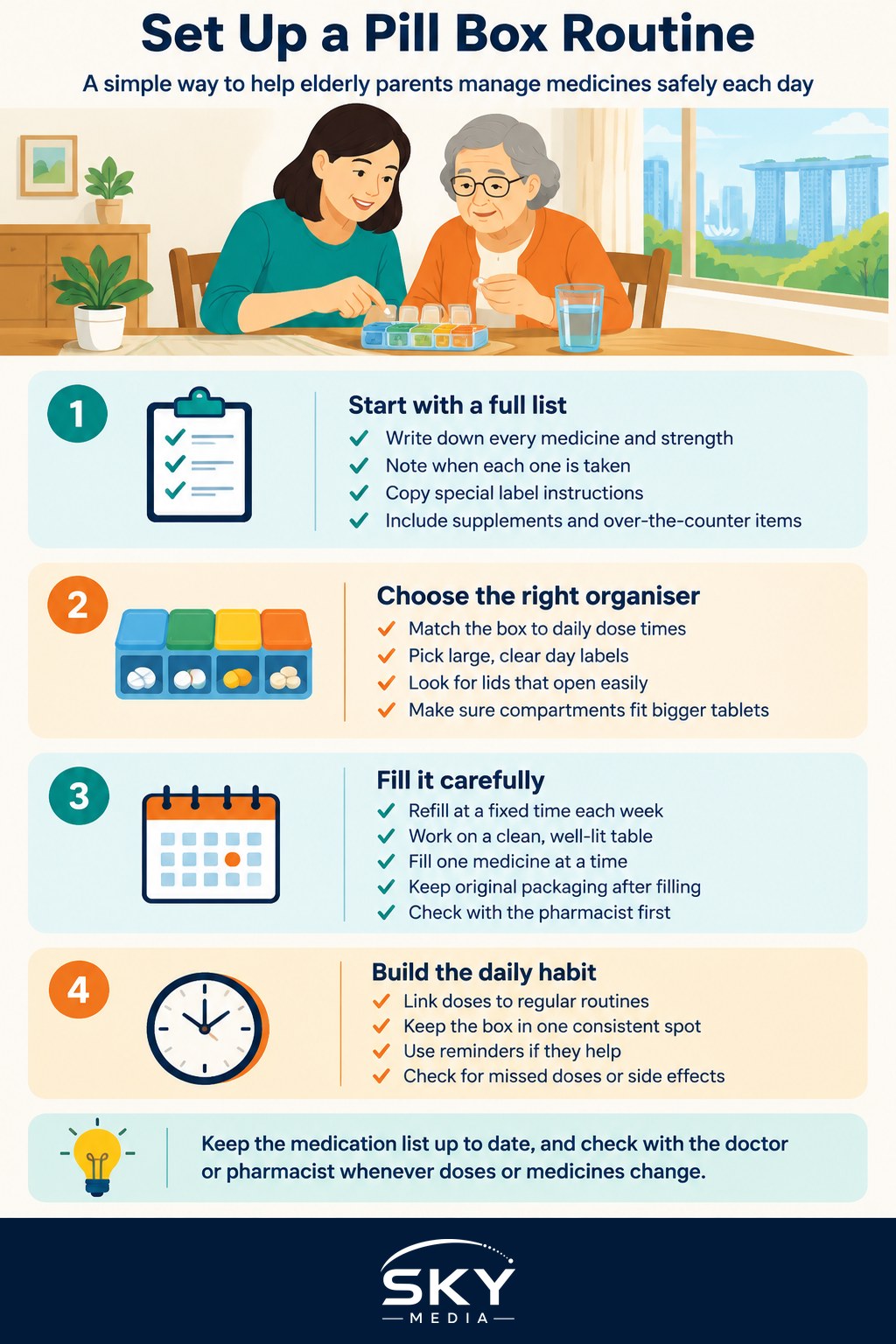
Start With an Accurate Medication List
Before you buy a pill box, write down exactly what your parent takes. Many families discover at this step that nobody has the full picture.
For each item, note:
- The medicine name and strength, exactly as printed on the pharmacy label.
- When it is taken, such as morning, after lunch, evening or bedtime.
- Special instructions on the label, like “take with food”, “before meals” or “do not crush”.
- Who prescribed it, whether a polyclinic, a hospital specialist clinic or a GP.
- Supplements and over-the-counter products, which are easy to forget but still matter.
If your parent sees doctors at more than one clinic, bring the complete list, or the medicines themselves in a bag, to the next appointment and ask the pharmacist to review it. Pharmacists at polyclinics and hospitals can confirm the timings and flag anything that should not go into an organiser. You can also check the medication records available on HealthHub, Singapore’s national health portal and app, though always treat the pharmacy label as the instruction to follow.
Choosing the Right Pill Box
Organisers come in many shapes. The right one depends on how many times a day your parent takes medicine and how well they can see and handle small lids.
| Pill box type | Best for | Watch out for |
|---|---|---|
| 7-day single row | One dose time a day | Not enough slots if doses are split across the day |
| 7-day with 2 to 4 rows (morning, noon, evening, bedtime) | Parents with several dose times | Small lids can be hard for arthritic fingers |
| Detachable daily strips | Parents who go out or stay with siblings on some days | Strips can be misplaced |
| Monthly or 28-day organiser | Very stable routines with few changes | Harder to update when the doctor changes a medicine |
| Alarm or locking dispenser | Parents with memory concerns | Costs more and needs batteries or charging |
Practical features worth looking for:
- Large, clear day labels, ideally in a language your parent reads comfortably. Some organisers come with Chinese or bilingual labels.
- Colour coded rows for different times of day.
- Lids that open easily but snap shut firmly, so tablets do not spill in a handbag.
- Compartments large enough for the biggest tablet or capsule on the list.
How to Fill the Pill Box Safely
Filling is where most mistakes happen, so give it your full attention.
- Set a fixed refill day and time, such as Sunday evening, when the house is quiet.
- Wash and dry your hands, and work on a clean, well-lit table.
- Lay out the medication list next to the organiser and go through it one medicine at a time, not one day at a time. Place each medicine into every slot it belongs in before moving to the next.
- Keep the original packaging after filling. Labels hold the dosage instructions and expiry dates you may need later.
- Check with the pharmacist first about any medicine that is sensitive to air or moisture, comes in special packaging, or should not be removed from its blister strip early. Some medicines, such as certain dissolving tablets, are meant to stay in their packaging until use.
- Do a final count. Each slot should match the list. A quick photo of the filled box helps if questions come up midweek.
Never cut, crush or split tablets to fit a slot unless the doctor or pharmacist has told you it is safe for that particular medicine.
Building the Daily Routine Around the Box
A pill box only works if it becomes part of daily life. Tie each dose to something your parent already does every day.
- Anchor doses to habits, such as breakfast, the afternoon news or brushing teeth at night.
- Keep the box in a consistent spot where it is seen, like the dining table, but out of reach of grandchildren and away from heat and humidity. Bathrooms are usually too damp.
- Use reminders if helpful. A phone alarm labelled with the dose time, or a large wall clock with notes, can prompt your parent without nagging. If your parent is learning a smartphone, our guide on helping elderly parents with tech has tips for setting simple alarms.
- Keep water and a cup nearby, so taking the medicine is easy.
If a helper assists your parent, walk through the routine together. Show which row is which and explain that the box is filled only by the family member responsible. For more on that arrangement, see our guide to hiring a helper to care for elderly parents.
Spotting Missed Doses and Problems Early
The visual nature of a pill box is its biggest strength. A quick look tells you whether doses were taken.
- Check the box daily, or ask your parent to send a photo if you live apart.
- If you find a missed dose, do not simply give two doses later. Check the medicine’s leaflet or call the pharmacist or clinic for advice on what to do.
- Notice patterns. If the lunchtime slot is often full, the timing may not suit your parent’s day. Ask the doctor whether the schedule can be simplified.
- Watch for side effects or changes in alertness, appetite, balance or mood, and report them to the doctor rather than adjusting medicines yourself.
Long-distance caregivers can still oversee the routine with video calls and a shared checklist. Our guide to long-distance caregiving for elderly parents covers more ways to stay involved from afar.
Handling Changes, Refills and Travel
Medication lists change, and the routine needs to keep up.
- When a doctor changes a dose or adds a medicine, update the written list first, then empty and refill the affected slots. Discard old instructions so nobody follows outdated ones.
- Track refill dates on a calendar so supplies do not run out over public holidays.
- For travel or overnight stays, use detachable daily strips and pack the original labelled packaging too, which is helpful at checkpoints and if you need a pharmacy overseas.
- Dispose of unused or expired medicines properly. Ask your pharmacy about safe disposal rather than throwing them in the rubbish chute.
A Small Habit That Brings Peace of Mind
A pill box routine is one of the simplest tools in a caregiver’s kit. With an accurate list, the right organiser, a careful weekly refill and daily checks, you reduce the risk of missed or doubled doses and give your parent more independence. Keep the doctor and pharmacist in the loop whenever something changes, and the routine will serve your family well for years.
Frequently Asked Questions
How do I know if my parent needs an alarm or locking pill dispenser? Look at how reliably they follow the routine. If your parent often forgets whether a dose was taken, or has been diagnosed with memory problems, an alarm or locking dispenser can help. Ask the doctor or pharmacist whether it suits their medicines and condition.
What should I do if my parent keeps refusing to take their medicine? Stay calm and try to find out why, since it may be side effects, difficulty swallowing or simply not understanding the need. Do not hide medicine in food unless a pharmacist says it is safe. Tell the doctor, who may adjust the medicine or timing.
Can I mix supplements and traditional Chinese medicine into the same pill box? It is better not to without checking. Some supplements and traditional remedies can interact with prescribed medicines or need different timing. Show the complete list, including products from the medical hall, to the pharmacist or doctor before deciding what goes into the organiser.
What if my parent lives alone and cannot fill the pill box by themselves? A family member can fill it weekly and check it by photo or video call, or a helper can supervise if one is employed. Pharmacies and clinics may also offer packing help, so ask your parent’s clinic what support is available.
How long can tablets safely stay inside an open pill box compartment? This depends on the medicine, so there is no single answer. Humidity and heat can affect some tablets, which is why many families fill only one week at a time. Ask the pharmacist which of your parent’s medicines should stay in their original packaging.
Official sources: HealthHub
Further reading: What to Do When an Elderly Parent Wanders From Home