

Weekly planning is the quiet habit that separates a week you steer from a week that drags you around by the collar. It does not need a fancy app or an hour of your Sunday. It needs fifteen honest minutes and a willingness to decide, in advance, what actually matters. This guide shows you a light, realistic way to plan your week so that Monday feels less like an ambush and more like a road you already mapped.
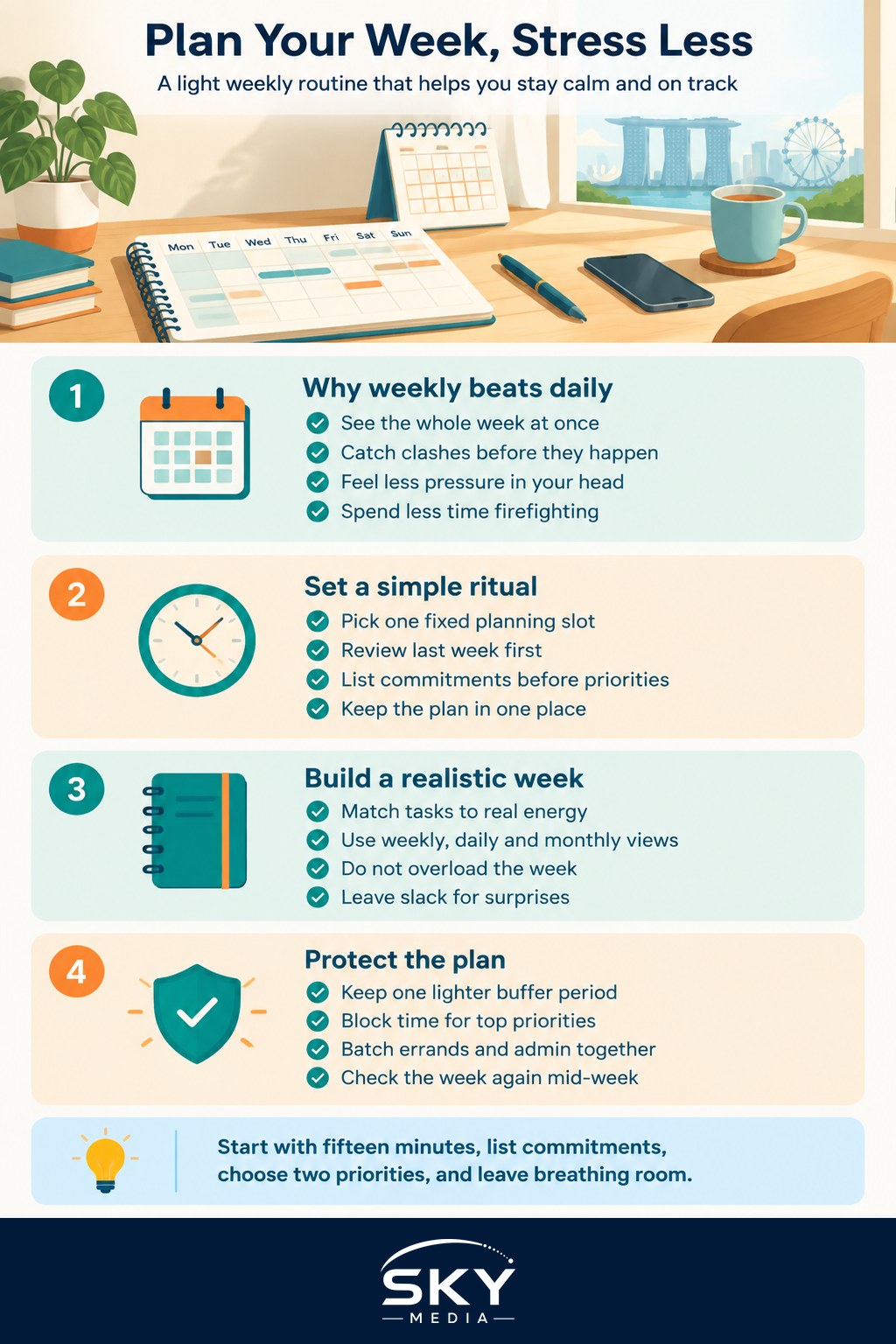
Why Weekly Planning Beats Daily Firefighting
When you only plan day by day, every morning starts with the same scramble: what is urgent, what did I forget, what is due today. You spend your freshest hours reacting instead of doing. By Thursday the small things you kept postponing have piled into a wall.
A weekly view fixes this because a week is the natural unit of real life. Deadlines, family duties, rest days and social plans all move on a weekly rhythm, so you can see the whole picture at once. You spot the packed Wednesday before it arrives, notice that you have booked three evenings out in a row, and move things while moving them is still easy.
Planning ahead also lowers the background hum of stress. A surprising amount of daily anxiety is just your brain trying to hold everything in memory at the same time. Write the week down and you hand that load to paper or a screen, freeing your mind to focus on the task in front of you rather than the ten behind it.
Set Aside a Weekly Planning Ritual
Pick one fixed slot and protect it. Sunday evening works for many people, but a quiet Friday afternoon or a Monday commute on the MRT can work just as well. The point is consistency, not the exact hour. When it always happens at the same time, you stop relying on motivation to do it.
A simple fifteen-minute routine:
- Look back first. What went well last week, what got dropped, and what carries over? This quick review stops old tasks from vanishing.
- List the real commitments. Deadlines, appointments, meetings, family events. Get the fixed points down before anything else.
- Choose two or three priorities. Not twenty. Ask what would make the week a success even if little else got done.
- Slot the big items into days. Give each priority a home so it is not competing with everything at once.
- Leave gaps on purpose. Empty space is not wasted; it is where real life lands.
Keep it in one place you actually check, whether that is a paper diary, a calendar app, or the notes app you already open twenty times a day. A perfect system you never look at loses to a scruffy one you do.
What a Realistic Week Actually Looks Like
The most common planning mistake is optimism. We plan for the week we wish we had, with no delays, no packed trains, no tired evenings. Then reality arrives and the plan collapses, which feels worse than not planning at all.
A realistic plan builds in the friction of ordinary Singapore life: a long commute, unpredictable overtime, energy that dips after dinner. It matches the task to the time you will genuinely have, not the time you fantasise about.
| Planning horizon | Best for | Watch out for |
|---|---|---|
| Monthly view | Big deadlines, trips, bills, appointments | Too far off to feel real; revisit weekly |
| Weekly view | Setting priorities and shaping your days | Overloading; leave slack for surprises |
| Daily list | Executing what the week already decided | Turning into a dumping ground of everything |
| Hour by hour | High-pressure or deadline days only | Exhausting and brittle if used every day |
Notice how the layers work together. The month tells you what is coming, the week decides what matters, and the day simply carries out a decision you already made. When those three line up, you stop rethinking the same choices over and over.
Protect Your Plan When Life Interrupts
No week goes exactly as planned, and a good plan expects that. The goal is not a perfect week but a flexible one that bends without breaking.
- Keep a buffer. Leave at least one lighter half-day with nothing important booked. That is where spillover and emergencies go.
- Protect one or two blocks. Mark your most important work time as unavailable, the same way you would a meeting, so it does not quietly get eaten by other people’s requests.
- Batch the small stuff. Group errands, replies and admin into one slot rather than letting them interrupt all day.
- Do a mid-week glance. A two-minute check on Wednesday lets you rebalance before Friday panic sets in.
When something does blow up your plan, resist the urge to abandon the whole thing. Move the affected item, protect your top priority, and let the smaller tasks slide to the buffer. A week that is 70 per cent on track is a win, not a failure.
Keep the System Light
The plans that last are the ones that are almost effortless to maintain. If your routine takes longer to run than the time it saves, you will quietly drop it within a fortnight.
So resist the temptation to over-engineer. You do not need colour-coded tags, five apps, or a productivity philosophy. You need to know what matters this week and roughly when you will do it. Everything beyond that is decoration.
Give yourself permission to adjust the system as you go. Maybe fifteen minutes is too long and five will do. Maybe you plan better on paper than on screen. The best weekly planning routine is the boring one you still keep doing three months from now, not the elaborate one you abandon after a fortnight.
Start this week. Take fifteen minutes, list your commitments, pick two priorities, and leave some breathing room. You will not get it perfect, and that is fine. A slightly planned week beats a completely unplanned one every single time, and the calm it buys you compounds.
Explore more
Weekly planning works best alongside a couple of supporting habits. Once you have your week mapped, use time blocking your week to give each priority a real slot, lean on how to prioritise your tasks when everything feels urgent, and read how to say no without guilt so late requests do not quietly wreck the plan you worked to build.
Related across Sky Media: Healthy Meal Planning for the Week · Meal Planning a Week of Home-Cooked Meals in Singapore
Frequently Asked Questions
What day is best for weekly planning? Pick whichever slot you can keep consistently. Sunday evening suits many people, but a Friday afternoon or Monday morning commute works just as well. Consider when you have the clearest head and the fewest interruptions, then treat it like any other regular appointment.
Should I plan my week on paper or digitally? Choose the format you will actually check every day. Paper gives a clear overview and fewer notifications, while a calendar app makes rescheduling, reminders and sharing with family easier. Some people combine both, planning on paper and putting fixed appointments into a phone calendar.
How do I plan a week around family and kids? Start with the fixed family points such as school runs, activities and meals, then fit work and personal priorities around them. A shared calendar or a weekly chat helps everyone see what is coming. Leave more slack than you think you need, since children’s plans change quickly.
How do I plan a week when my work schedule changes constantly? Plan around anchors instead of a fixed routine. Note your confirmed shifts or deadlines first, then choose two priorities and place them in whatever gaps appear. Review briefly each morning and be ready to move items, since a flexible plan suits unpredictable work better than a rigid one.
What if I never stick to the plan I make? Your plan is probably too full. Cut it to two or three priorities, add buffer time and make each task smaller. Missing items is data about what is realistic, not a verdict on you, so use the weekly review to adjust the next plan to match your real capacity.
Further reading: How to Design Your Ideal Week