

For many polytechnic students, the internship is the first time a grade depends on how you behave at a real workplace, not just how you do in tests. That can feel unsettling. Who decides your grade? Does your company supervisor matter more than your lecturer? What happens if things go badly? Understanding poly internship grading before you start helps you focus on the right things from day one.
Each polytechnic and each diploma sets its own rules, and these can change between cohorts. Treat this guide as a general picture of how internships are commonly assessed, then check your module handbook, internship portal or briefing slides for the exact components and weightings for your course.
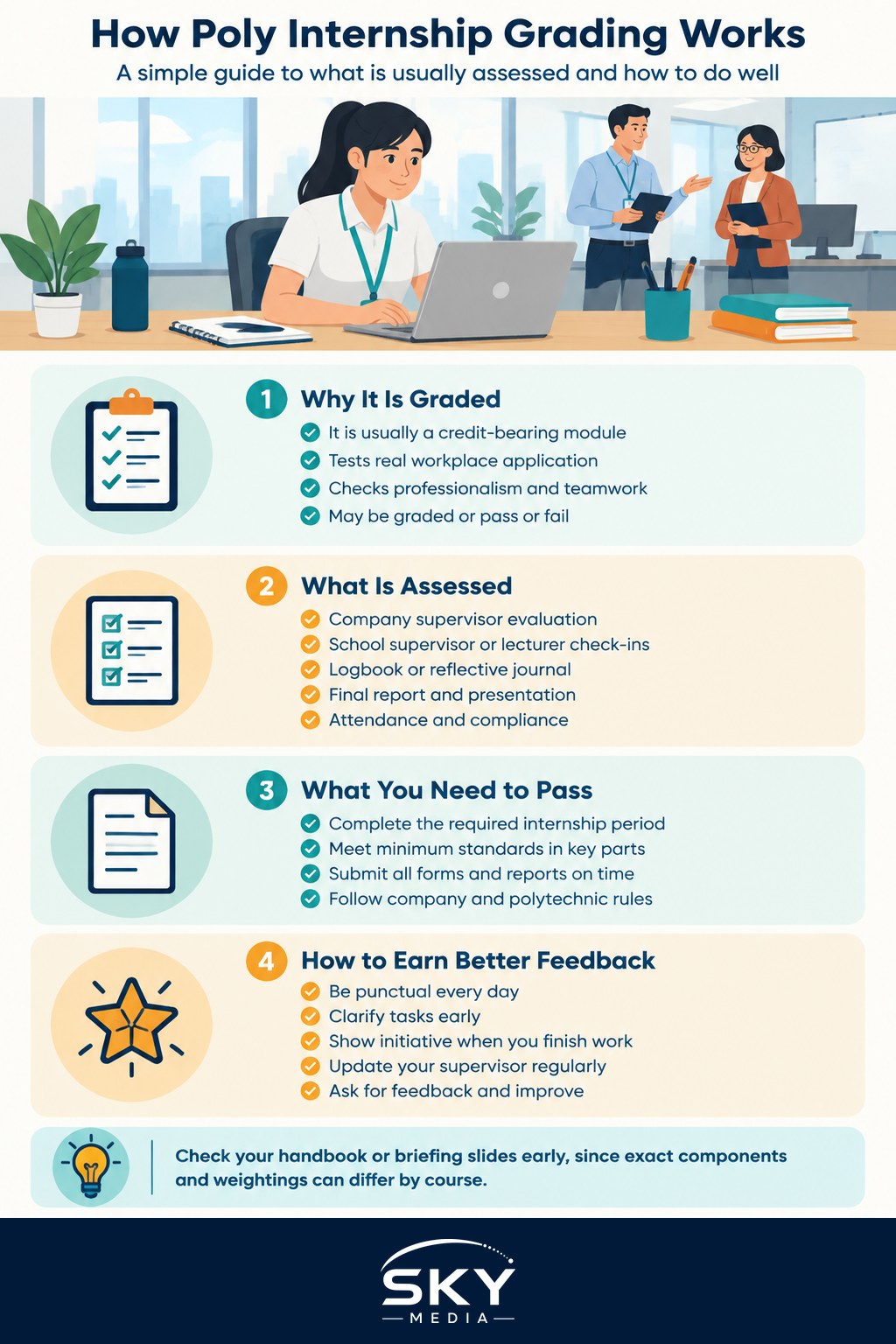
Why Your Internship Is Graded at All
In most diplomas, the internship is a credit-bearing module, just like your classroom modules. It is designed to check that you can apply what you learned in school to real work, and that you show professional behaviour such as reliability, communication and teamwork.
Depending on your course, the internship may be:
- Graded, contributing a letter grade to your GPA, or
- Pass or fail, where you must meet requirements to pass but it does not affect your GPA in the same way.
Your polytechnic will tell you which applies. This matters because a graded internship can lift or lower your overall results, which may affect university applications or scholarships.
The Usual Components of Poly Internship Grading
While details differ, most internship assessments combine several of these parts.
Company supervisor evaluation. Your workplace supervisor rates you on areas such as work quality, initiative, attendance, punctuality, attitude, communication and teamwork. This is often one of the largest parts of the grade, because they see your work every day.
School supervisor or lecturer assessment. A lecturer is usually assigned to monitor you. They may visit the workplace or hold online check-ins, speak to your company supervisor, and review your progress.
Logbook or reflective journal. Many courses ask you to record your tasks, learning points and reflections weekly. Some are checked during the internship, not only at the end.
Internship report. A written report describing the organisation, your role, projects you worked on and what you learned. Pay attention to any confidentiality limits set by your company.
Presentation or viva. Some courses end with a presentation to lecturers, sometimes with the company supervisor present, where you explain your work and answer questions.
Attendance and compliance. Completing the required internship period, following company rules and submitting forms on time is often a basic requirement to pass.
How the Pieces Usually Fit Together
| Component | Who assesses it | What they usually look for |
|---|---|---|
| Workplace performance | Company supervisor | Quality of work, attitude, reliability, teamwork |
| Progress check-ins | School supervisor | Learning progress, issues raised early, professionalism |
| Logbook or journal | School supervisor | Regular entries, honest reflection, link to course skills |
| Final report | School supervisor or panel | Clear structure, depth of learning, good writing |
| Presentation | Lecturers or panel | Clear explanation, confidence, ability to answer questions |
The exact weightings and assessors vary. Some courses use a rubric with descriptors for each grade level, so ask for a copy early and read it carefully.
What It Usually Takes to Pass
Passing requirements differ by polytechnic and course, but commonly include:
- Completing the required number of weeks or days, with absences properly covered by medical certificates or approved leave.
- Meeting a minimum standard in key components, such as the supervisor evaluation and the report.
- Submitting all required documents, such as logbooks, reports and feedback forms, by the deadlines.
- Following the code of conduct of both the polytechnic and the company.
Missing deadlines, unexplained absences or serious misconduct can lead to a fail, even if your work was good. If you fall ill or face a family emergency, inform both your company supervisor and school supervisor quickly and follow the official process.
How to Earn Strong Supervisor Feedback
Since your company supervisor often has a big say, small habits make a real difference:
- Be on time, every time. Punctuality is one of the easiest marks to secure and one of the easiest to lose.
- Clarify tasks. Repeat back instructions and ask questions early rather than guessing.
- Show initiative. When you finish a task, ask what else you can help with.
- Update your supervisor. A short end-of-week summary of what you did shows organisation and helps them remember your work when they fill in the evaluation.
- Take feedback well. Thank them, apply it, and show improvement over the weeks.
- Ask for a mid-point review. If your company is open to it, a short check-in halfway through lets you fix weaknesses before the final evaluation.
For more ideas on getting value beyond the grade, read our guide on making the most of your internship.
Writing the Logbook and Report Well
Students often lose marks on written work simply because they leave it too late.
- Write logbook entries every week, while details are fresh. Note tasks, tools used, problems and what you learned.
- Link your work to course skills. Show how the internship connects to modules you have studied.
- Reflect honestly. Lecturers want to see learning, including mistakes and how you handled them.
- Respect confidentiality. Check with your supervisor before including company data, screenshots or client names.
- Proofread. Clear structure and careful language make a better impression.
When Things Go Wrong During the Internship
Not every placement goes smoothly. You may be given too little work, unclear instructions, or tasks unrelated to your course. In more serious cases, there may be safety issues or unfair treatment.
Do not wait until the final week. Speak to your school supervisor early and keep a record of what happened. Polytechnics have processes to help, which may include talking to the company or, in some cases, arranging a change of placement. Raising concerns early protects both your wellbeing and your grade.
For background on the wider range of work-based learning options, see our guide to internships and traineeships in Singapore, and if you are still choosing a course, a guide to polytechnics in Singapore explains how diplomas are structured.
An internship grade rewards consistency more than brilliance. Turn up reliably, communicate clearly, keep your records up to date and ask for help early, and you give yourself the best chance of a strong result.
Further reading: How to Do Well in Your Final Year Project at Poly or University