

For many polytechnic students, the cumulative GPA on their diploma is the number that feels like it decides everything. It does matter a lot. Your poly GPA for university applications is usually the main academic measure that local universities use to compare diploma holders. But it is not the only factor, and what counts as a “good” GPA depends heavily on which course you are aiming for.
This guide explains how diploma GPA connects to local university options in Singapore, what else universities look at, and how to plan if your GPA is higher or lower than you hoped. It complements our guides on choosing a poly course; here the focus is on what happens after your diploma.
How Universities Use Your Poly GPA
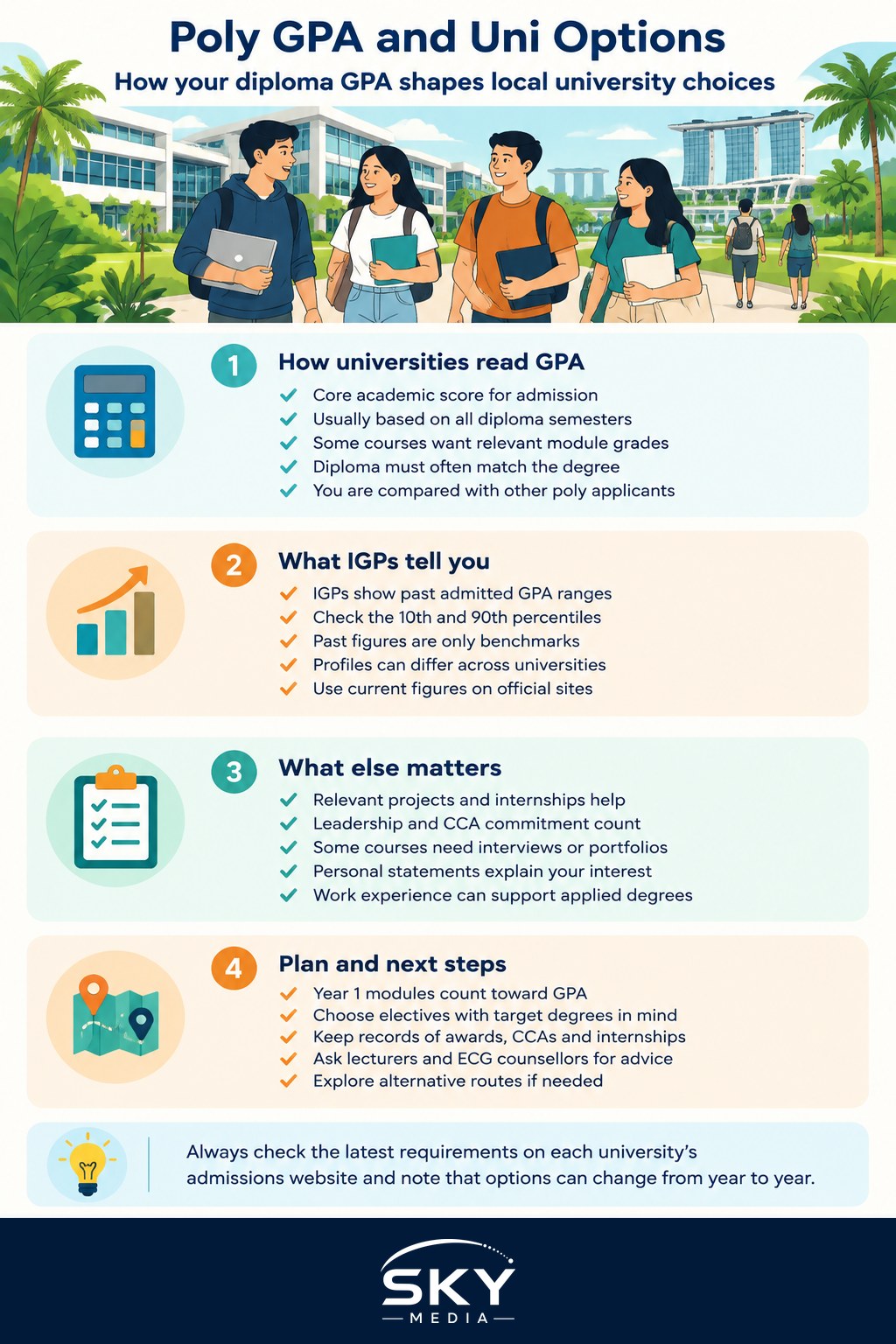
Singapore’s autonomous universities (the publicly funded local universities such as NUS, NTU, SMU, SUTD, SIT and SUSS) admit polytechnic graduates through their own processes. Each university and each course sets its own criteria, but in general:
- Your cumulative GPA is the core academic score. It is usually computed on a 4.0 scale across all semesters of your diploma.
- Some courses also look at specific module grades that are relevant, such as mathematics for engineering or computing.
- Your diploma must often be relevant to the degree, or you may need to meet extra subject prerequisites. Some courses accept any diploma, others accept only related ones.
- Applications are compared against other poly applicants, not against A-level students directly.
Because courses compete for a limited number of places, the GPA you need is not a fixed pass mark. It changes year to year depending on demand.
Reading Indicative Grade Profiles
Universities publish indicative grade profiles (IGPs), which show the GPA range of polytechnic applicants who were offered places in the previous intake. These are useful benchmarks but they are not guarantees.
Tips for reading them:
- Look at the 10th percentile and the 90th percentile. If your GPA is near the lower end, you are in competition; if above the higher end, you are in a strong position for that course.
- Check the year. IGPs reflect the past cycle and can move up or down.
- Note when a course shows no figure, which can mean too few poly applicants were admitted to publish one.
- Compare across universities. The same subject area can have quite different profiles at different institutions.
Always use the current figures on each university’s admissions website, as they are updated every year.
What GPA Range Usually Means for Your Options
The table below is a general way to think about your position. It is not an official classification and actual outcomes depend on the course, year and your full application.
| Your GPA position | What it often means | Sensible next steps |
|---|---|---|
| Near the top of the scale | Competitive for most courses, including popular ones | Apply widely to first choices, prepare strong interview and portfolio material |
| Comfortably above many course benchmarks | Good range of options, some highly competitive courses still uncertain | Mix ambitious and realistic choices across universities |
| Around the middle of published ranges | Options exist, especially in related degrees | Emphasise relevance, projects and aptitude, research less contested courses |
| Below most published benchmarks | Direct entry to many courses is harder | Use aptitude-based routes, consider SIT or SUSS applied pathways, private or overseas degrees, or work first |
What Else Counts Besides GPA
Universities increasingly look beyond grades through aptitude-based admissions, which consider a portion of places based on talents, achievements and suitability for the course. What helps:
- Relevant projects, internships and final-year work that show you can handle the discipline.
- Leadership and co-curricular involvement, especially sustained commitment rather than a long list.
- Interviews, written tests or portfolios required by some courses, such as design, architecture or medicine-related fields.
- Personal statements that explain why you want the course and what you have done to prepare.
- Work experience, which some applied degrees value, especially for working adults applying later.
Aptitude-based routes do not mean grades stop mattering. They can, however, help a solid but not outstanding GPA stand out, particularly when your record shows genuine interest in the field.
Credit Exemptions and Time to Graduate
Poly graduates often receive module exemptions for content already covered in their diploma. This can shorten the degree or lighten the workload, especially when the diploma closely matches the degree. Exemptions are decided by each university and course, so ask during application or after receiving an offer. A strong GPA in relevant modules can sometimes support more exemptions.
Planning From Year 1 of Poly
Your cumulative GPA is built across all semesters, so the earlier you plan, the more room you have.
- Treat Year 1 seriously. Early modules count toward the cumulative GPA and are harder to make up later.
- Identify target degrees early and check their subject requirements, so you can choose suitable electives.
- Keep a simple record of projects, awards, CCAs and internships for future applications.
- Talk to lecturers and education and career guidance (ECG) counsellors at your poly for advice on realistic targets.
- Attend university open houses in your final year to ask current students and staff about admission experiences.
If you are still in secondary school and weighing your options, our comparison of JC vs poly vs ITE pathways and the guide to choosing a polytechnic course explain how the decision you make now shapes these later options. Students entering poly through the Early Admissions Exercise can read about EAE for poly and ITE.
If Your GPA Is Lower Than You Hoped
A modest GPA does not close the door on further study. Common routes include:
- Applying to courses with lower competition that still match your interests.
- Applied degree programmes at universities that value industry relevance and work experience.
- Working first, then applying later as a working adult, where experience can carry more weight.
- Private education institutions or overseas universities, after checking accreditation and costs carefully.
- Upgrading through part-time or modular study, building a track record before reapplying.
Admission policies, IGPs and schemes change, so always confirm current requirements with the Ministry of Education (MOE) and each university’s admissions office. Your poly GPA for university is important, but a clear plan, relevant experience and a well-prepared application can widen your options considerably.
Further reading: How to Do Well in Your Final Year Project at Poly or University · University GPA and Honours Classes in Singapore Explained · Getting Module Exemptions at University With a Poly Diploma