
You start holding your phone further away. The menu at the kopitiam seems printed smaller than it used to be. Threading a needle or reading medicine labels becomes a chore, especially in dim light. If this sounds familiar and you are somewhere past your early forties, you are probably noticing presbyopia, the most common eye change of middle age. This guide explains reading glasses and presbyopia in plain terms: what is happening inside the eye, the main options for seeing clearly up close, and when you should see an eye professional rather than simply buying a pair of readers.
This is general information, not medical advice. An optometrist or eye doctor (ophthalmologist) is the right person to assess your eyes.
What Presbyopia Actually Is
Inside each eye sits a natural lens behind the iris. When you are young, this lens is soft and flexible. Tiny muscles around it change its shape so that you can switch focus from a distant bus number to a book in your hands. This focusing ability is called accommodation.
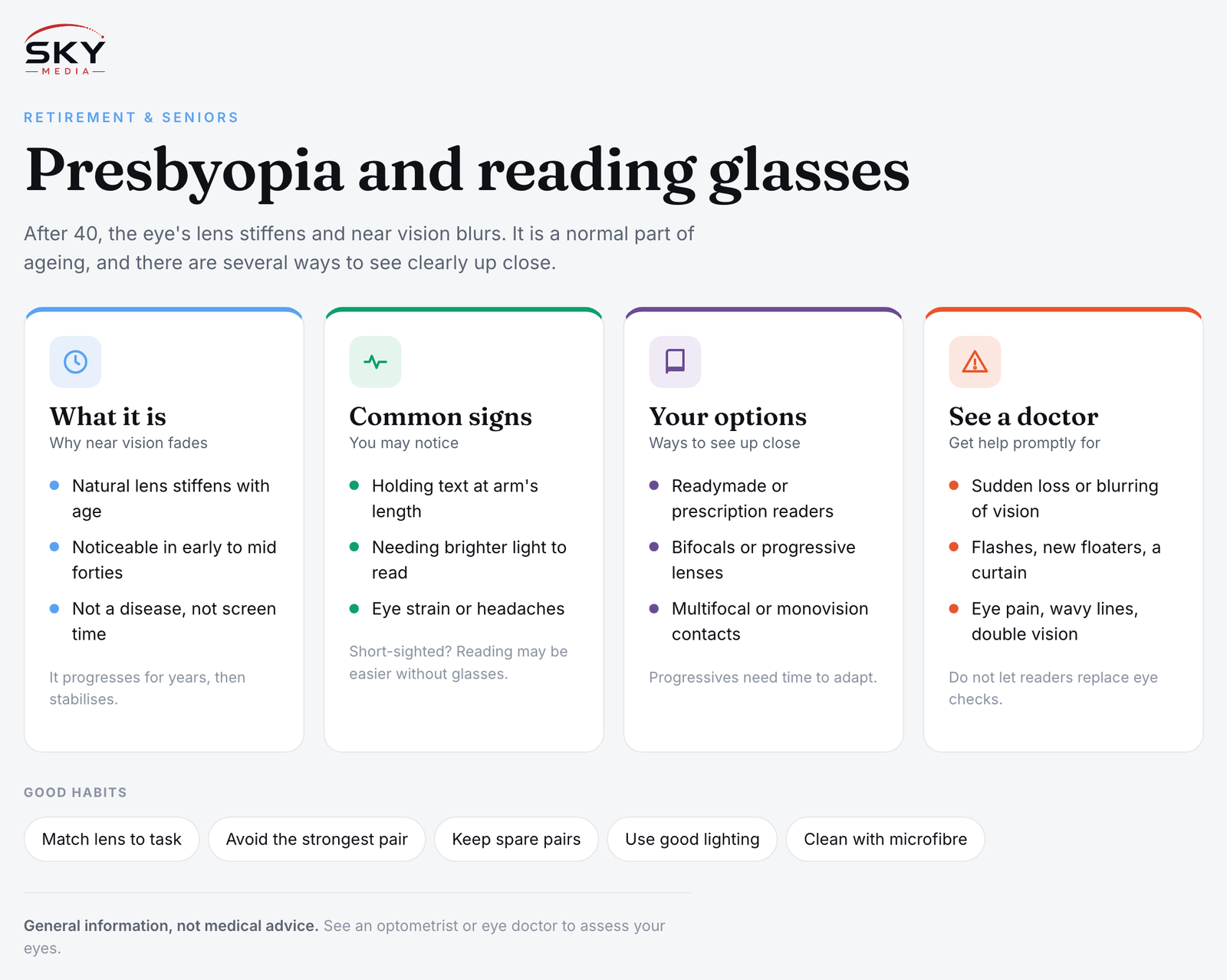
With age, the lens gradually stiffens and loses flexibility. The muscles still work, but the lens no longer changes shape as easily, so close objects become harder to bring into focus. That is presbyopia. It is not a disease and it is not caused by too much screen time; it is a normal part of ageing that happens to almost everyone eventually.
Common signs include:
- Holding reading material at arm’s length to make it clearer
- Needing brighter light to read
- Eye strain, tired eyes or headaches after close work
- Blurry near vision at the end of the day
- Difficulty switching focus between near and far
Presbyopia usually becomes noticeable in the early to mid forties and tends to progress over the following years before stabilising. That is why many people find their first readers are not strong enough a few years later.
How Presbyopia Interacts With Short-Sightedness
Singapore has a very high rate of myopia (short-sightedness), so many people reaching their forties already wear glasses for distance. Presbyopia affects them differently.
- If you are short-sighted, you may find you can read better by taking your distance glasses off. That is a sign your distance prescription is now too strong for close work.
- If you are long-sighted, you may notice near blur earlier than your friends.
- If you have never needed glasses, presbyopia may be your first reason to wear them.
Because these combinations vary so much, a proper eye test is the most reliable way to find the right solution. Our guide to getting glasses and eye care in Singapore explains how eye tests work locally.
Your Main Options for Seeing Up Close
There is no single best answer. The right choice depends on your existing prescription, your daily activities, your budget and how comfortable you are with change.
| Option | Best suited for | Things to know |
|---|---|---|
| Readymade reading glasses | People with no distance prescription and similar strength in both eyes | Cheap and convenient, but the same power for both eyes and a fixed lens centre |
| Prescription single-vision readers | People whose eyes differ, or who have astigmatism | Made to your exact measurements, but only for near work |
| Bifocals | People who want near and distance in one pair | Visible line splits the lens into two zones |
| Progressive (multifocal) lenses | People who need near, middle and far vision in one pair | No visible line, but needs an adjustment period |
| Multifocal or monovision contact lenses | Active people who prefer not to wear glasses | Requires a proper fitting and follow-up, not suitable for everyone |
Readymade readers
These are the reading glasses sold off the shelf at pharmacies, opticians and department stores. They come in set strengths, labelled in steps such as +1.00, +1.50 and so on. They work well as a simple first step if your eyes are otherwise healthy and roughly equal. The limitation is that both lenses have the same power and are centred for an average face, so they may cause strain if your eyes differ or your pupils are set wider or closer than average.
Prescription readers
An optometrist measures each eye separately and accounts for astigmatism and the distance between your pupils. These are more comfortable for long reading sessions or detailed hobbies, and better if one eye is noticeably different from the other.
Bifocals and progressives
If you already wear distance glasses, constantly swapping between two pairs gets tiresome. Bifocals put a reading segment at the bottom of the lens. Progressive lenses do the same job without a visible line, with a gradual change from distance at the top, through an intermediate zone suitable for computer screens, to reading at the bottom.
Progressives take some getting used to. You learn to point your nose at what you want to see and move your eyes down to read. Some people feel slightly unsteady at first, particularly on stairs or escalators, so take care in the first days. Most adapt within a short period, but if discomfort persists, return to your optician to check the fitting.
Contact lenses
Multifocal contact lenses have zones for different distances. Another approach, monovision, sets one eye for distance and the other for near. Both need a fitting by a qualified practitioner and regular reviews, and they do not suit every eye or every lifestyle.
There are also surgical options for some people, typically discussed with an ophthalmologist after a thorough assessment. These are a separate decision with their own risks and are not covered here.
Choosing and Using Your Readers
A few practical habits make a big difference:
- Match the lens to the task. Reading a book, using a laptop and doing needlework happen at different distances. Office or “computer” lenses can help if you spend long hours at a screen.
- Do not just buy the strongest pair. Too strong a lens forces you to hold things uncomfortably close and can cause strain. Start with what your eye professional recommends.
- Keep spare pairs where you need them. Many people keep readers by the bed, in the kitchen and in a bag.
- Light matters. Good lighting reduces strain, especially as eyes age.
- Choose a comfortable frame. Lightweight frames that sit securely are easier to wear for long periods. See our tips on choosing spectacle frames that suit your face shape.
- Clean lenses gently with a microfibre cloth and lens cleaner, not your shirt.
When to See an Optometrist or Doctor
Buying readers is fine for straightforward near blur, but do not let them replace regular eye checks. From middle age onwards, the risk of conditions such as cataract, glaucoma and age-related macular degeneration rises, and some of these cause little or no early warning. A routine eye examination can pick up changes you would not notice yourself.
See a doctor promptly, rather than waiting for a routine check, if you notice:
- Sudden loss of vision or sudden blurring
- Flashes of light, a shower of new floaters or a curtain over your vision
- Eye pain or redness with blurred vision
- Distorted or wavy straight lines
- Double vision
People with diabetes or high blood pressure should follow the eye screening schedule advised by their doctor or polyclinic, as these conditions can affect the eyes. HealthHub and your polyclinic are good starting points for information on eye screening.
Living Comfortably With Changing Eyes
Presbyopia is a sign of a normal, healthy life lived long enough to reach middle age. With the right reading glasses, a sensible routine of eye checks and a little patience while adapting to new lenses, most people continue reading, working and enjoying their hobbies comfortably for decades. If you are unsure where to start, a visit to a qualified optician is a simple first step, and our round-up of opticians in Singapore for glasses, lenses and eye tests can help you choose one.
Frequently Asked Questions
Can I just buy cheap reading glasses from a pharmacy? Readymade readers are a simple first step if your eyes are otherwise healthy and roughly equal. Both lenses share the same power, so they may cause strain if your eyes differ or you have astigmatism, in which case prescription readers are better.
Why do my reading glasses feel too weak after a few years? Presbyopia usually becomes noticeable in the early to mid forties and tends to progress over the following years before stabilising. That is why many people find their first readers are no longer strong enough later on.
Do progressive lenses take long to get used to? Most people adapt within a short period. You learn to point your nose at what you want to see and move your eyes down to read. Take care on stairs and escalators at first, and return to your optician if discomfort persists.
Is it worse to wear readers that are too strong? Yes, a lens that is too strong forces you to hold things uncomfortably close and can cause strain. Rather than buying the strongest pair, start with what your optometrist or eye doctor recommends.
Can I read better without my glasses if I am short-sighted? Often, yes. If you find you read better with distance glasses off, that suggests your distance prescription is too strong for close work. An eye test can sort out whether you need readers, bifocals or progressives.
Official sources: HealthHub
Further reading: LASIK vs SMILE vs ICL in Singapore: Choosing Vision Correction Surgery