

Results day brings a flood of options, and private schools advertise heavily in the weeks that follow. If you are weighing a private diploma vs polytechnic, the choice can look simple on a brochure but carries real differences in cost, recognition and what comes next. This guide compares the two routes honestly and shows you the checks to make before you pay a deposit anywhere.
From the 2027 cohort, the GCE O-Level exam was replaced by the Singapore-Cambridge Secondary Education Certificate (SEC), so many students now receive SEC results in January. The comparison below applies whichever certificate you hold, but entry criteria are set by each institution and the Ministry of Education (MOE), so always check current requirements.
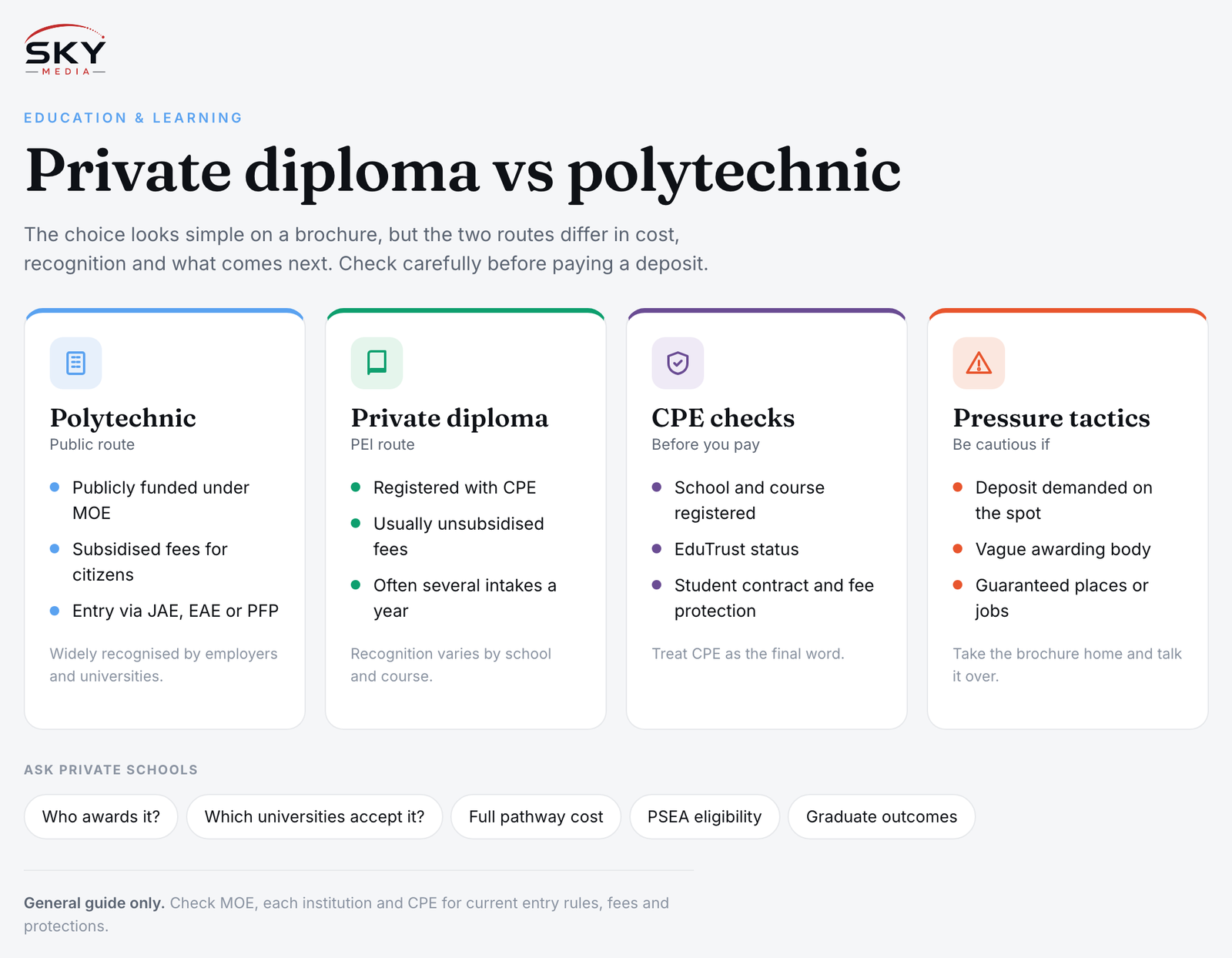
What Each Route Actually Is
Polytechnics are publicly funded institutions under MOE. They offer full-time diplomas, usually over three years, in fields such as engineering, business, design, health sciences and information technology. Entry for most students is through the Joint Admissions Exercise (JAE), with earlier routes such as the Early Admissions Exercise (EAE) and the Polytechnic Foundation Programme (PFP) available to eligible students.
Private diploma schools are private education institutions (PEIs). In Singapore, PEIs offering courses must be registered with the Committee for Private Education (CPE), which sits under the Skills and Workforce Development Agency (SWDA, formed in 2026 from Workforce Singapore and SkillsFuture Singapore). Many offer diplomas in business, hospitality, design, IT and similar areas, often with shorter durations, multiple intakes a year and pathways into degree programmes awarded by partner universities, frequently overseas ones.
Both can lead to work or further study. The differences lie in funding, recognition and how much checking you need to do yourself.
Side-by-Side Comparison
| Factor | Polytechnic diploma | Private diploma |
|---|---|---|
| Who runs it | Publicly funded institution under MOE | Privately run PEI registered with CPE |
| Fees for citizens | Subsidised by the government | Usually unsubsidised, so typically higher |
| Entry | JAE, EAE or PFP based on results and criteria | School’s own criteria, often more flexible |
| Intakes | Mainly one intake a year | Often several intakes a year |
| Recognition | Widely recognised by employers and local universities | Varies by school, course and awarding body |
| Progression | Local and overseas universities, sometimes with module exemptions | Often linked to partner university top-up degrees |
| Protections | Public institution governance | EduTrust status, student contract and fee protection checks matter |
Cost and Funding
For Singapore citizens, polytechnic fees are heavily subsidised, and permanent residents and international students pay different rates. Financial assistance schemes and bursaries are available for eligible students, and you may be able to use your Post-Secondary Education Account (PSEA) for approved fees. Check the current figures on each polytechnic’s fees page.
Private diploma fees are set by each school and are usually not subsidised in the same way. When comparing, look at the full cost of the whole pathway, not just the first module: application fees, course fees, materials, exam fees and any later top-up degree fees. Ask whether any part of the course is eligible for PSEA or other funding, and confirm it in writing. Do not assume it is.
Recognition and Progression
A polytechnic diploma is a well-understood qualification for employers and universities in Singapore. Local autonomous universities accept polytechnic graduates through their own admission processes, and some courses grant module exemptions to relevant diploma holders.
Private diplomas vary much more. Some are well regarded within a specific industry, while others are mainly useful as an entry point into the same school’s partner degree. Before enrolling, ask:
- Who awards the qualification? The school itself, or a partner university or examining body?
- Which universities accept it, and for what? Get specific programme names, not general claims.
- Is the partner degree recognised where you plan to work? If you might apply for public sector jobs or further study, check recognition with the relevant employer or university.
- What do graduates actually do next? Ask for honest examples rather than marketing statistics.
If you are thinking of studying overseas later, our guide to applying to Australian universities with a poly diploma shows how one destination treats diplomas.
The EduTrust and Protection Checks
This is where private schools need the most care. Before you sign or pay, check these on CPE’s official website:
- Registration. Confirm the school is registered with CPE and that the specific course you want is listed.
- EduTrust status. EduTrust is CPE’s certification scheme for PEIs that meet higher standards in areas like management and student protection. Note whether the school holds it and for how long.
- Student contract. CPE requires PEIs to sign a standard student contract with students. Read the fee schedule, refund policy and withdrawal terms before signing.
- Fee protection. Check that your fees are protected under CPE’s fee protection requirements, which are meant to safeguard students if a school closes or cannot deliver the course.
- Complaint and dispute channels. Know where to go if something goes wrong.
Rules can change, so treat CPE as the final word on what protections apply.
Who Each Route Suits
A polytechnic may suit you if:
- Your results meet the entry criteria for a course that interests you.
- You want a subsidised, widely recognised diploma with strong industry links.
- You are happy to start in the usual April intake and commit to a three-year structure.
A private diploma may suit you if:
- You narrowly missed the course you wanted and prefer not to wait or repeat an exam.
- You have identified a specific, well-checked private course with clear progression that matches your goal.
- You need a flexible intake date or a part-time structure.
Also consider other options before deciding. ITE courses offer a strong hands-on route that can lead to polytechnic later. If you are close to an entry requirement, retaking subjects can be an option, and our guide on sitting exams as a private candidate explains how that works. For a wider view of what comes after results, see What to Do After O-Levels End.
Pressure Tactics to Watch For
Results season brings urgency. Be cautious if a school:
- Pushes you to pay a deposit on the spot or within hours.
- Cannot clearly name the awarding body or partner university.
- Makes vague claims about “guaranteed” university places or jobs.
- Is reluctant to show you the student contract before you pay.
Take the brochure home, talk to your family and a teacher or school counsellor, and do the CPE checks first.
A Simple Way to Decide
Write down your end goal, whether a particular job, a degree or a field you want to explore. Then trace each route backwards: which gets you there with the least cost, the strongest recognition and the protections you need? For most students who qualify, the polytechnic route is the default to beat. A private diploma can be a sound choice, but only when you have checked it as carefully as you would any other large purchase.
Further reading: IGCSE vs O-Levels: Choosing a Path for Newcomer Teens in Singapore · What to Do After Your Child Receives a DSA Offer · How to Verify Private School Accreditation in Singapore