

Most students know ITE for its Nitec and Higher Nitec certificates (see A Guide to ITE in Singapore for the basics). Fewer know that ITE also runs diploma-level programmes, and the ITE Technical Engineer Diploma is one of the more specialised options. It is built for students who enjoy hands-on engineering work, want deep technical skills in a specific field, and are comfortable learning in close partnership with industry rather than purely in a classroom.
This guide explains what the ITE Technical Engineer Diploma is, how the partner company model usually works, who it suits, and where graduates can go next. Course names, intakes and partners change from year to year, so treat this as an orientation and check the current list on the ITE website before you apply.
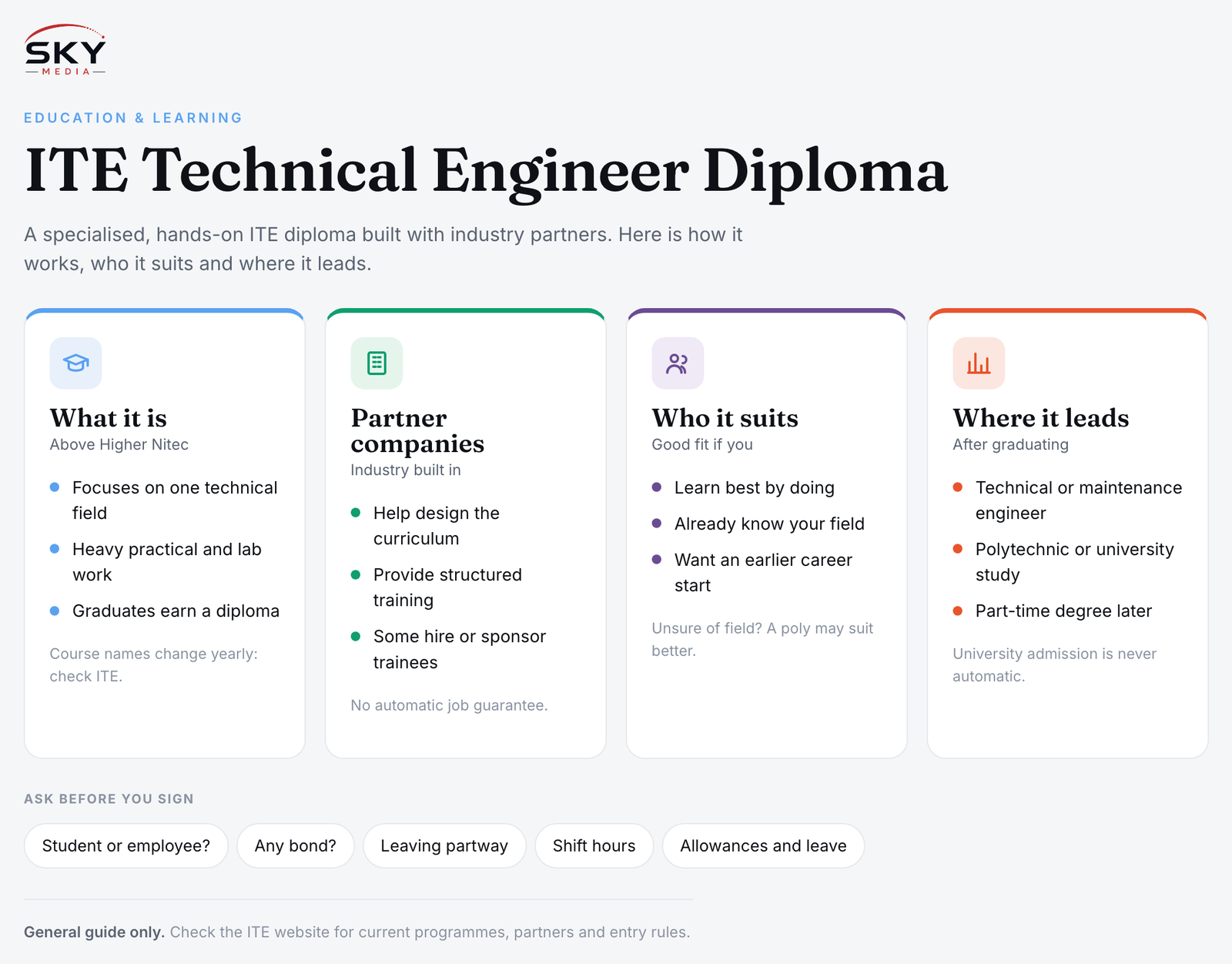
What the ITE Technical Engineer Diploma Is
The Technical Engineer Diploma sits above the Higher Nitec in ITE’s qualification ladder. Where a Nitec trains you to carry out skilled technical tasks, a technical engineer diploma aims to produce people who can plan, troubleshoot, maintain and improve complex systems, often acting as the bridge between the shop floor and the engineers who design the equipment.
A few features set it apart from the general ITE route:
- Specialisation. Each programme focuses on one technical field, such as machine technology, mechatronics, aerospace or rail-related engineering, rather than a broad introduction.
- Industry involvement. Programmes are typically developed with industry partners, sometimes including overseas training institutions, so the curriculum tracks what employers actually need.
- Applied depth. Expect a heavy share of practical work: workshops, labs, projects on real equipment and structured training periods in a company.
- A diploma qualification. Graduates earn a diploma rather than a certificate, which changes how employers and universities view the qualification.
ITE also runs Work-Study Diplomas, where you are employed by a company from day one and learn partly at ITE and partly on the job. Depending on the year, some technical engineer programmes are structured in a similar way, so read each course page carefully to see whether you apply to ITE directly or apply for a job with a participating company.
How Partner Companies Fit In
The partner company model is what makes this pathway distinctive. While details vary by programme, it commonly works like this:
- Partners help design the curriculum. Companies in the sector advise on the skills, equipment and standards students should learn, so you train on tools and processes used in industry.
- Partners provide structured training. A significant part of the programme may take place in a partner company, where you work under supervisors and mentors on real tasks.
- Some partners hire or sponsor trainees. In work-study formats, the company employs you and pays a salary during the programme. In other formats, partners may offer internships or consider graduates for jobs, but there is usually no automatic job guarantee.
- Overseas links may be part of it. Some technical engineer programmes have historically been run with institutions abroad, and selected students may get overseas training or attachments. Do not assume this applies to every course or intake.
Questions to ask ITE or the partner company:
- Am I an ITE student, a company employee, or both during the programme?
- Is there a bond or service commitment if a company sponsors me?
- What happens if I want to leave the company partway?
- Which shifts or working hours apply during company training?
ITE Technical Engineer Diploma vs Other Post-Secondary Options
Here is how the technical engineer route compares with other options a student interested in engineering might weigh up.
| Option | Main focus | Learning style | Typical next step |
|---|---|---|---|
| Nitec or Higher Nitec (engineering) | Skilled technician tasks | Mostly ITE campus, with internship | Work, or progress to a diploma |
| ITE Technical Engineer Diploma | Specialised technical engineering in one field | ITE plus significant industry training | Technical engineer roles, possible further study |
| ITE Work-Study Diploma | Job-specific diploma while employed | Mainly on the job with a company, plus ITE modules | Continue with employer, further study |
| Polytechnic engineering diploma | Broader engineering theory and application | Mostly campus-based, with internship | Work, or university |
For a wider look at how ITE, polytechnic and junior college routes differ, see JC vs Poly vs ITE: Choosing a Pathway in Singapore.
Who the Technical Engineer Diploma Suits
This route is not for everyone, and that is fine. It tends to suit students who:
- Learn best by doing. If you understand a concept once you take a machine apart or wire a control panel, the practical depth will feel natural.
- Already know their field. Because programmes are specialised, it helps to have a real interest in that area, such as aircraft, factory automation or trains, rather than a vague interest in “engineering”.
- Are ready for workplace discipline. Company training means punctuality, safety rules, shift patterns and supervisors who expect professional behaviour.
- Want an earlier start to a career. Students who want to earn and build experience sooner, while keeping the door open to further study, often find the model attractive.
It may suit you less if you are unsure which field you like or want a broad academic grounding first. A polytechnic diploma may then give you more flexibility.
Entry Requirements and How to Apply
Entry requirements depend on the programme and the year. In general, technical engineer and work-study diplomas are aimed at students who have completed a relevant Nitec or Higher Nitec, or who hold suitable secondary school results. Some programmes also involve interviews, aptitude tests or selection by the partner company.
Exam names are changing too. From the 2027 cohort, the GCE O-Level and N-Level exams are replaced by the Singapore-Cambridge Secondary Education Certificate (SEC), so check how current entry requirements are phrased for SEC results. MOE and SEAB (the Singapore Examinations and Assessment Board) publish the details.
To apply:
- Browse the current diploma programmes on the ITE website and note the intake period.
- Read each course page for entry requirements, format, and whether you apply through ITE or through a company.
- Talk to your school’s ECG (Education and Career Guidance) counsellor about fit.
- Attend ITE open house events, where lecturers and sometimes partner company staff explain the programme.
- Submit your application through the channel stated on the course page, before the deadline.
Where the Diploma Can Lead
Graduates typically move into roles such as technical engineer, maintenance engineer, systems technician or senior technician, depending on the field. In sectors like aerospace, manufacturing and rail, the ability to troubleshoot complex equipment is valued, and experience gained during company training counts on your CV.
Further study is also possible. Diploma holders may apply to polytechnics for related courses, or to universities, especially applied-learning universities that value industry experience. Admission is never automatic, and universities set their own criteria, so check each institution’s requirements for ITE diploma holders.
In the longer term, some technical engineers choose to deepen their qualifications through part-time degrees and, much later, aim for professional engineering recognition. That is a long road with its own rules; see How to Register as a Professional Engineer (PE) in Singapore for how that process works.
Tips Before You Commit
- Visit the training environment. If possible, see the workshops or the partner company site.
- Talk to current students or graduates. They can tell you about workload, shift patterns and what the company training really involves.
- Read the fine print. Check salary, allowances, bonds, leave and what happens if you change your mind.
- Keep your options open. Strong grades and a good training record make it easier to switch to further study later.
The ITE Technical Engineer Diploma can be an excellent route for the right student: practical, specialised and closely tied to real jobs. Confirm the current programmes, partners and entry rules on the ITE website, then decide with your parents and counsellor.
Explore more: Career Paths After Polytechnic or ITE
Official sources: Ministry of Education (MOE)