

If you have ever noticed a small van parked by your HDB block and someone releasing a cloud of mosquitoes along the corridor, you have seen Project Wolbachia Singapore at work. It sounds counterintuitive: releasing more mosquitoes to get fewer of them. But the method is one of the most closely watched dengue control efforts in the region, and it is run by the National Environment Agency (NEA). This guide explains how it works, how the releases are carried out, where they happen and what the results so far suggest, so you know what you are looking at and what it means for your household.
What Wolbachia Is and Why It Matters for Dengue
Dengue in Singapore is spread mainly by the Aedes aegypti mosquito, a species that thrives in urban areas and breeds in small pockets of clean, stagnant water. Only female mosquitoes bite, because they need blood to produce eggs. When an infected female bites someone, the virus can pass on.
Wolbachia is a bacterium that occurs naturally in many insect species, including some butterflies, fruit flies and other mosquitoes. It lives inside insect cells and cannot infect people or other animals. The Aedes aegypti mosquito does not normally carry it, which is what makes the approach possible.
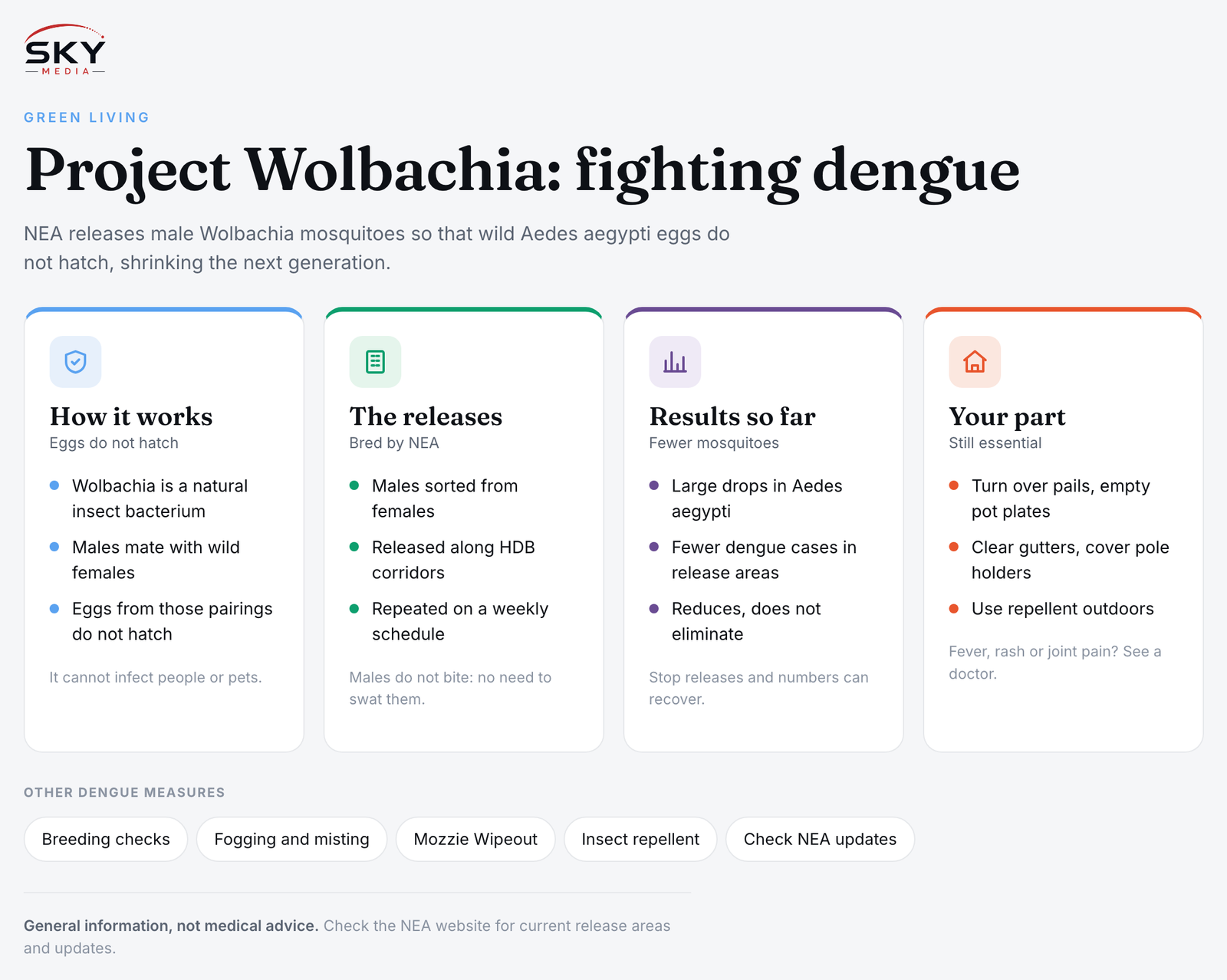
The key effect is what scientists call incompatibility. When a male Aedes aegypti carrying Wolbachia mates with a wild female that does not carry the bacterium, the eggs she lays do not hatch. Female mosquitoes typically mate only once, so each female that pairs with a released male produces no offspring for that cycle. Release enough of these males over time, and the next generation of the local Aedes aegypti population shrinks.
This is a suppression strategy: it aims to reduce the number of urban dengue mosquitoes in an area, rather than to change the mosquitoes that remain.
How NEA Releases Wolbachia Mosquitoes
The mosquitoes used in the project are bred at NEA facilities. The process, in broad terms, goes like this:
- Breeding: Wolbachia-carrying Aedes aegypti are reared in large numbers under controlled conditions.
- Sorting: Males are separated from females. Because females bite, NEA has described sorting steps and additional measures designed to minimise the number of females released.
- Transport: The male mosquitoes are packed into release containers and taken to selected estates.
- Release: Officers release them at ground level and along common corridors of residential blocks, usually on a regular schedule each week.
Released males do not bite, so they are not a health risk and do not spread dengue. They live for a short time, which is why releases need to be repeated. Their only job is to find and mate with wild females.
You may see the releases happen in the morning or at other set times. Residents sometimes notice more mosquitoes flying around corridors shortly after a release, which is expected and temporary.
Where Releases Happen and How Areas Are Chosen
Project Wolbachia began as small field studies in a handful of residential estates and has since expanded in phases to cover many more households across the island. Areas have typically been chosen based on factors such as historical dengue risk and Aedes aegypti population levels, alongside operational considerations like the capacity to produce enough mosquitoes.
Because the programme changes over time, the exact list of release sites is not something to rely on from memory. NEA updates its public information as new areas are added. If you want to know whether your estate is covered, check the NEA website or follow its official announcements.
A few practical points for residents in release areas:
- You do not need to do anything special. The releases work alongside, not instead of, your own efforts.
- The mosquitoes are harmless males, so there is no need to spray them or chase them off.
What the Results Show So Far
NEA has reported that areas with sustained Wolbachia releases saw large reductions in the Aedes aegypti population compared with similar areas without releases, and fewer dengue cases among residents. The project’s results have been published in scientific journals as well as in NEA’s public updates, which is part of why it has attracted international attention.
It is worth keeping the findings in perspective:
- It reduces, it does not eliminate. Mosquito numbers fall, but some wild mosquitoes, including those flying in from neighbouring areas, remain.
- It needs continuous effort. If releases stop, mosquito populations can recover over time.
- It targets one species. The project focuses on Aedes aegypti. The Aedes albopictus mosquito, more common in greenery and gardens, can also spread dengue and is not the main target.
- Coverage takes time to build. Scaling up depends on production capacity, so not every estate is covered at once.
How Wolbachia Compares With Other Dengue Control Methods
Project Wolbachia is one layer in a wider system. The table below shows how it fits alongside the other measures you will see in Singapore.
| Method | Who does it | What it targets | Limits |
|---|---|---|---|
| Wolbachia male releases | NEA | Breeding of urban Aedes aegypti | Covers selected estates, needs ongoing releases |
| Breeding habitat checks and inspections | NEA officers, town councils, residents | Stagnant water where larvae grow | Relies on every household and site staying vigilant |
| Fogging and misting | Pest control operators, town councils | Adult mosquitoes in the open | Short-lived effect, does not reach indoor breeding spots |
| Household prevention (Mozzie Wipeout habits, repellent) | Residents | Breeding spots at home, bites | Only as good as daily consistency |
The point of the table is simple: Wolbachia lowers mosquito numbers in covered areas, but stagnant water at home can still breed mosquitoes. Your own checks matter just as much as before. Our guides on preventing mosquitoes at home and dengue prevention at home walk through those everyday habits in detail.
Common Questions From Residents
Can a Wolbachia mosquito bite me? The released mosquitoes are males, and male mosquitoes do not bite. NEA’s sorting process is designed to keep the number of females released very low.
Can Wolbachia infect humans or pets? No. Wolbachia lives inside insect cells and is not known to infect people or animals. It occurs naturally in many insects already found around us.
Will it harm the ecosystem? Aedes aegypti is an urban species that lives closely alongside people, and the project aims to suppress only this species locally. NEA has published information on the safety assessments carried out before and during the programme.
Should I kill the mosquitoes I see after a release? There is no need. Swatting released males simply removes mosquitoes that would otherwise help reduce the next generation. Wild females, which do bite, still deserve the usual precautions, such as repellent.
Does this mean dengue season is no longer a concern? No. Dengue cases rise and fall over the year, and no single tool removes the risk. Read Dengue Season in Singapore, Explained to understand the patterns and when to be extra careful.
What You Can Do Alongside the Project
Even if your estate has regular releases, the basics still count:
- Turn over pails and empty water from flowerpot plates regularly.
- Clear blocked roof gutters and check corridor drains for standing water.
- Cover bamboo pole holders when not in use.
- Use insect repellent outdoors, especially in the early morning and late afternoon when Aedes mosquitoes are most active.
If you or a family member develop symptoms such as fever, headache, joint pain or a rash, see a doctor or visit a polyclinic. This article is general information and not medical advice.
Explore more: Protecting Your Family From Dengue
Official sources: National Environment Agency (NEA)