

There is something magical about a child who curls up with a book by choice. Raising a bookworm in Singapore is one of the most rewarding gifts you can give your child, and the good news is that it has far less to do with pushing worksheets than with sharing joy. Children who love reading tend to have richer vocabularies, stronger imaginations, and a lifelong habit of learning. Best of all, a love of reading is caught, not taught. When books are woven warmly into family life, children come to see them as pleasure rather than homework.
You do not need a house full of expensive books or a strict reading schedule. What you need is a bit of consistency, some good stories, and a willingness to make reading a cosy, shared part of the day. Singapore makes this wonderfully easy, with an excellent network of public libraries within reach of most families.
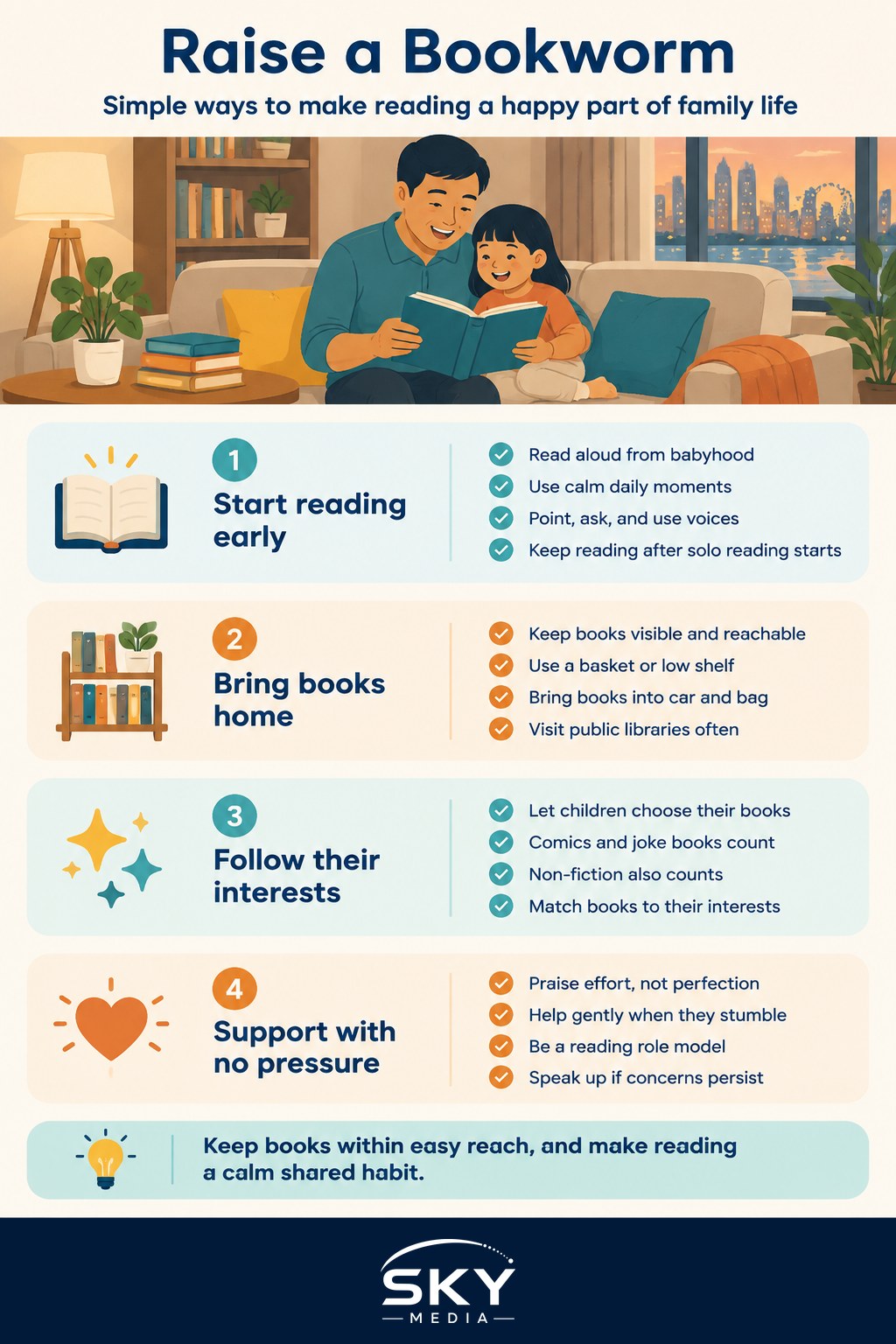
Start Early and Read Aloud Often
It is never too early to read to your child. Even babies benefit from hearing your voice, seeing bright pictures, and turning sturdy board book pages. Long before they understand the words, they are learning that books are warm, safe, and linked to your attention. As your child grows, keep reading aloud daily, ideally at a calm time such as before bed. This shared ritual does far more than build language. It builds connection.
Make read-aloud time interactive rather than a performance. Point at pictures, ask what your child thinks will happen next, and use silly voices for different characters. Let your child choose the book, even if it means the same story ten nights in a row, because repetition is exactly how young children learn and feel secure. If your child interrupts with questions, welcome it, since curiosity is the engine of reading. Reading before bed also fits neatly into a calming evening, which you can read more about in establishing good bedtime routines for children in Singapore.
Keep reading aloud even after your child can read alone. Older children still love being read to, and it lets you share books that are a little beyond their own reading level, feeding their imagination and vocabulary while keeping the ritual alive.
Make Books a Natural Part of Home Life
Children read more when books are easy to reach and visible. You do not need a grand library, just a low shelf or a basket of books your child can browse without asking. Keep a few in the car, in your bag, and by the sofa, so reading can fill small pockets of waiting time. When books are always within reach, picking one up becomes as natural as reaching for a toy.
Singapore’s public libraries are a treasure for families. Regular visits let your child borrow armfuls of books, discover new authors, and join story sessions, all at very little cost. Make the trip a treat your child looks forward to, and let them pick their own titles, even the ones you might not choose. Ownership over reading choices is a powerful motivator. Do check current library programmes and opening details through official sources, as these change from time to time.
Let Children Choose What They Love
One of the quickest ways to put a child off reading is to insist on books you think they should read. Comics, joke books, non-fiction about sharks or space, magazines, and series they are obsessed with all count as real reading. What matters at this stage is that your child enjoys reading, not that they read the right thing. Follow their interests, whether that is dinosaurs, football, or fairy tales, and you will keep the flame alive. As reading becomes a genuine pleasure, harder and richer books follow naturally.
Support Without Turning It Into Pressure
As your child learns to read independently, patience matters. Celebrate effort rather than perfection, and never turn reading into a test at the dinner table. If your child stumbles over words, gently help without making a fuss, and keep the mood light. A child who feels judged while reading quickly loses their nerve, while one who feels supported grows in confidence. For practical help as your child builds skill, helping your child with reading fluency in Singapore offers useful guidance.
Be a reading role model yourself. When children see the adults around them enjoying books, newspapers, or magazines, they absorb the message that reading is something grown-ups value and enjoy, not just a school chore. Talk about what you are reading, share interesting bits, and let reading be part of the family’s normal rhythm. This ties closely to nurturing your child’s love of learning in Singapore, where curiosity and joy do the heavy lifting.
If you ever have real concerns about your child’s reading progress, such as persistent difficulty recognising letters or sounds well past the usual stage, it is worth speaking to their teacher or a qualified professional for a proper assessment. Most children simply bloom at their own pace, but early support, where it is genuinely needed, can make a big difference.
Raising a bookworm is a gentle, patient journey rather than a race. Read aloud often, keep books close and plentiful, follow your child’s interests, and let reading stay a source of comfort and delight rather than pressure. Do this steadily, and you may well raise a child who reaches for a book not because they have to, but because they cannot imagine life without one.
Frequently Asked Questions
My child says reading is boring. What can I try? Start by finding out what they enjoy, because boredom often means the books on offer do not match their interests. Try comics, joke books, or non-fiction about their favourite topic. Read together for a few relaxed minutes, then stop while it is still fun. Pressure tends to make it worse, so keep it light.
Do e-books and audiobooks count as real reading? They count for building vocabulary, imagination and a love of stories, especially audiobooks for listening skills. Printed books are still handy for shared reading and fewer distractions, so a mix works well. If you use a tablet, keep it for reading only so your child is not tempted to switch to games.
How do I encourage a reluctant boy or a child who prefers screens to books? Meet them where their interests are, such as books about games, sport, animals or characters from shows they already love. Keep a short daily reading slot, make it a cosy ritual, and let them see you reading too. Cutting back screen time a little often leaves more room for books.
How much reading should a child do each day? There is no magic number, and a short daily habit usually beats long, forced sessions. Aim for a regular slot, such as ten to twenty minutes before bed, and let it grow if your child wants more. Read aloud to them as well, since listening counts towards a love of stories too.
What can I do if my child struggles with reading in a second language? Be patient and keep reading fun in both languages. Read aloud in the language you are most comfortable in, then add easy picture books in the weaker one, letting your child choose. Talk about the story in whichever language flows best. If difficulties persist, ask the teacher about extra support.
Official sources: National Library Board
Further reading: Supporting Your Child’s Love of Drawing and Art in Singapore