

Many mainland Chinese newcomers worry about how to rent without a guarantor in Singapore. Back home, a landlord might want to meet a local relative, see a company stamp or ask for someone to vouch for you. In Singapore you will rarely be asked for a personal guarantor at all. Instead, landlords look at your immigration pass, your job or studies, and your ability to pay a deposit and rent on time.
The real challenge for newcomers is not the missing guarantor but the missing track record: no local employment history, no Singapore credit record and sometimes no local bank account yet. This guide explains what landlords actually check and how to strengthen your application when you are brand new.
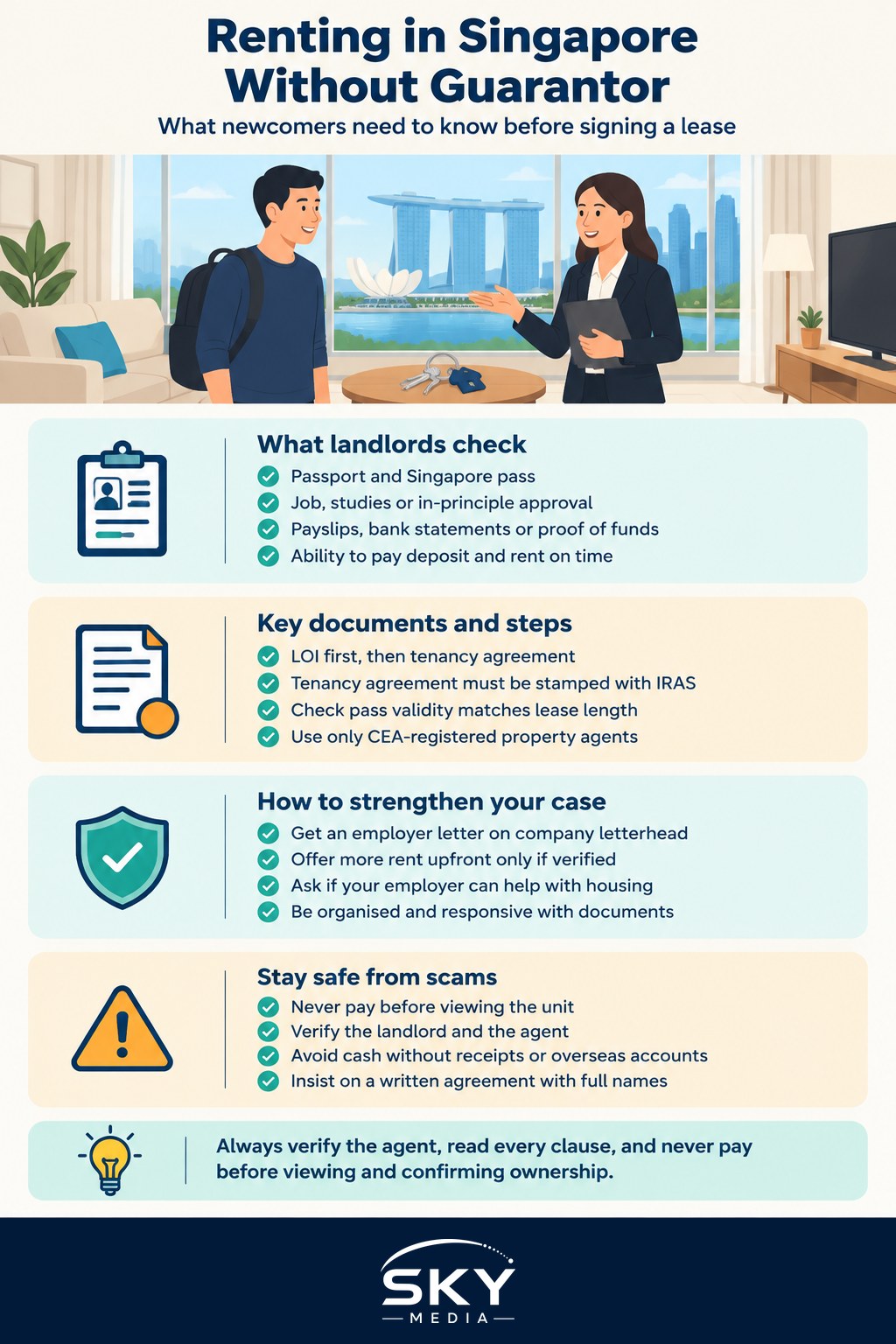
How Renting in Singapore Differs From China
If you have rented in a Chinese city, some things will feel familiar and some will not.
- Deposits instead of guarantors. Singapore landlords usually rely on a security deposit, typically linked to the length of the lease, plus rent paid in advance. This deposit is the landlord’s main protection. The exact amount is negotiable and not fixed by law.
- Letter of Intent (LOI). Before the tenancy agreement, tenants commonly sign an LOI and pay a good faith deposit to reserve the unit. Read it carefully, since it sets out key terms and what happens if either side pulls out.
- Tenancy agreement and stamp duty. The tenancy agreement must be stamped with IRAS (the Inland Revenue Authority of Singapore). Check current stamp duty rules and who pays under your agreement.
- Pass validity matters. Landlords generally want the lease to fit within the validity of your pass, such as an Employment Pass, S Pass, Dependant’s Pass or Student’s Pass.
- Property agents. Many rentals go through agents. Agents must be registered with the Council for Estate Agencies (CEA), and you can check an agent’s registration on the CEA public register.
For a broader walkthrough of the first rental, see our guide to renting your first home as a Chinese newcomer.
What Landlords Check Instead of a Guarantor
When a landlord or agent assesses you, they are trying to answer one question: will this tenant pay rent and look after the home? Expect to show some of the following:
- Passport and pass. Your passport and your Singapore pass, or an in-principle approval letter if your pass is still being processed.
- Employment proof. An employment contract or a letter from your employer stating your role, salary and start date.
- Student documents. For students, your Student’s Pass, school offer letter and proof of funds, which may include a parent’s bank statement.
- Payment ability. Recent payslips, or bank statements if you have just arrived.
Be careful with personal documents. Share copies only with verified agents or landlords, and consider watermarking them with the purpose, for example “for rental application only”.
Ways to Strengthen Your Application With No Local History
If you have just landed and have little to show yet, you can still make yourself an attractive tenant.
- Get an employer letter early. A clear letter on company letterhead confirming your employment often reassures landlords more than anything else.
- Offer more rent upfront. Some newcomers offer to pay several months in advance. This can help, but only do it with a verified landlord and a properly signed agreement, and make sure the terms state how advance rent is treated if the lease ends early.
- Ask about a company lease. If your employer is relocating you, ask HR whether the company can sign the lease or provide housing support.
- Show stability. A longer lease, a quiet household and a clear move-in date are all attractive to landlords.
- Be responsive and organised. Having documents ready in English, with Chinese originals if needed, speeds things up.
Comparing Your Housing Options as a Newcomer
| Option | What is usually needed | Good for | Watch out for |
|---|---|---|---|
| Whole unit, private condo or apartment | Pass, employment proof, deposit, stamped agreement | Families, longer stays | Higher upfront costs, minimum lease periods |
| Whole HDB flat | Valid pass, landlord must meet HDB rules | Value, local neighbourhoods | Eligibility and minimum stay rules set by HDB |
| Room rental | Pass, smaller deposit, house rules | Singles, first few months | Shared spaces, verify landlord is allowed to sublet |
| Serviced apartment or coliving | Pass, card or bank payment | Very new arrivals, short stays | Higher monthly cost, check what is included |
Minimum rental periods differ between HDB flats and private property and can change, so check the current rules on the HDB and URA (Urban Redevelopment Authority) websites before agreeing to a short lease.
Using a Short-Term Stay to Build Your Track Record
Many newcomers find it easier to start with a room rental, serviced apartment or coliving space for the first one to three months. This gives you time to open a local bank account, receive your first payslip and get a feel for neighbourhoods before committing to a longer lease.
During this period:
- Open a bank account and set up local payment methods
- Keep payslips and rental receipts
- Visit areas you are considering at different times of day
- Ask colleagues and community members for honest views on landlords and agents
Mainland newcomer groups can be a helpful source of shared experience and referrals. Our guide to mainland newcomer community groups in Singapore lists the kinds of groups to look for, though always verify any landlord or agent independently.
Avoiding Rental Scams
Newcomers are frequent targets of rental scams, and pressure to pay quickly is a warning sign. Protect yourself:
- Never pay before viewing the unit in person or through a reliable live video viewing with a verified agent.
- Verify ownership and the agent. Check the agent on the CEA register, and ask the agent to confirm the landlord’s ownership.
- Avoid paying cash without a receipt, and be wary of requests to pay into personal accounts overseas.
- Be careful with WeChat-only deals. Messaging apps are convenient, but insist on a proper written agreement with full names and the unit address.
- Read before signing. If your English is limited, ask a trusted friend to go through the LOI and tenancy agreement with you.
If something feels wrong, report it to the Singapore Police Force or check the latest scam advisories on the official ScamShield resources.
A Simple Plan for Your First Lease
- Confirm your pass status and expected validity.
- Gather your passport, pass, employment or student letter and bank statements.
- Decide whether to start with a short stay or go straight to a full lease.
- Shortlist verified agents and units within your budget.
- View in person, then negotiate deposit, advance rent and lease length.
- Sign the LOI and tenancy agreement only after reading every clause, then stamp it with IRAS.
You do not need a local guarantor to rent in Singapore. With a clear pass, solid paperwork and a careful approach to agents and payments, you can secure a good home and settle in with confidence. For more help getting set up, see our list of essential apps for Chinese newcomers in Singapore.
Further reading: How to Rent Without a Local Credit Record · Can You Rent an HDB Flat to Mainland Chinese Tenants?