

Arriving in a new country usually means arriving with no local paper trail. You have no Singapore bank history yet, no local credit report and no previous landlord here to vouch for you. The good news is that it is very common to rent without credit history in Singapore. Landlords and agents deal with newcomers all the time, and most care far more about whether you can pay reliably and look after the home than about a credit score.
This guide explains what landlords tend to look for, which documents help when you have no local record, and how to put together an offer that feels safe to a property owner. It is general information, not legal or financial advice. Rental rules, especially for public housing, can change, so check current requirements with the relevant official body.
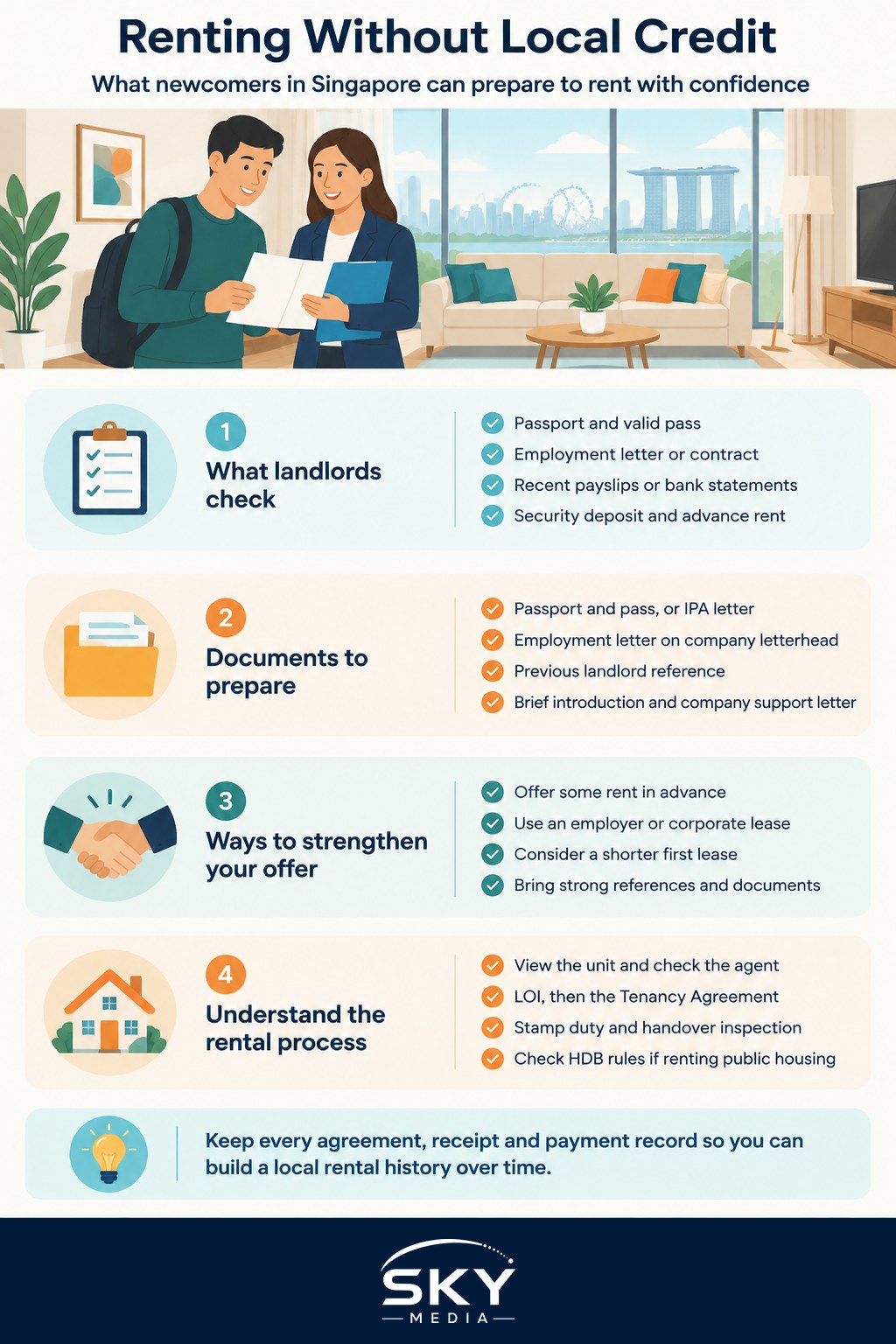
What Landlords Usually Check Instead of Credit
In many countries, renting starts with a credit check. In Singapore’s private rental market, the process often leans more on your pass, your job and the deposit. Practices vary between landlords and agents, but typical checks include:
- Your identity and immigration status. Your passport and a valid pass from the Ministry of Manpower (MOM) or the Immigration and Checkpoints Authority (ICA), such as an Employment Pass, S Pass, Dependant’s Pass or Student’s Pass. The pass validity often matters, because landlords want a tenant who can legally stay for the whole lease.
- Your employment. An employment contract or letter showing your employer, role and start date.
- Your ability to pay. Recent payslips, an offer letter showing salary, or bank statements.
- Upfront money. A security deposit and advance rent, paid when the tenancy agreement is signed.
Some landlords or agents may ask for a credit report from Credit Bureau Singapore once you have one, but many newcomers rent successfully before any local report exists.
Documents That Reassure a Landlord
When you lack a local record, the aim is to replace it with clear, honest evidence of stability. Prepare a simple folder, digital and printed, containing:
- Passport and pass, or your In-Principle Approval (IPA) letter if your pass has not been issued yet.
- Employment letter or contract, ideally on company letterhead, stating your position and salary.
- Recent payslips or bank statements, from Singapore or your home country, to show regular income.
- A previous landlord reference, even from overseas. A short letter or email confirming you paid on time and left the home in good condition is valuable.
- A brief introduction, a few lines on who you are, who will live in the unit and why you are moving.
- Company support letter, if your employer provides relocation help or a housing allowance.
Translate any key documents not in English, and keep copies tidy. A well-organised tenant tends to come across as a reliable one.
Ways to Strengthen Your Offer
If a landlord hesitates, these levers can help. Not every option suits every budget, so weigh them carefully.
| Option | How it helps the landlord | What to consider for you |
|---|---|---|
| Offer some rent in advance | Reduces the risk of missed payments | Ties up your cash; get it recorded in the agreement |
| Employer or corporate lease | The company stands behind the tenancy | Depends on your employer’s policy; may limit flexibility |
| Shorter initial lease | Lets the landlord assess you before renewing | May cost more per month, and you may need to move sooner |
| Strong references and documents | Replaces missing local history with evidence | Takes time to gather before viewings |
| Local guarantor | Someone in Singapore shares responsibility | Not everyone has one; a big ask of a friend or relative |
Be cautious about offering a much larger deposit than usual. It can help, but make sure every amount is written into the tenancy agreement with clear refund terms. If a guarantor is not an option for you, our guide on how mainland Chinese newcomers rent without a guarantor covers alternatives that apply to many nationalities.
Understanding the Rental Process in Singapore
Knowing the usual sequence helps you avoid surprises:
- Viewing. You view the unit, often with a property agent. Agents should be registered with the Council for Estate Agencies (CEA), and you can check their registration on the CEA public register.
- Letter of Intent (LOI). A short document stating the rent, lease length and key terms you are proposing, usually paid with a good faith deposit to hold the unit.
- Tenancy Agreement (TA). The full contract. Read it carefully, including clauses on repairs, early termination (often called a diplomatic clause), and the return of your deposit.
- Stamp duty. Tenancy agreements in Singapore are subject to stamp duty, which is paid to the Inland Revenue Authority of Singapore (IRAS). Check who pays and the current rules on the IRAS website.
- Handover. Inspect the unit with the landlord or agent, take dated photos, and list any existing defects in an inventory.
If you are thinking of renting a room or flat in a Housing and Development Board (HDB) block, note that HDB has its own eligibility rules for tenants and landlords, including which pass holders can rent and minimum lease periods. Check the HDB website before committing.
Building Your Local Record While You Rent
Your first tenancy is also your chance to start a track record for next time.
- Pay rent on time, every time, ideally by bank transfer so there is a clear record.
- Keep receipts and statements in one folder.
- Communicate in writing with your landlord about repairs and issues, and keep things polite and factual.
- Ask for a reference when you move out, if the tenancy went well.
- Open a local bank account early and use it consistently for income and bills.
Over time, responsible use of local financial products can also help you build a credit file. Our guides on building a credit history in Singapore and how to do so without taking on unnecessary debt explain the basics.
Red Flags to Watch Out For
Newcomers without local knowledge are sometimes targeted by rental scams. Be wary if:
- Someone asks for a deposit before you have viewed the home in person or by a live video call.
- The “landlord” is overseas and cannot meet or show proof of ownership.
- The rent is far below similar units nearby.
- You are pressured to pay quickly to beat other tenants, with no LOI or written agreement.
Always confirm the owner’s identity, check the agent’s CEA registration, and only pay into accounts you have verified. Our article on spotting rental scams when you rent a home has a fuller checklist.
Renting without a local credit record is a normal first step for many people moving to Singapore. With your documents ready, a fair offer and a careful read of the agreement, you can secure a home with confidence and start building the local history that makes your next move easier.