
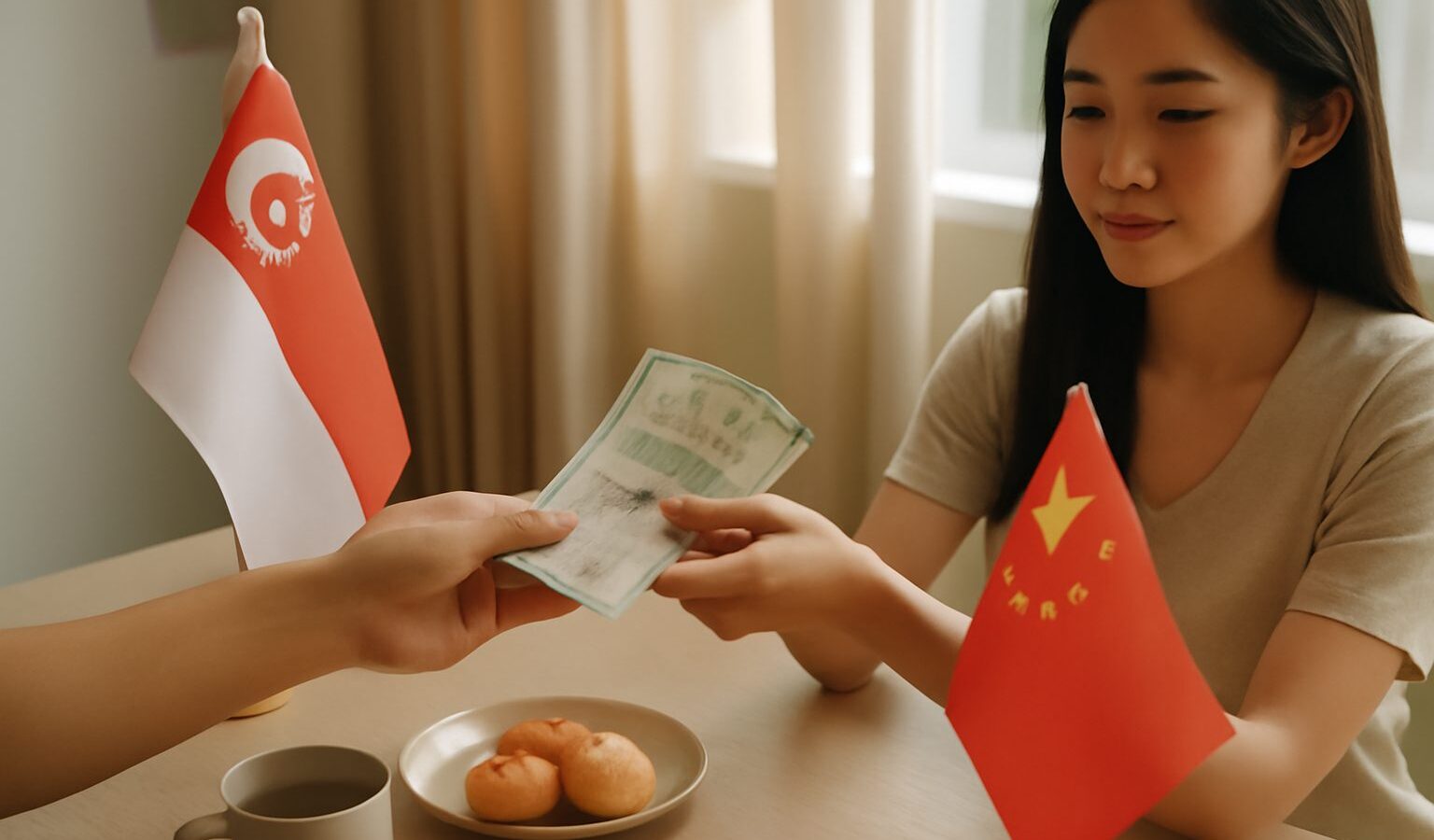
Many mainland Chinese residents in Singapore reach a point where money needs to travel the other way. Perhaps you are supporting parents, servicing a mortgage back home, funding a child’s education, or simply moving savings you no longer need in Singapore dollars. Repatriating money to China is very doable, but it sits at the meeting point of two systems: Singapore’s open banking environment and China’s managed foreign exchange regime. Understanding both sides before you send saves you delays, questions from your bank, and money lost to poor rates. This guide walks through how the flow works and what to check with the authorities before you move a large sum.
How the Money Actually Moves
When you send money from Singapore to China, you are usually converting Singapore dollars (SGD) into Chinese renminbi (RMB, also called CNY), and the funds land in a Chinese bank account or a linked wallet. There are a few common channels:
- Bank telegraphic transfer (SWIFT). Your Singapore bank wires funds to a Chinese bank. Reliable for larger sums, but fees and exchange spreads vary, and there may be intermediary bank charges.
- Licensed remittance and money transfer operators. Specialist providers often quote sharper exchange rates and lower fees than a bank counter, and many settle quickly to Chinese accounts or wallets. Use only providers licensed by the Monetary Authority of Singapore (MAS).
- Digital wallets and app-based transfers. Some services push funds to a recipient’s Chinese bank card or a wallet linked to it.
The receiving side matters as much as the sending side. RMB arriving in China is subject to China’s currency rules, so the person who receives it, and the reason for the transfer, both affect how smoothly it clears.
China’s Foreign Exchange Rules on the Receiving End
This is the part newcomers most often underestimate. China operates a managed foreign exchange system overseen by the State Administration of Foreign Exchange (SAFE). Individuals in China have an annual facility for converting between foreign currency and RMB, and both incoming settlement and outgoing purchase of foreign currency are watched. Because these caps, documentation requirements, and reporting thresholds are adjusted from time to time and can differ by bank and city, do not rely on a number you read online. Confirm the current annual facility, per-transaction thresholds, and any paperwork needed with SAFE, the Chinese Embassy or Consulate in Singapore, or the receiving bank in China before you send a large amount.
A few practical points that tend to hold true regardless of the exact figures:
- Transfers with a clear, legitimate purpose (family support, tuition, living costs) are ordinary and expected.
- Large or frequent transfers may trigger questions, and banks increasingly ask the recipient to explain the source and purpose of funds.
- Splitting one large transfer into many small ones to dodge a threshold is treated as evasion and can cause accounts to be flagged, so avoid it.
- If a transfer will exceed the individual facility, the recipient may need to apply to their local SAFE office with supporting documents.
Because rules on the China side genuinely change and vary by cohort and location, treat the recipient’s own bank in China as your first source of truth for what will and will not clear.
Choosing a Channel: What to Weigh
Different channels suit different amounts and urgencies. The table below compares the common routes at a high level. Fees, rates, and limits are illustrative categories only, not fixed values, so confirm live figures before committing.
| Channel | Best for | Typical speed | Rate and cost feel | Watch-outs |
|---|---|---|---|---|
| Bank telegraphic transfer (SWIFT) | Larger, one-off sums | Slower | Wider spread, plus wire and intermediary fees | Confirm all-in cost; keep the purpose clear |
| Licensed money transfer operator | Regular support, mid-size sums | Fast to same-day | Often sharper rate, lower fee | Use MAS-licensed providers only |
| Digital wallet or app transfer | Small, frequent transfers | Fast | Convenient, watch hidden margins | Check receiving limits on the China side |
| In-person via a bank in China | When SAFE approval is needed | Slowest | Depends on bank | Recipient handles documentation locally |
Whatever you choose, ask for the total landed amount in RMB before you confirm, not just the headline rate, so you can compare like for like.
Tax and Record-Keeping on the Singapore Side
Singapore does not tax the act of sending your own money abroad, and there is no capital gains tax on ordinary savings. But two things are worth keeping tidy. First, the money you are repatriating should come from income or savings you can account for; if you ever face questions from a bank about the source of funds, clean records make it painless. Second, if the money originates from Singapore employment income or business income, make sure your obligations with the Inland Revenue Authority of Singapore (IRAS) are already settled in the normal way. Repatriation itself is a transfer, not a taxable event, but the underlying income may have been taxable.
On the China side, whether the recipient owes anything depends on the nature of the funds and their own circumstances. Confirm any China tax questions with the relevant Chinese authorities rather than assuming.
Keep a simple paper trail: who sent, who received, how much, and why. This single habit resolves almost every query that either banking system might raise later.
Timing, Rates, and Avoiding Common Snags
Exchange rates between SGD and RMB move daily, so the timing of a large transfer affects how much lands. If a sum is not urgent, watching the rate for a few days can help, though nobody can predict the market. Avoid airport counters and same-day cash conversions for large amounts, as the spread is usually poor.
Other snags to sidestep:
- Sending to an account whose name does not match the sender’s stated relationship, which can slow verification.
- Vague transfer purposes; a clear reason such as “family maintenance” moves faster than a blank field.
- Assuming last year’s limits still apply. Both SAFE rules on the China side and compliance checks generally have been tightening, so verify current requirements each time you move a significant sum.
This article is general information, not personalised financial, tax, or legal advice. Rules on both the Singapore and China sides change, so confirm current requirements with MAS-licensed providers, IRAS where relevant, and SAFE or the Chinese Embassy or Consulate in Singapore before you send.
Explore more
For the reverse direction and channel comparisons, see sending money to China from Singapore and Singapore to China remittance compared. If you are weighing accounts that hold both currencies, read multi-currency accounts for China and Singapore, and to understand the caps behind all of this, see forex controls and currency limits for China.