

Retirement can feel distant until suddenly it is not. The good news is that retirement planning in Singapore does not have to be complicated, because a solid national foundation already exists. Your task is to build sensibly on top of it. This guide lays out a clear roadmap, from understanding your base to estimating what you will need and taking practical steps at any age.
This is a general overview, not financial advice. Schemes and figures change, so confirm current details with the CPF Board and consider professional advice for your situation.
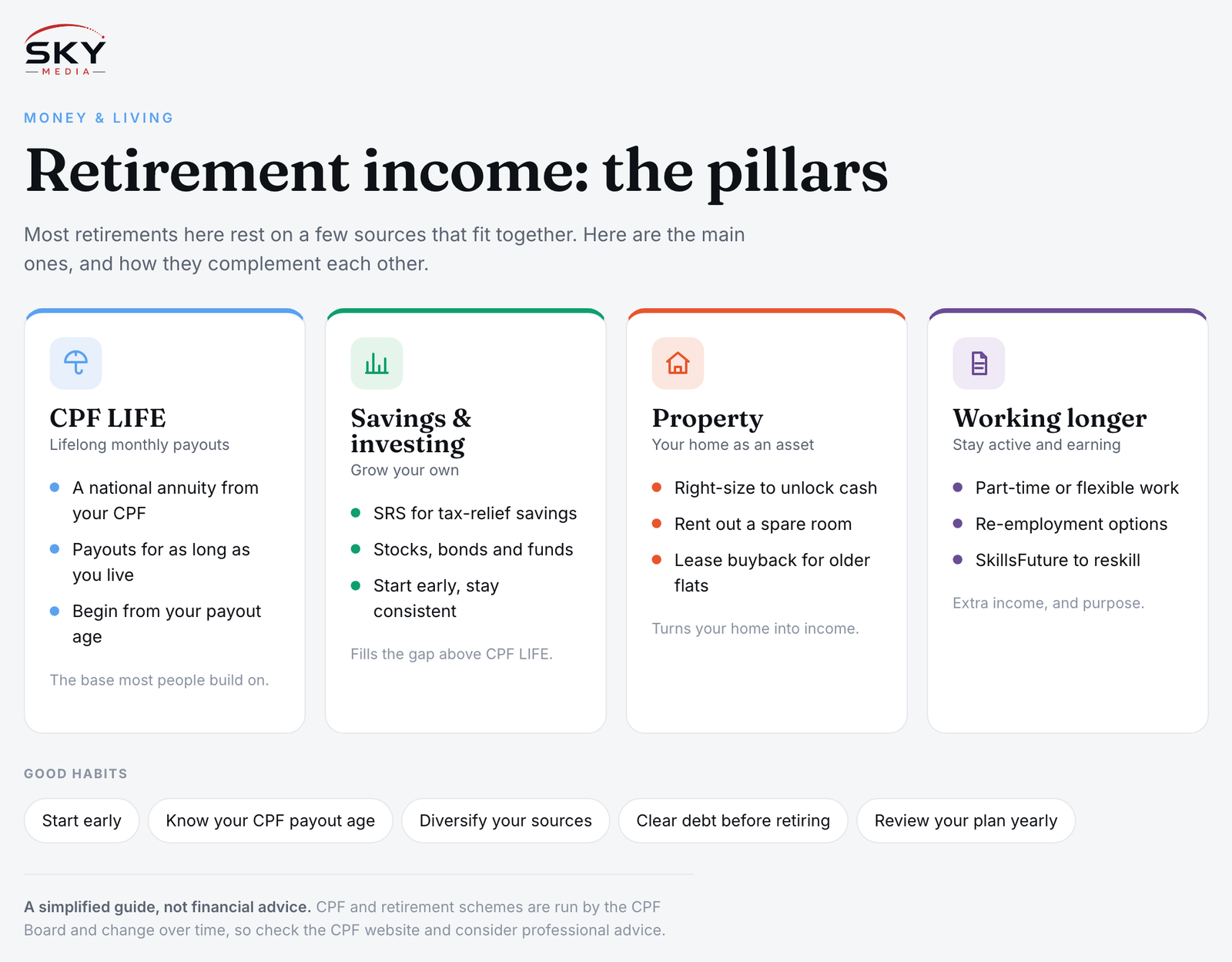
Start with your foundation: CPF LIFE
For Citizens and Permanent Residents, CPF LIFE provides a monthly income for life once payouts begin. This is a powerful base because it does not run out, no matter how long you live. Knowing roughly what your CPF LIFE payout might be gives you a starting figure to plan around. Everything else you build is designed to top up this base to the lifestyle you want.
Layer your retirement income
Think of retirement income as several layers stacked together.
| Layer | Role | Examples |
|---|---|---|
| Base | Guaranteed lifelong income | CPF LIFE |
| Tax-advantaged savings | Extra retirement savings, possible tax relief | CPF top-ups, SRS |
| Personal investments | Growth over the long term | Diversified funds, shares |
| Cash buffer | Liquidity and emergencies | Savings held outside CPF |
The more layers you build, the more comfortable and flexible your retirement becomes. No single layer needs to do everything.
Estimate what you will need
A rough target makes planning concrete. Think about the lifestyle you want, then estimate your likely monthly expenses in retirement, remembering that some costs fall, such as commuting, while others rise, such as healthcare. Compare that figure to your expected CPF LIFE payout, and the gap is what your savings and investments need to fill. You do not need perfect precision. A reasonable estimate, revisited every few years, is far better than no plan at all.
Steps by life stage
Retirement planning looks different depending on where you are.
- In your 20s and 30s: time is your biggest asset. Build the habit of saving and investing regularly, even small amounts, and let compounding work. Keep an emergency fund.
- In your 40s: peak earning years for many. Increase contributions, consider CPF top-ups and the Supplementary Retirement Scheme, and check you are on track against your target.
- In your 50s: sharpen the picture. Reduce unnecessary risk over time, clear high-interest debt, and confirm your CPF and insurance arrangements.
- Approaching payout age: decide when to start CPF LIFE payouts, tidy your accounts, and plan how you will draw down other savings.
The Supplementary Retirement Scheme
The Supplementary Retirement Scheme (SRS) is a voluntary scheme that can complement CPF. Contributions may bring tax relief, and the money can be invested while it sits in the account. Withdrawals in retirement have their own tax treatment. It is worth understanding as one of the tax-advantaged tools available, especially for those with spare income after building their core savings.
Habits that make the difference
- Automate saving. Pay your future self first, before spending.
- Invest for the long term. Time in the market, through diversified, low-cost investments, tends to beat trying to time it.
- Protect the plan. Adequate insurance stops a health or life shock from derailing your savings.
- Review regularly. Life changes, so revisit your plan every couple of years.
It is never too early or too late
If you are young, starting now gives compounding decades to work, which is an enormous advantage. If you are older and feel behind, the answer is not to give up but to act with focus: save more aggressively, reduce risk sensibly, and make full use of CPF and SRS. Wherever you are, a clear roadmap turns a vague worry into a set of manageable steps.
Traps that quietly derail retirement plans
Even well-intentioned savers fall into a few common traps. Knowing them in advance is half the battle.
- Lifestyle creep. As income rises, spending often rises to match, leaving nothing extra for the future. Directing a share of every pay rise straight into savings beats it.
- Waiting for the perfect moment. People delay investing until they feel they know enough, losing years of compounding. Starting small and learning as you go is far better than waiting.
- Underestimating healthcare and longevity. Living longer is wonderful, but it means your money must last longer too. Plan for a long retirement, not an average one.
- Being too conservative too early. Holding only cash for decades can mean inflation erodes your savings. A sensible level of long-term investment matters.
- No protection. A single uninsured health or income shock can wipe out years of saving. Adequate insurance protects the plan itself.
Make it automatic
The single most effective habit is to remove willpower from the equation. Set up automatic transfers to savings and investments on payday, before you have a chance to spend the money, and schedule CPF top-ups if they suit you. Automation turns good intentions into consistent action, month after month, without you having to decide each time.
Build on your CPF LIFE base, layer savings and investments on top, automate the whole thing, and revisit the plan as you go, and retirement becomes something you have prepared for rather than something that happens to you.
Plan for healthcare, not just income
A comfortable retirement income can still be undone by medical costs, so healthcare deserves its own line in your plan rather than being lumped in with general spending. In Singapore, several building blocks work together here. Your MediSave account helps pay for approved treatments, hospital stays, and certain outpatient bills, while MediShield Life provides basic protection against large hospital bills for life. Many people add an Integrated Shield Plan for higher ward classes or private options, and CareShield Life or ElderShield offers payouts if severe disability leaves you needing long-term care. The key is to know what you already have before buying more.
- Map your existing cover first. Check your MediShield Life tier and whether you hold an Integrated Shield Plan, so you avoid paying twice for protection you already have.
- Keep some MediSave headroom. Leaving a healthy MediSave balance going into retirement gives you a dedicated pool for premiums and approved bills.
- Factor in premiums for life. Health insurance premiums generally rise with age, so budget for them as an ongoing retirement expense, not a one-off.
Schemes, limits, and premiums are reviewed from time to time, so confirm the current details with the CPF Board, the Ministry of Health, or your insurer before making decisions.
Your home as a retirement asset
For many Singaporeans, the family home is the largest asset they own, and it can play a quiet but useful role in retirement. The point is not to treat property as a guaranteed windfall, but to understand the options that exist if you need to unlock some value later. Right-sizing to a smaller or less costly flat can free up cash while reducing running expenses, and certain HDB schemes, such as the Lease Buyback Scheme, let eligible flat owners monetise part of their lease for retirement income while continuing to live at home. Each option has its own conditions, trade-offs, and long-term implications for what you leave behind, so treat these as tools to consider rather than defaults. Eligibility rules and scheme terms change over time, so check the latest position with HDB and the CPF Board, and weigh any decision against your wider plan before committing.
Explore more: CPF LIFE explained · Your SRS account explained · Investing basics in Singapore