
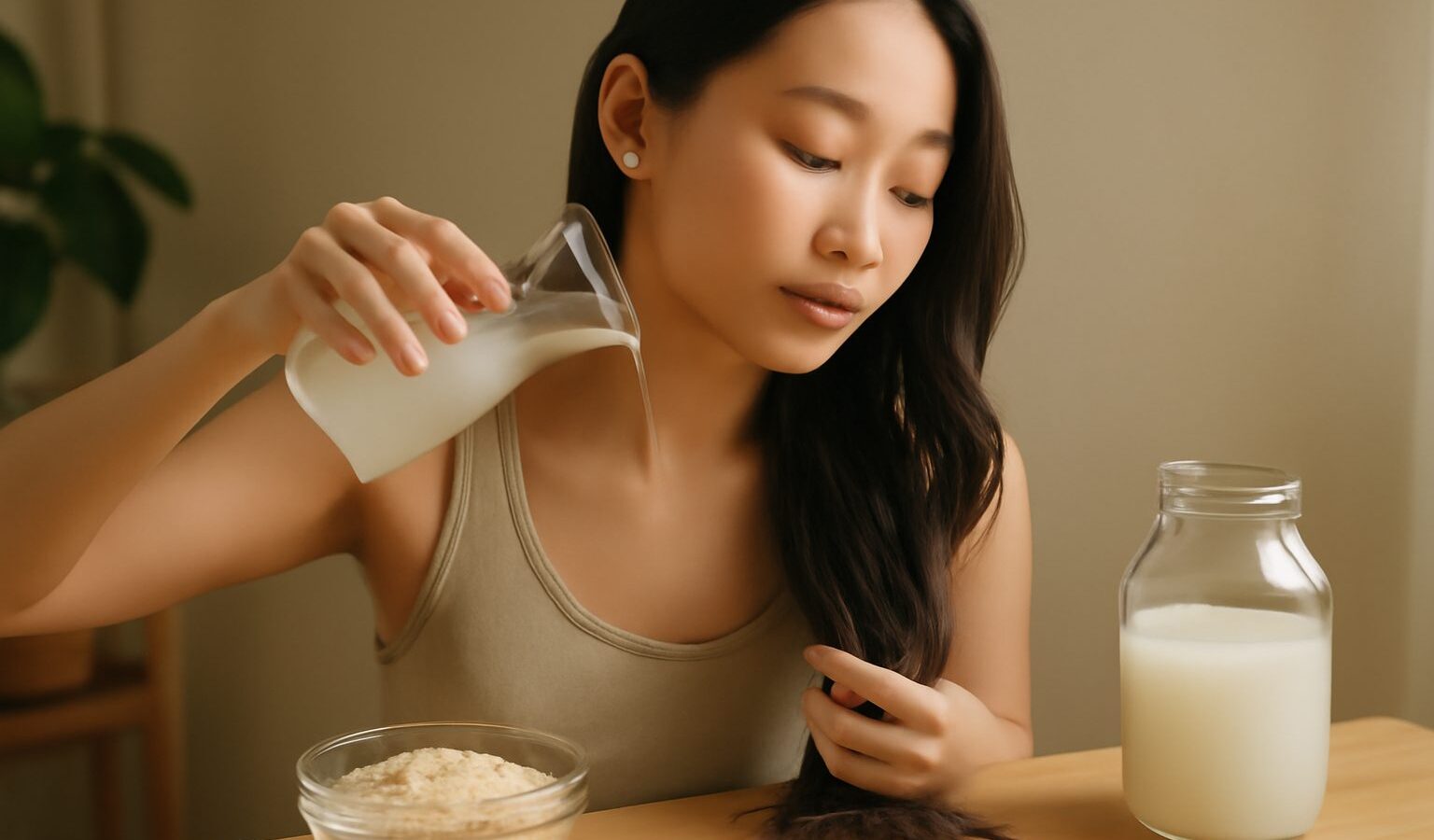
Few hair traditions have travelled as far as this one. Rice water for hair in Singapore turns up everywhere from grandmothers’ advice to social media tutorials, usually with promises of longer, shinier, stronger strands. It is an old practice worth understanding on its own terms: honestly, with realistic expectations, and with a few safety notes so you get the pleasant parts without the pitfalls.
This is general grooming information, not medical advice. If you have a scalp condition, significant hair loss or any irritation, see a doctor or dermatologist rather than relying on a home remedy.
The Tradition and What It Is
Rinsing hair with the starchy water left over from soaking or cooking rice is a long-standing practice in several Asian cultures. It is often linked to communities known for very long hair, and it has been passed down for generations as a simple, low-cost hair rinse.
Rice water is essentially water that has taken on some of the starch and small amounts of compounds from rice, including trace vitamins, minerals and amino acids. Some people use plain soaked rice water, others ferment it for a day or two, which changes its smell and lowers its pH.
There are a few common ways to prepare it:
- Soaking: rinse raw rice, cover with water, leave for around 30 minutes, then strain.
- Fermenting: leave the soaked water at room temperature for a day or so until slightly sour, then dilute before use.
- Cooked: the cloudy water left after boiling rice, cooled before use.
It sits within a wider family of traditional scalp and hair rituals. If you enjoy that approach, our guides to hair oiling and scalp treatments and scalp care and dandruff are worth a look too.
What the Evidence Actually Says
Here is the honest part. The evidence for rice water for hair is largely anecdotal. Plenty of people report that their hair feels smoother and looks shinier after using it, and that is a real, pleasant experience. But strong scientific proof that rice water makes hair grow longer or faster, or permanently stronger, is limited.
A few reasonable observations:
- The starch and proteins can coat the hair and give a temporary smoothing, softening effect, which can make hair feel silkier and easier to manage.
- Any shine or slip you notice is mostly a surface effect that washes out, not a structural change to the hair.
- Claims about dramatic growth are not well supported. Hair growth is influenced by genetics, health, nutrition and hormones, none of which a rinse can override.
So treat rice water as a gentle, traditional finishing rinse that some people simply enjoy, rather than a proven treatment. If it makes your hair feel nice, that is a fair reason to use it. Just do not expect miracles, and do not use it to replace medical care for a genuine problem.
How to Use It Safely
Rice water is generally low-risk, but a few sensible habits keep it that way, especially in Singapore’s warm climate where anything left out ferments quickly.
- Patch test first on a small area of skin and scalp, particularly if you have sensitive skin.
- Dilute it, especially fermented rice water, which is more acidic and stronger smelling. Watered-down is gentler.
- Do not leave it on too long. A few minutes is plenty. Leaving protein-rich rinses on for extended periods can, for some people, make hair feel stiff, straw-like or brittle rather than soft.
- Rinse well afterwards with clean water. Do not let starchy residue sit on your scalp, which can feel itchy or flaky.
- Use it occasionally, perhaps once a week or less, not with every wash. More is not better here.
- Make it fresh and keep it cool. In the heat, discard anything that smells strongly off, and do not store it for long. Refrigerate briefly if you must, and throw out leftovers.
A specific caution about protein: hair can react to too much of a good thing. If your hair starts to feel dry, hard or snappy after regular use, you may be getting protein overload. Ease off, and focus on moisture and conditioning instead.
Fitting It Into a Real Routine
Rice water works best as an optional extra, not the foundation of your hair care. The everyday basics matter far more: a suitable shampoo and conditioner, gentle handling, heat awareness and protection from the humidity. Our guide to hair care in Singapore’s climate covers those fundamentals.
If you are drawn to the idea because you like rice-derived ingredients, note that formulated products take a different, more controlled approach. Our companion piece on rice extract and rice water in skincare looks at how these ingredients show up in modern formulas.
Rice water for hair in Singapore is a lovely tradition to try if you are curious. Approach it honestly: the benefits are mostly a temporary, cosmetic smoothing, the growth claims are not well proven, and the real rules are simple. Dilute it, do not leave it on too long, rinse thoroughly, use it sparingly, and keep it fresh. For anything beyond ordinary hair care, such as sudden shedding or a troubled scalp, speak to a professional.