

If you hold shares or REIT units listed on the Singapore Exchange (SGX), sooner or later a letter or notification will arrive about a corporate action. The three most common are rights issues, bonus issues and scrip dividends. Each one asks something different of you, from paying for new shares to simply choosing between cash and shares, and a few come with deadlines that cost you money if you miss them.
This guide explains how a rights issue in Singapore works alongside bonus issues and scrip dividends, what your options are, and how to respond. It is general information, not financial advice. The details of each offer are set out in the company’s announcement and offer documents on SGXNet, so always read those and speak to a licensed adviser if you are unsure.
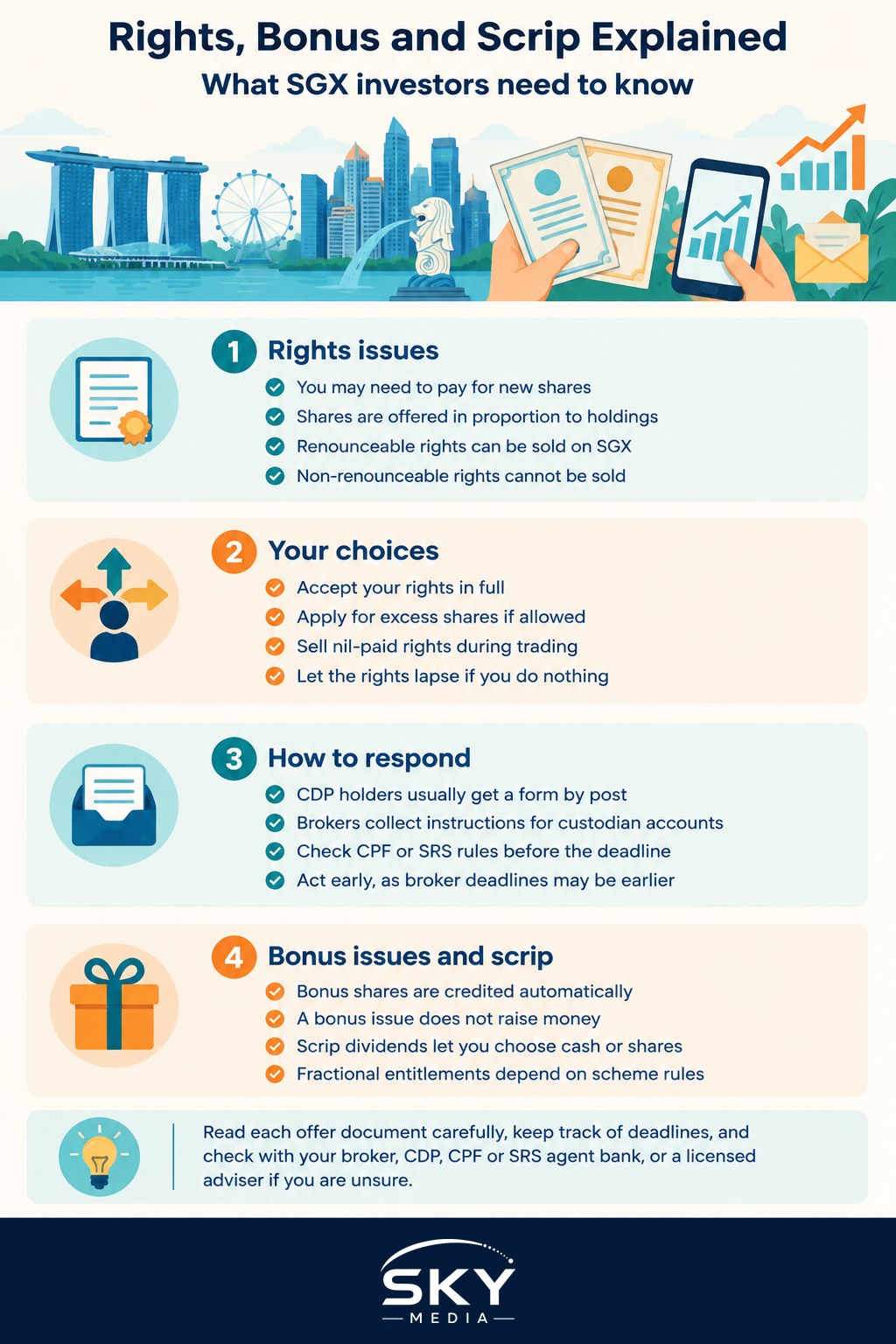
How a Rights Issue Works
A rights issue is a way for a listed company or REIT to raise money from existing shareholders. You are offered the right to buy new shares in proportion to what you already own, for example a certain number of new shares for every set number held, usually at a discount to the market price.
Key terms you will see:
- Ratio. How many rights you get per share held.
- Issue price. What you pay per new share.
- Books closure or record date. You must hold the shares by this date to receive rights.
- Renounceable rights. Rights you can sell to someone else. These trade on SGX for a short period as “nil-paid rights”.
- Non-renounceable rights. Rights you can only accept or let lapse. You cannot sell them.
- Excess rights. Extra shares you can apply for beyond your entitlement, allocated from rights others did not take up.
Because new shares are issued at a discount, the share price usually adjusts downward once the shares go “ex-rights”. If you do nothing, your percentage ownership in the company shrinks, which is called dilution, and with renounceable rights you also lose whatever value the rights had.
Your Four Choices With Rights
When you receive renounceable rights, you typically have four paths:
- Accept in full. Pay for all your new shares and keep your ownership percentage.
- Accept and apply for excess. Take up your entitlement and ask for more. Excess shares are allocated according to the rules in the offer document, and you are refunded for any you do not get.
- Sell the nil-paid rights. Trade them on SGX during the rights trading period through your broker, and receive cash instead of investing more.
- Do nothing. The rights lapse after the closing date. For renounceable rights, this means giving up value you could have sold.
You can also mix these, such as selling some rights and accepting the rest. With non-renounceable rights, your choices are simply to accept, apply for excess where allowed, or let them lapse.
Before deciding, ask yourself whether you still believe in the company, why it is raising money (growth, an acquisition or paying down debt), and whether you have spare cash without upsetting your emergency fund.
How to Accept Rights in Practice
How you respond depends on where your shares are held.
- Shares in your own CDP account. The Central Depository (CDP) is the SGX unit that holds shares directly in your name. You usually receive an acceptance form by post, and many offers also allow acceptance through ATMs of participating banks or electronic channels such as the SGX investor portal. The offer document lists the exact methods.
- Shares held with a broker’s custodian account. Your broker notifies you and collects your instructions through its app or platform. Brokers often set an internal deadline earlier than the official closing date, so act early.
- Shares bought with CPF or SRS funds. Whether you can use these funds to accept depends on the scheme’s rules and your agent bank. Check with your CPF or SRS agent bank before the deadline.
Keep a note of the closing date and pay attention to timing if you plan to sell nil-paid rights, since the trading window is short and closes before acceptance does.
Bonus Issues: Free Shares, Same Value
A bonus issue gives existing shareholders additional shares at no cost, in a set ratio. It does not raise money for the company. Instead, it capitalises reserves into share capital.
What it means for you:
- You do not need to act. The new shares are credited to your CDP or custodian account automatically after the books closure date.
- Your total value stays roughly the same. The share price adjusts downward to reflect the larger number of shares. Owning more shares does not make you richer on its own.
- Your holding may end up in odd lots. A bonus ratio can leave you with a number of shares smaller than a standard board lot. Odd lots can still be traded on SGX, though sometimes with a wider price spread.
Companies also sometimes issue bonus warrants, which give you the right to buy shares at a set price before an expiry date. Unlike bonus shares, warrants do require a decision: exercise, sell, or let them expire. Note the expiry date, as unexercised warrants become worthless.
Scrip Dividends: Shares Instead of Cash
Under a scrip dividend scheme, a company lets shareholders choose to receive a dividend in new shares instead of cash. The scrip price is often set at a small discount to the recent market price, which can make it appealing for long-term holders who would reinvest the dividend anyway.
What to consider:
- Election is usually by form or broker instruction within a set period. If you do nothing, you normally receive cash by default, but check the specific scheme.
- Some schemes let you elect permanently for future dividends until you change your mind.
- Fractional entitlements are typically paid in cash or disregarded, depending on the scheme rules.
- Custodian accounts may not offer the choice. Some brokers pass on only the cash option, so check before assuming you can elect scrip.
For income investors who rely on cash dividends, taking cash is often the simpler choice. Our guide to dividend investing in Singapore covers how dividends fit into a portfolio more broadly.
Comparing the Three Corporate Actions
| Corporate action | Do you pay? | Action needed | Main risk if you ignore it |
|---|---|---|---|
| Rights issue (renounceable) | Yes, to accept | Accept, sell nil-paid rights, or apply for excess | Dilution and losing the value of unsold rights |
| Rights issue (non-renounceable) | Yes, to accept | Accept or let lapse | Dilution only |
| Bonus issue (shares) | No | None, credited automatically | None, though you may hold odd lots |
| Bonus warrants | Yes, only to exercise | Exercise, sell or let expire | Warrants expiring worthless |
| Scrip dividend | No | Elect scrip or take cash | Receiving the default option |
Tax and Record-Keeping Points
In general, dividends paid by Singapore-resident companies under the one-tier system are tax-exempt for shareholders, and that typically covers scrip dividends too. Foreign dividends and situations involving trading activity can be treated differently. Confirm your own position with IRAS (the Inland Revenue Authority of Singapore) or a tax professional, particularly if you trade frequently or hold shares through a company.
Good habits:
- Keep copies of offer documents, acceptance forms and payment receipts.
- Record your adjusted cost per share after rights or bonus issues, so you know your true gain or loss later.
- Update your mailing address with CDP so you do not miss physical notices.
If a windfall prompted you to start investing, our guide on what to do with a bonus or windfall can help you decide how much belongs in shares in the first place.
Explore more: Dividend Investing in Singapore · Tax on China Dividends and Interest You Receive in Singapore · What to Do With a Bonus or Windfall
Further reading: Ex-Dividend Dates Explained: When You Must Own a Stock to Get the Dividend