

You spot a Singapore stock announcing a dividend, buy it a day or two before the announced date, and then find you are not getting the payout. This is one of the most common surprises for new investors, and it comes down to how the ex dividend date in Singapore works alongside SGX’s settlement cycle.
This guide focuses purely on timing mechanics: what each date means, why the ex-date sits where it does, and how to work out the last day you can buy. For choosing dividend stocks and building income, see our guide to dividend investing in Singapore. This is general information, not financial advice.
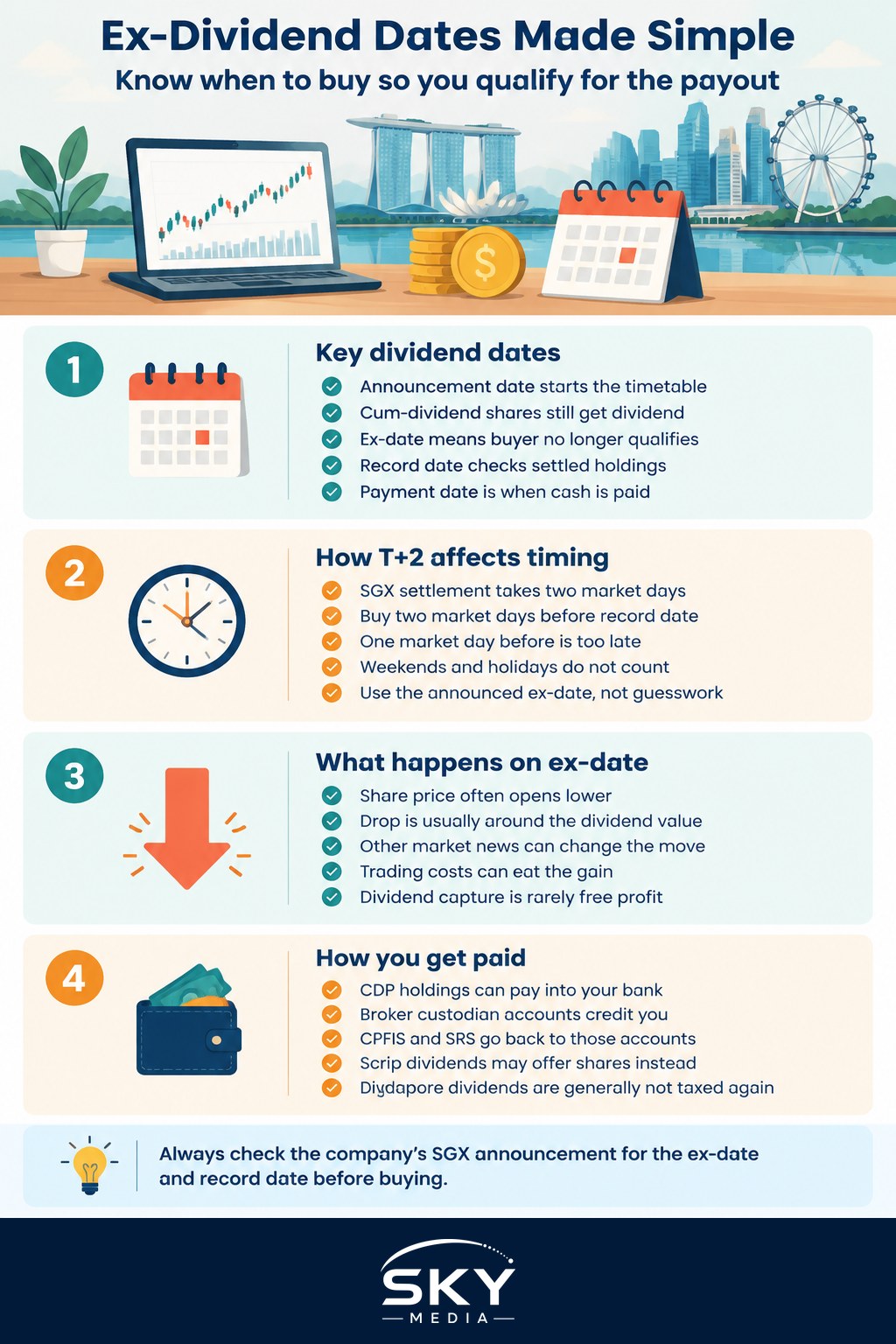
The Key Dates in Every Dividend Announcement
When a company listed on the Singapore Exchange (SGX) declares a dividend, its announcement on SGXNet usually lists several dates. Each has a specific job.
- Announcement (declaration) date. The day the company tells the market the dividend amount and the timetable. For final dividends, the dividend may still need shareholders’ approval at the annual general meeting.
- Cum-dividend period. “Cum” means “with”. Shares traded during this period carry the right to the upcoming dividend. The last cum-dividend day is the last day you can buy and still qualify.
- Ex-dividend date. “Ex” means “without”. From this trading day onwards, buyers do not get the declared dividend. The seller keeps it instead.
- Record date. The date on which the company (through its share registrar and The Central Depository, or CDP) checks who its shareholders are. You must be on the register at the close of this day. SGX announcements used to call this the “books closure date”, and you may still see that term.
- Payment date. The day the money is actually paid out. This can be a few weeks after the record date.
Why T+2 Settlement Moves the Deadline Earlier
Buying a share on SGX does not make you the registered owner instantly. Singapore uses a T+2 settlement cycle, which means a trade is settled two market days after the trade date (T). Only after settlement do the shares show in your name in CDP’s records.
Because the company looks at its register at the end of the record date, your purchase must settle by then. Working backwards:
- A trade made two market days before the record date settles on the record date. You qualify.
- A trade made one market day before the record date settles the day after. You do not qualify.
That is why the ex-dividend date on SGX normally falls one market day before the record date, and the last day to buy (the final cum-dividend day) is two market days before the record date. Weekends and public holidays do not count as market days, so a long weekend or a holiday such as Deepavali can push the dates further apart on the calendar.
Always use the ex-date stated in the company’s announcement rather than calculating it yourself. Settlement rules can change, and SGX’s announcement is the authoritative timetable.
A Worked Example
Imagine a company announces a dividend with a record date on a Friday, and there are no public holidays that week.
| Date | Day | What it means for you |
|---|---|---|
| Last cum-dividend day | Wednesday | Buy on or before this day to receive the dividend |
| Ex-dividend date | Thursday | Buy on or after this day and the seller keeps the dividend |
| Record date | Friday | Your Wednesday trade has settled, so you are on the register |
| Payment date | Several weeks later | Dividend is credited to you |
Notice that selling works the other way round. If you own the shares and sell on or after the ex-date, you still receive the dividend, because you were the holder of record. Sell on the last cum day or earlier, and the buyer gets it.
What Happens to the Share Price on the Ex-Date
Many new investors try a “dividend capture” trade: buy just before the ex-date, collect the dividend, and sell straight after. In practice, this rarely produces a free profit.
On the ex-dividend date, a share’s price tends to open lower by roughly the value of the dividend, because new buyers are no longer getting that payout. Other market news also moves the price on the day, so the drop is not exact. But on average, what you gain in dividend you tend to lose in price.
Add brokerage commissions, clearing fees and other trading charges on both the buy and the sell, and short-term dividend capture often leaves you worse off. Dividends are usually better viewed as part of a long-term holding than as a quick trade.
How You Actually Receive the Money
How the dividend reaches you depends on how you hold your shares.
- CDP account (direct holding). If your shares are held in your own CDP securities account, dividends are paid through CDP. Linking your bank account to CDP’s direct crediting service means cash goes straight into your bank on the payment date. Without it, you may receive a cheque or face delays.
- Custodian account. Many online brokers hold shares in a nominee or custodian account. The broker receives the dividend and credits it to your trading or cash account. Check whether your broker charges a dividend handling fee, as some do.
- CPF Investment Scheme or SRS. Shares bought through the CPF Investment Scheme or the Supplementary Retirement Scheme are held through your agent bank, and dividends are credited back into the relevant account rather than paid to you as cash.
Some companies offer a scrip dividend scheme, letting shareholders choose new shares instead of cash. The announcement will set out the election deadline and how the share price for the scrip is calculated. If you do nothing, you usually get the default option stated in the announcement.
On tax, dividends from Singapore-resident companies under the one-tier corporate tax system are generally not taxed again in individual shareholders’ hands. Distributions from REITs and foreign shares can be treated differently. Check IRAS for current rules on your situation.
Common Timing Mistakes to Avoid
- Buying on the ex-date. The ex-date is the first day you will not get the dividend, not the last day you will.
- Confusing the record date with the buying deadline. Buying on the record date itself is too late under T+2.
- Forgetting holidays. Singapore public holidays, and market closures, shift market days. Check the SGX trading calendar.
- Applying SGX rules to overseas stocks. US markets moved to a shorter T+1 settlement cycle, so the ex-date relationship differs there. Our guide to investing in US stocks from Singapore covers how foreign holdings work.
- Assuming a dividend is certain. Final dividends can still need shareholder approval, and companies can change their dividend policy. Read the announcement in full.
Where to Check the Official Dates
The most reliable source is the company’s corporate action announcement on the SGX website, which lists the ex-date, record date and payment date. Your broker’s platform or CDP’s online services usually show upcoming corporate actions for stocks you hold. If anything seems inconsistent, the company’s announcement prevails, and you can contact its share registrar or investor relations team.
Once you understand that you must buy before the ex-date, and that the record date is a check on settled holdings rather than a buying deadline, dividend timing on SGX becomes straightforward.
Explore more: Dividend Investing in Singapore · Investing in US Stocks From Singapore
Frequently Asked Questions
Do ex-dividend dates work the same way for REITs and ETFs on SGX? The timing logic is the same for any SGX-listed security that announces a distribution, since settlement still decides who is on the register. The terms may differ, such as distribution instead of dividend, and the tax treatment can be different, so read each announcement and check IRAS.
Do I have to hold a share for a minimum period to get the dividend? No minimum holding period applies for the payout itself. What counts is being on the register at the record date, which means buying early enough for the trade to settle. You could sell on or after the ex-date and still receive the dividend.
How often do Singapore-listed companies pay dividends? It varies by company. Some pay quarterly, others twice a year, once a year or only occasionally. The announcement on SGXNet gives the timetable for each declaration, and a company’s past pattern is no guarantee of future payments, so read each announcement.
How do I work out a stock’s dividend yield? Divide the dividends paid per share over a year by the current share price, then express it as a percentage. Because the price keeps moving, the yield changes too. Compare the figure across several years rather than judging by one announcement.
Is a very high dividend yield always a good sign? Not necessarily. A high yield can mean the share price has fallen sharply, or that the payout may be hard to sustain. Look at the company’s earnings, debt and dividend history, and remember that a company can change its dividend policy at any time.
Further reading: Rights Issues, Bonus Issues and Scrip Dividends Explained · The W-8BEN Form and US Dividend Tax for Singapore Investors