

A sore throat is one of the most common reasons parents bring a child to a GP or polyclinic. Most are caused by viruses and settle on their own. A smaller share are caused by bacteria called group A Streptococcus, and when that infection also produces a distinctive rash, it is known as scarlet fever. Scarlet fever in children sounds old-fashioned and alarming, but today it is usually straightforward to treat once it is recognised.
This guide explains how strep throat and scarlet fever differ from an ordinary cold, why doctors usually prescribe antibiotics, how long a child typically stays away from school or childcare, and which rare complications are worth knowing about. It is general information, not medical advice. Always follow the guidance of your child’s doctor.
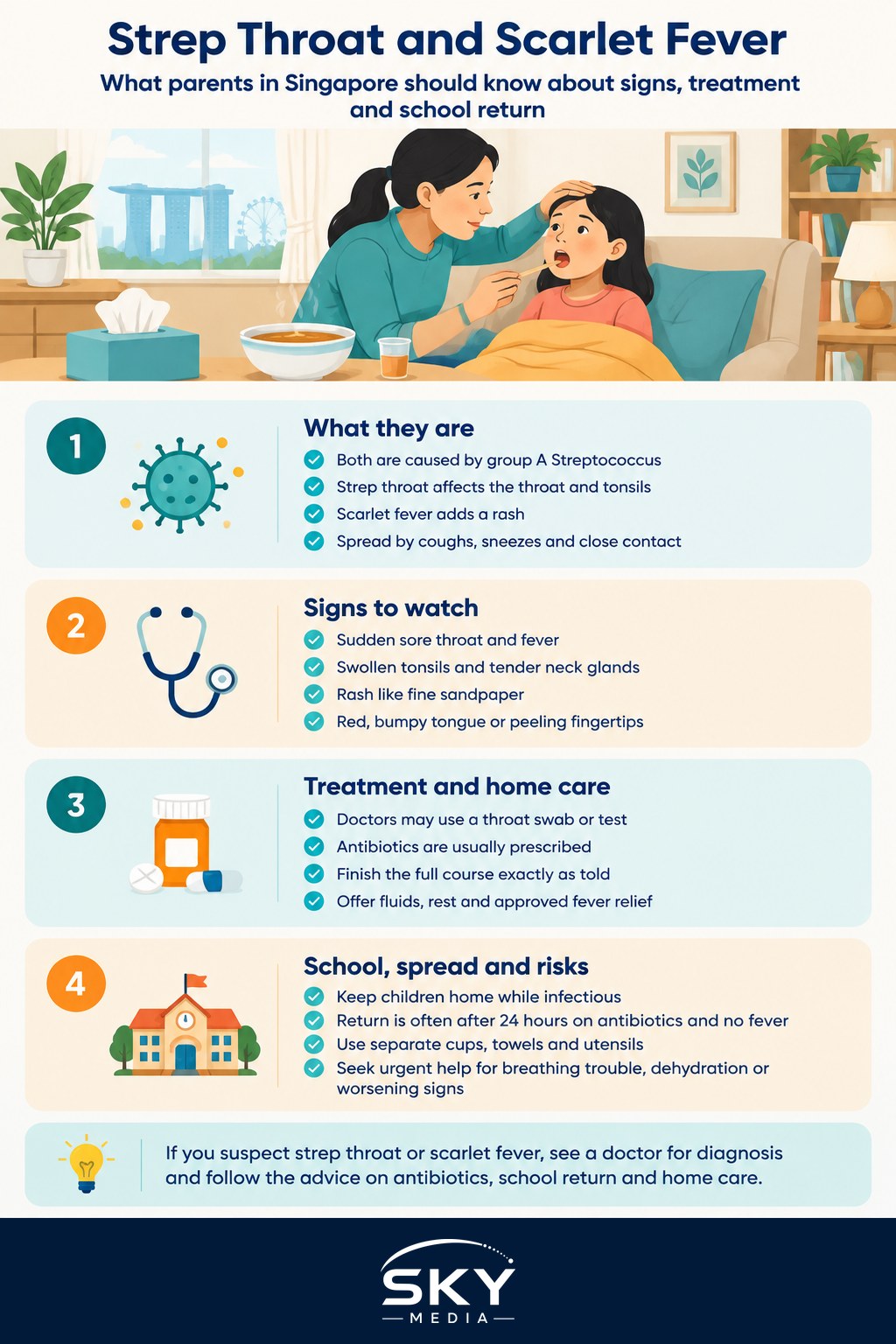
What Strep Throat and Scarlet Fever Actually Are
Both conditions come from the same bacteria, group A Streptococcus (often shortened to “group A strep”). This is a different organism from the group B strep that pregnant women are screened for, which we cover in Group B Strep in Pregnancy Explained.
- Strep throat is a bacterial infection of the throat and tonsils. It is most common in school-age children, though younger children and adults can catch it too.
- Scarlet fever is strep throat (or, less often, a strep skin infection) plus a rash. Some strains of the bacteria release a toxin that causes the rash and the reddened tongue.
The bacteria spread through droplets from coughs and sneezes, close contact, and shared cups or utensils. That is why cases often cluster in classrooms, childcare centres and households.
Signs to Look Out For
Symptoms usually start suddenly, often a few days after exposure. Not every child has every sign, and only a doctor can confirm the diagnosis.
Common signs of strep throat:
- Sore throat, sometimes severe, with pain on swallowing
- Fever
- Red, swollen tonsils, sometimes with white patches or streaks
- Tender, swollen glands in the front of the neck
- Headache, tummy ache, nausea or vomiting, especially in younger children
- Usually no runny nose or cough, which is one clue it may not be a typical cold
Extra signs that suggest scarlet fever:
- A rash of tiny red bumps that feels rough, like fine sandpaper, often starting on the neck and chest and spreading outwards
- The rash may be harder to see on darker skin, but the rough texture can still be felt
- Skin folds such as the armpits and elbow creases may look redder
- Flushed cheeks with a paler area around the mouth
- A “strawberry tongue”, which looks red and bumpy, sometimes after an initial white coating
- Peeling skin on the fingertips and toes as the rash fades, often a week or so later
Because fever and sore throat are so common, it helps to know the general fever guidance too. Our guides on managing a fever in children and when a child’s fever needs a doctor cover home care and red flags.
How It Differs From a Viral Sore Throat
| Feature | Viral sore throat or cold | Strep throat or scarlet fever |
|---|---|---|
| Onset | Often gradual | Often sudden |
| Runny nose and cough | Common | Usually absent |
| Rash | Uncommon, or a different type | Sandpaper-like rash in scarlet fever |
| Tongue | Usually normal | May become red and bumpy |
| How it is confirmed | Clinical judgement | Doctor’s assessment, sometimes a throat swab or rapid test |
| Usual treatment | Rest, fluids, symptom relief | Antibiotics prescribed by a doctor |
This table is a rough guide only. If you suspect strep, see a doctor rather than trying to sort it out yourself.
Diagnosis and Why Antibiotics Matter
A GP, polyclinic doctor or paediatrician will usually examine the throat, skin and neck glands. Some clinics use a throat swab, either for a rapid test or for a lab culture, to confirm group A strep.
If strep is confirmed or strongly suspected, the doctor will normally prescribe antibiotics. These help in several ways:
- They shorten the illness and ease symptoms sooner
- They reduce the period during which your child can spread the infection
- They lower the risk of complications
Finish the full course. Your child will often feel better within a day or two, but stopping early can leave bacteria behind. Follow the doctor’s instructions on the dose and duration exactly, and do not use leftover antibiotics from a previous illness or another family member. If your child has a known allergy to any antibiotic, tell the doctor before anything is prescribed.
At home, you can help with comfort measures your doctor approves:
- Offer plenty of fluids; cool drinks, soft foods and ice pops can soothe a sore throat
- Let your child rest
- Use fever and pain medicine only as advised by the doctor or pharmacist, at the right dose for your child’s age and weight
- Wash hands often, and keep cups, towels and utensils separate
School and Childcare: When Can Your Child Go Back?
Strep is contagious, so children are generally kept away from school, kindergarten or childcare while they are infectious. A common guideline is that a child can return once they have been on antibiotics for at least 24 hours and no longer have a fever, but the exact rule your child must follow depends on the doctor’s advice and the policy of the school or centre.
Practical steps:
- Ask the doctor for a medical certificate covering the days your child should stay home.
- Inform the school or centre. Many preschools have their own exclusion policies for infectious diseases and may want to alert other parents so they can watch for symptoms.
- Check the centre’s re-entry rules. Some childcare centres may ask for a doctor’s note stating the child is fit to return.
- Watch siblings. Brothers and sisters may develop symptoms in the following days. See a doctor if they do.
Your child’s school, the Early Childhood Development Agency (ECDA) for preschools, and the Ministry of Health (MOH) publish guidance on infectious diseases. Requirements can change, so confirm the current rules with your school or centre.
Complications to Know About
With prompt treatment, most children recover fully. Complications are uncommon, but knowing them helps you act quickly.
Possible complications include:
- Ear infections and sinus infections from the bacteria spreading nearby
- A collection of pus near the tonsils (peritonsillar abscess), which can cause severe one-sided throat pain, a muffled voice and difficulty opening the mouth
- Rheumatic fever, an inflammatory condition that can affect the heart and joints, weeks after an untreated strep infection
- Kidney inflammation (post-streptococcal glomerulonephritis), which may show as dark or cola-coloured urine or puffy eyes
- Invasive group A strep, a rare but serious infection where the bacteria enter the blood or deeper tissues
Seek urgent medical help (go to A&E or call 995) if your child:
- Has difficulty breathing, or is breathing very fast
- Is very drowsy, hard to wake, floppy or confused
- Cannot swallow saliva, is drooling, or cannot drink
- Shows signs of dehydration, such as very little urine
- Has a rash that does not fade when pressed with a glass
- Has a painful, red, swollen area of skin that is spreading quickly
- Seems to be getting worse rather than better after starting antibiotics
Also return to the doctor if new joint pain, chest pain, dark urine or swelling appears in the weeks after the illness.
Reducing the Spread at Home
You cannot always prevent strep, but good habits help:
- Teach children to cough or sneeze into a tissue or elbow, and to wash hands with soap afterwards
- Avoid sharing water bottles, cups and cutlery, especially at school
- Replace your child’s toothbrush once they have been on antibiotics for a day or so
- Keep a sick child home until the doctor says they can return
If your child seems to get strep throat repeatedly, discuss it with your doctor or a paediatrician, who can advise on next steps.
Explore more: Conjunctivitis in Children, another common infection that spreads quickly in classrooms.
Official sources: HealthHub
Further reading: Appendicitis in Children: Signs Parents Should Not Miss · Mycoplasma Pneumonia in Children: Signs Parents Should Know · Tonsillitis in Children: When Do Tonsils Need to Come Out?