

Getting a call from your child’s school about a disciplinary matter is stressful. You may wonder how serious it is, what the school is allowed to do, and whether you should defend your child or back the teachers. Understanding how school discipline in Singapore works makes that conversation calmer and more useful for everyone, especially your child.
This guide explains the broad approach Ministry of Education (MOE) schools take, the common consequences from a reminder to suspension, how caning fits in, and what your role as a parent is. Each school sets its own detailed rules within MOE’s guidelines, so always read your school’s student handbook and ask the school for specifics.
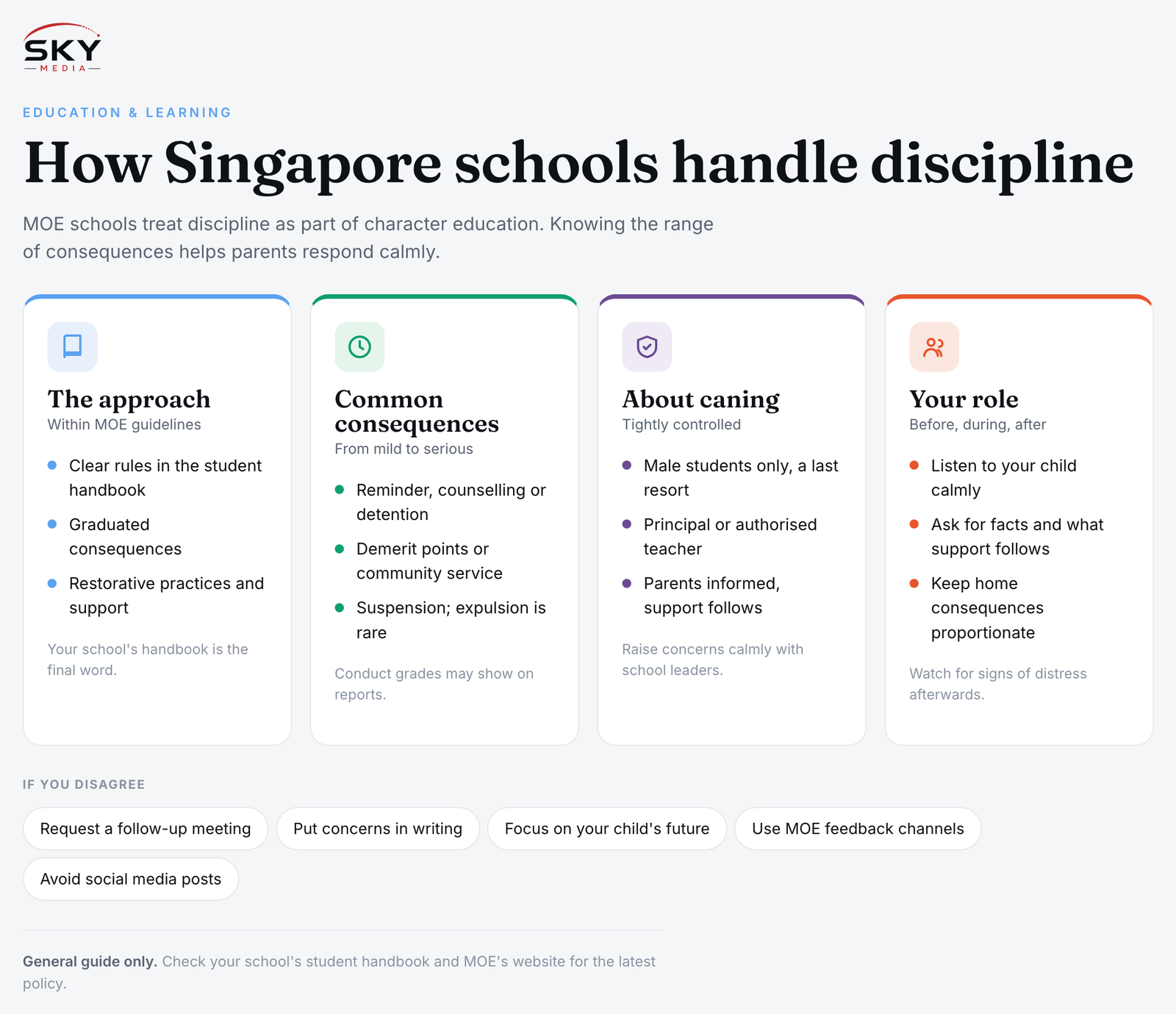
The Thinking Behind Discipline in MOE Schools
Singapore schools see discipline as part of character and citizenship education, not just punishment. The aim is for students to understand why their behaviour was wrong, take responsibility and repair any harm.
A few principles you will commonly see:
- Clear school rules. Each school publishes a code of conduct, usually in the student handbook, covering attendance, uniform, punctuality, phones, respect and safety.
- Graduated consequences. Minor offences get lighter responses. Serious or repeated offences lead to stronger measures.
- Restorative approaches. Many schools use restorative practices, where students reflect on what happened, hear how others were affected, and agree on how to make amends.
- Support alongside consequences. Form teachers, year heads, school counsellors and student welfare officers may work with a child whose behaviour signals a deeper difficulty.
- Partnership with parents. Schools generally inform and involve parents for anything beyond minor matters.
The exact wording and processes differ between primary schools, secondary schools and junior colleges, so treat your school’s handbook as the final word.
Common Consequences, From Mild to Serious
Schools choose consequences based on the offence, its impact, the student’s age and history, and any circumstances. The table below shows a typical range. Not every school uses every measure.
| Consequence | Typical situations | What usually happens |
|---|---|---|
| Verbal reminder or counselling by a teacher | Talking in class, late homework, minor uniform issues | A conversation, sometimes a note home |
| Detention | Repeated lateness, disruption, incomplete work | Staying back after school or during a set period under supervision, often with a reflection task |
| Demerit points or conduct record entry | Repeated minor offences or a moderate offence | A record that may affect the conduct grade; parents may be informed |
| Community service or restorative task | Littering, vandalism, unkind behaviour | Cleaning, helping in school or making amends to those affected |
| Caning | Serious offences, as a last resort, for boys only | Administered under strict rules, with parents informed |
| Suspension | Serious offences such as fighting, theft or serious bullying | Student kept out of class or school for a period, with a return plan |
| Expulsion or transfer | Very serious or repeated serious offences | Rare; handled with MOE involvement and depends on the student’s level |
Your child’s conduct grade may appear in the school report. For older students, it can matter for some applications later, which is one reason schools encourage reflection and improvement rather than just penalties.
Caning: What Parents Should Know
Caning still exists in Singapore schools, but it is tightly controlled and used far less than many people assume. Under MOE’s guidelines, it is generally:
- Only for male students. Female students are not caned in schools.
- A last resort for serious offences, after other measures have been considered.
- Carried out only by the principal or a teacher authorised by the principal, with procedures that include safeguards for the student’s safety and dignity.
- Accompanied by follow-up support, such as counselling, so the student understands the reasons and is helped to change.
- Communicated to parents. Schools inform parents when caning is carried out.
Views on caning vary among families. If you have concerns, raise them calmly with the school leadership and ask how the decision was reached and what support will follow. For the latest policy, check MOE’s official website or ask the school directly.
Suspension and Serious Cases
Suspension is used for serious offences, especially those that hurt others or threaten safety. Schools usually:
- Contact parents promptly and ask to meet
- Explain the incident, the rule broken and the length of the suspension
- Set out what the student must do, such as reflection work or completing assignments
- Plan the return to school, sometimes with counselling or a behaviour plan
If another child was harmed, the school also supports the affected student and may involve both families in a restorative process. In cases involving possible crimes, such as serious assault or theft, the school may involve the police.
Expulsion is rare. Because of compulsory education for primary school children, younger students are generally handled through other measures. For secondary and post-secondary students, very serious cases are handled with MOE. If your family faces this, ask the school to explain each step in writing and what your child’s options are.
Your Role When Your Child Is Punished
How you respond shapes what your child learns from the experience.
Before the meeting
- Listen to your child’s account without interrupting or judging. Ask open questions such as “What happened before that?”
- Stay calm. Your child is watching how you handle conflict.
- Read the school’s code of conduct so you understand the rules involved.
During the meeting
- Ask for the facts: what happened, who saw it, which rule applies and why this consequence was chosen.
- Share relevant context, such as stress at home, learning needs or a health issue, which the school may not know.
- Ask what support will be given, not only what penalty applies.
- Keep the tone respectful. Teachers and parents usually want the same outcome.
Afterwards
- Help your child reflect on choices and on how others were affected.
- Agree together on what to do differently next time.
- Keep home consequences proportionate. Doubling up punishment can backfire. Our guides to positive parenting and discipline and positive discipline that works explain approaches that build self-control rather than fear.
- Watch for signs of distress such as withdrawal, sleep changes or refusing school. If you see them, speak with the form teacher or school counsellor, or seek professional help.
If You Disagree With the School
Sometimes parents believe a decision was unfair or the facts are wrong.
- Ask for a follow-up meeting with the form teacher, year head or discipline master, and then the vice-principal or principal if needed.
- Put concerns in writing, calmly and factually, with dates and details.
- Focus on your child’s future, such as a fair record, support and a clear way back, rather than on winning the argument.
- Escalate through official channels. If you cannot resolve it with the school, contact MOE through its official feedback channels.
Avoid posting about the incident on social media. It can identify your child and other students, and it rarely helps resolve the matter.
Helping Your Child Move Forward
One disciplinary incident does not define a child. Most students who are disciplined learn from it and move on. What helps most is a steady adult who holds them accountable while making it clear they are still loved and trusted. Encourage good habits such as routines and study goals, and our guide to building self-discipline for studying has practical ideas. Stay in touch with the form teacher for a few weeks after the incident so you can spot progress early and praise it.
Official sources: Ministry of Education (MOE)
Further reading: Can Your Child Repeat a Year in a Singapore School? · Values in Action (VIA) in Singapore Schools Explained · Mobile Phone Rules in Singapore Schools: What Students Can and Cannot Do