

If your child has come home talking about a “VIA project”, you may be wondering what it is, whether it is graded, and how much it matters. Values in Action, usually shortened to VIA, is the service learning programme that runs through Singapore’s primary schools, secondary schools and pre-university institutions. This guide to values in action VIA explains what the projects look like, how the school records them, and how they connect to LEAPS, the framework secondary schools use to recognise what students do outside the classroom.
VIA sits under the Ministry of Education’s (MOE) Character and Citizenship Education, often called CCE. It replaced the older Community Involvement Programme (CIP), which many parents will remember as a set number of service hours each year. The shift in name was also a shift in emphasis: less about clocking hours, more about students learning from the act of contributing.
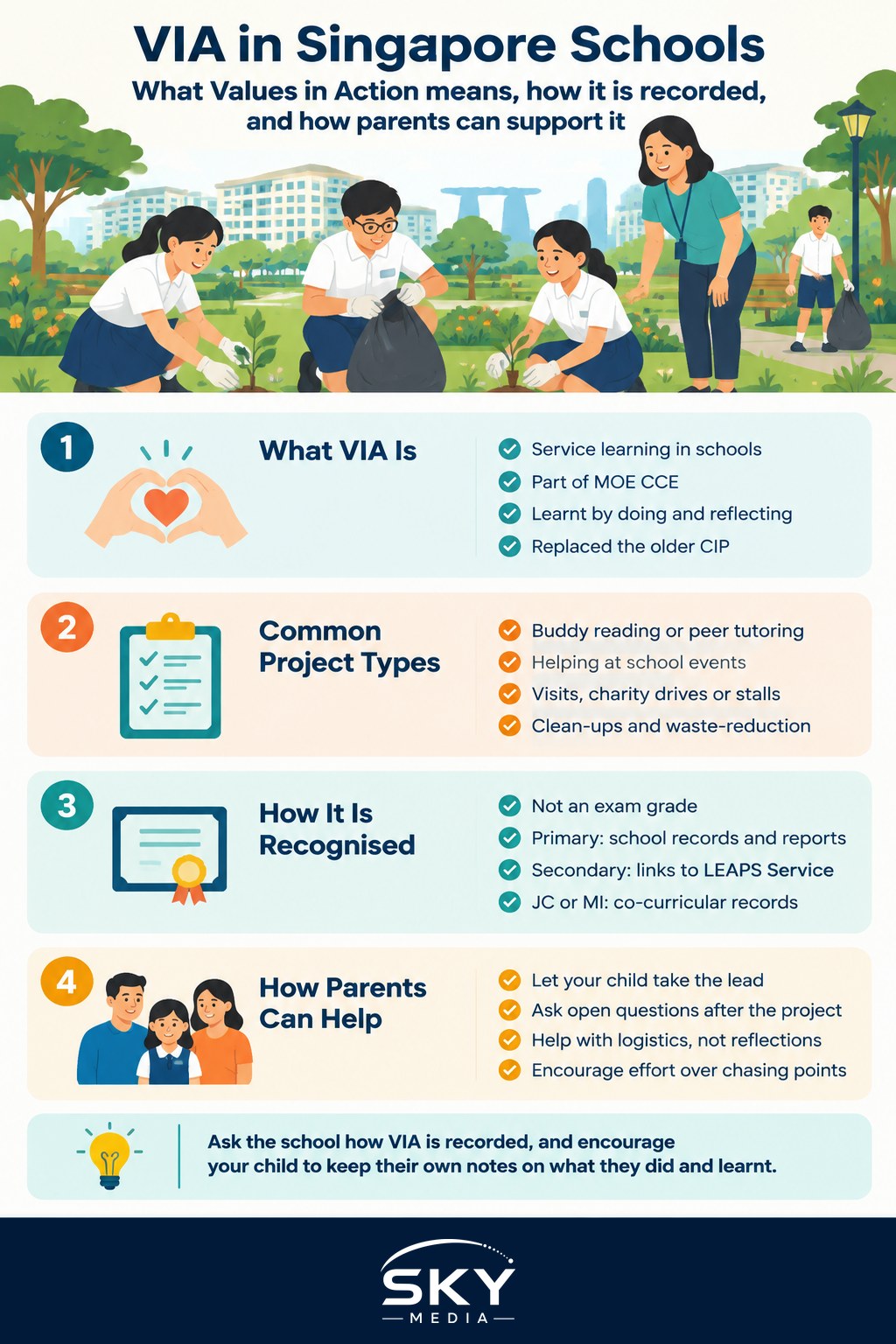
What VIA Is Actually Trying to Teach
The core idea is that values are learnt by doing. Rather than simply reading about responsibility, care or respect, students plan and carry out something that benefits other people, then reflect on what they learnt. Schools generally frame a VIA experience around three parts:
- Learning about a need. Students find out about a group or an issue, such as elderly residents living alone, litter in a nearby park, or younger pupils who need reading support.
- Taking action. They design and carry out an activity that responds to that need, ideally with some say in how it is done.
- Reflecting. They think and talk about what went well, what surprised them, and what they would do differently.
The reflection step is what separates VIA from a one-off outing. Teachers are usually more interested in what a student can say about the experience than in how many hours it took.
What VIA Projects Typically Look Like
Every school designs its own programme, so the details vary. In general, younger children do more class-based or school-based projects, while older students take on more ownership and work with community partners.
Commonly seen examples include:
- Within the school: buddy reading for younger pupils, keeping classrooms and shared spaces clean, helping at school events, or peer tutoring.
- In the neighbourhood: visiting senior activity centres, packing and distributing items with a local charity, or running a small fundraising stall for a cause.
- Environmental projects: recycling drives, park clean-ups, or campaigns to cut food waste in the canteen.
- Student-initiated projects: at secondary and pre-university level, students may identify a need themselves and pitch a project, sometimes linked to their co-curricular activity (CCA).
Some projects are done as a whole class, some through the CCA, and some in smaller groups. If your child’s school offers choice, encourage them to pick something they actually care about. A project chosen out of genuine interest usually produces better reflection and a more meaningful record.
How VIA Is Recorded and Recognised
Parents often ask whether VIA “counts” for anything. It does, but not as an exam grade. The table below summarises how it typically shows up at each stage. Exact practices differ by school and are updated by MOE from time to time, so treat this as a general picture.
| Stage | How VIA usually works | How it is typically recognised |
|---|---|---|
| Primary school | Mostly teacher-planned class or school projects, with growing student input in upper primary | Noted in school records and holistic reports; feedback through form teachers |
| Secondary school | Mix of school-wide, CCA-based and student-initiated projects | Contributes to the Service domain of LEAPS, which feeds into the co-curricular attainment level |
| Junior college / Millennia Institute | Greater student ownership, often project-led and partner-based | Recorded in the student’s co-curricular record; may feature in portfolios and testimonials |
Schools usually keep track through a mix of attendance, teacher observation and student reflections. Your child may be asked to write a short reflection, complete an online form, or present to the class. Encourage them to keep their own notes too: the project name, dates, their role and one or two things they learnt. These notes are useful later for testimonials, scholarship forms or interviews.
How VIA Links to LEAPS in Secondary School
LEAPS is the framework secondary schools use to recognise co-curricular achievement. The letters stand for Leadership, Enrichment, Achievement, Participation and Service. Students build up levels in each domain over their secondary years, and these are combined into an overall co-curricular attainment level.
VIA connects mainly through the Service domain. In broad terms, students are recognised for the service learning projects they complete, and for going further, such as helping plan a project or initiating one themselves. Taking a leading role can also be relevant to the Leadership domain, depending on how the school assesses it.
A few practical points for parents:
- Quality and initiative matter. Recognition generally rewards meaningful involvement and student ownership rather than simply turning up.
- The attainment level can matter for transitions. Co-curricular attainment has historically been relevant to post-secondary admissions, so it is worth understanding how your child’s school applies it. Ask the school or check MOE’s website for the current rules, as they can change.
- Do not chase points at the expense of wellbeing. Over-scheduling service activities purely for recognition tends to defeat the purpose and can add stress.
If you are unsure how your child is tracking, the CCA teacher, form teacher or the school’s CCE coordinator can explain how VIA has been recorded so far.
How Parents Can Support Without Taking Over
VIA works best when students lead. Your role is to encourage and help them reflect, not to run the project.
- Talk about it at dinner. Ask open questions: Who did you help? What was hard? What would you change?
- Help with logistics only where needed. Transport, a quick review of a fundraising poster, or reminders about deadlines are fine. Writing their reflection is not.
- Model service at home and in the community. Children who see adults volunteering, helping neighbours or caring for the environment tend to take VIA more seriously.
- Connect it to their own values. A project lands better when a child can link it to what matters to them. The guide on finding your personal values has simple prompts you can adapt for teenagers.
- Extend interest beyond school. If a project sparks a passion, such as the environment, look for family-friendly ways to keep going. Our piece on advocating for climate action locally has ideas that older students can lead.
A Note for Families New to Singapore
If you have moved from another education system, VIA may feel unfamiliar. In many places, community service is optional or treated as an extracurricular extra. In Singapore, it is built into the school’s character education and is expected of every student, though it is assessed through participation and reflection rather than tests.
Projects sometimes involve working with seniors, people with disabilities or charities. This is a good chance for your child to learn about Singapore’s community support networks. For example, a project with a disability charity may touch on services like those described in our guide to mobility aids and disability support via SG Enable.
If your child is shy about visiting strangers or speaking in front of others, let the teacher know early. Teachers can often suggest a role that suits them, such as behind-the-scenes planning, making materials, or working in a pair.
Questions to Ask Your Child’s School
To get a clear picture of how VIA works at your child’s school, consider asking:
- What VIA projects are planned for this year, and is there any student choice?
- How is participation and reflection recorded, and can we see the record?
- How does VIA count towards the LEAPS Service domain at this school?
- Are there opportunities for my child to propose their own project?
- Who should we contact if my child has concerns about a project?
Values in Action is less about producing a perfect project and more about helping children see that they can make a difference to people around them. With a little encouragement at home, many students come away with experiences they remember long after their exams.
Official sources: Ministry of Education (MOE)