

Most people in Singapore think of Changi as “the airport”, so it can come as a surprise when a booking confirmation lists Seletar Airport instead. Seletar is Singapore’s second airport for passenger flights, a far smaller and quieter facility in the north-east of the island. It handles a mix of short regional flights, business jets, flying schools and aerospace activity rather than big international jets.
If you have a flight from Seletar coming up, or you are simply curious, this guide explains what the airport is, what kind of flights use it, how to get there and how the experience differs from Changi.
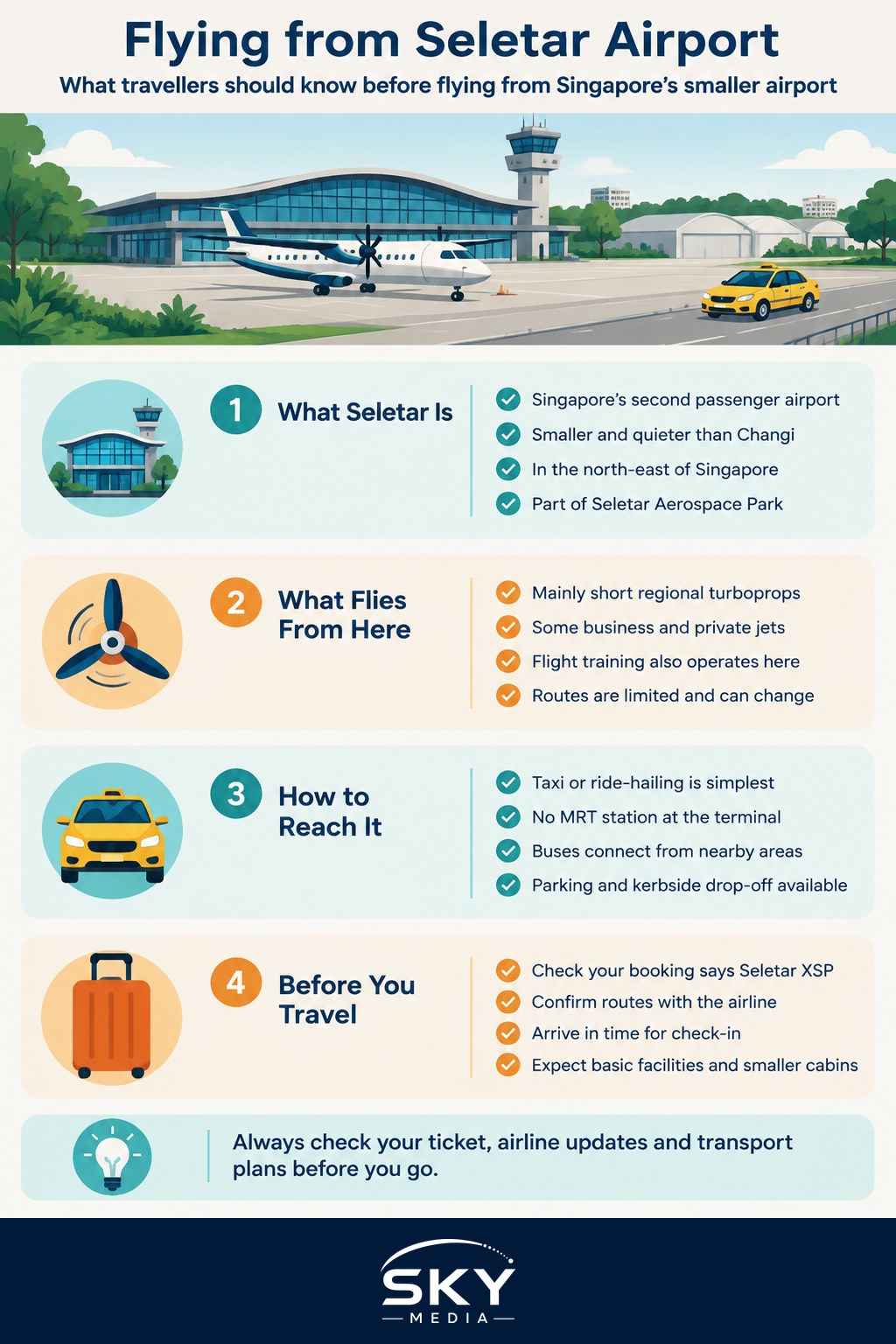
What Seletar Airport Is and Why It Exists
Seletar has a long history. It began as a Royal Air Force base in the colonial era and later became a civilian airfield. Today it sits within the Seletar Aerospace Park, an industrial estate for aircraft maintenance, manufacturing and training companies.
A dedicated passenger terminal opened in late 2018 to take over turboprop flights that had previously operated from Changi. Moving smaller propeller aircraft to Seletar frees up runway capacity at Changi for larger jets, while giving those short regional routes a compact, efficient home.
Besides scheduled passenger flights, Seletar is used for:
- Business and private jets, through operators that handle executive travel.
- Flight training, with flying schools and clubs based there.
- Aircraft maintenance and aerospace work in the surrounding park.
Routes and Airlines: What Actually Flies From Seletar
Scheduled passenger services at Seletar are limited and mostly use turboprop aircraft, which are smaller propeller planes suited to short sectors. Over the years, flights from Seletar have mainly connected Singapore with destinations in Malaysia, operated by regional carriers.
Routes and operators change with airline strategy, so do not rely on old information or on anyone else’s trip report. Before you plan:
- Check your booking for the departure airport. It should state Seletar (airport code XSP) rather than Changi (SIN).
- Confirm current routes with the airline’s own website. Schedules can be added, cut or moved between Seletar and Changi.
- Watch for schedule-change emails. If an airline moves a route, your departure airport could change after you book.
Because the range of destinations is small, most travellers flying long-haul or to destinations beyond nearby countries will still use Changi.
How to Get to Seletar Airport
Seletar is further from the city centre and less connected by public transport than Changi. Allow more time than you think you need.
- Taxi or ride-hailing. This is the simplest option for most travellers, especially with luggage or an early flight. Confirm the pickup and drop-off point is the passenger terminal, as the aerospace park has many buildings.
- Public bus. There is no MRT station at the terminal. Buses run into Seletar Aerospace Park from nearby areas, and you may need to connect from an MRT station on the North East Line or elsewhere. Check current bus services and stops on the LTA, SBS Transit or SMRT journey planners, or a maps app, before you go.
- Driving. There is parking near the terminal. Check current parking details and charges on arrival or on official Seletar Airport information.
- Being dropped off. Friends or family can drop you at the terminal kerb, following any posted signs.
If you are arriving at Seletar, plan your onward journey in advance, particularly late at night, when bus frequency may be lower and the area is quiet.
Seletar vs Changi: How the Experience Differs
The difference between the two airports is huge, in both scale and atmosphere. Here is a quick side-by-side.
| Aspect | Seletar Airport | Changi Airport |
|---|---|---|
| Size | Single small terminal | Multiple large terminals plus Jewel |
| Typical flights | Short regional turboprop, business jets, training | Full range of regional and long-haul jets |
| Getting there | Taxi, ride-hailing, bus or car; no MRT at terminal | MRT, buses, taxis, ride-hailing, car |
| Shopping and dining | Very limited | Extensive |
| Walking distances | Short, quick to move through | Can be long between gates |
| Crowds | Usually quiet | Busy at peak periods |
Check-in and immigration
At Seletar, you still go through check-in, security and immigration and customs clearance by ICA (the Immigration and Checkpoints Authority) just as at Changi. The process is usually quick because there are fewer passengers, but counters may only open a set time before departure. Check the airline’s recommended arrival time and check-in cut-off, and do not cut it fine just because the terminal is small.
Facilities
Expect basic amenities: a small waiting area, toilets and a limited range of food and drink. You will not find the shopping, gardens or attractions that make Changi famous. If you want a proper meal, eat before you arrive, and bring a snack and an empty water bottle for the wait.
Boarding and the flight itself
On smaller propeller aircraft, you may walk across the apron and board by stairs rather than an aerobridge. Seats are typically fewer and the cabin is narrower. Turboprops cruise lower than jets, so you may notice more noise and occasionally more movement in clouds. Nervous flyers may find our guide on overcoming the fear of flying helpful.
Packing and Practical Tips
Smaller aircraft mean tighter rules on bags, so check these before you fly:
- Cabin baggage limits. Overhead bins on turboprops are smaller, and some carry-on items may need to be checked at the aircraft door. Pack a small bag for valuables and medicines that you can keep with you.
- Checked baggage allowance. Confirm the weight and piece allowance on your fare type with the airline, as it can differ from what you are used to on larger carriers.
- Liquids and security rules. Standard security screening applies, so follow the current guidance on liquids, powerbanks and prohibited items.
- Travel documents. Make sure your passport has enough validity and that you meet the entry requirements of your destination.
- Travelling with little ones. Strollers and baby gear may be handled differently on smaller aircraft. Ask the airline in advance and see our tips on flying with a baby or toddler.
Is Flying From Seletar Worth It?
For the right trip, Seletar can be a pleasant surprise. The terminal is calm, queues are short, and you can be through to the departure area quickly. It suits short regional getaways where convenience matters more than airport shopping.
The trade-offs are fewer routes, fewer facilities and a less direct journey to the airport. If you are new to travel, our first-time traveller tips cover the basics of planning and packing that apply wherever you depart from.
Whatever your plans, always check your ticket for the correct airport and confirm current flight, transport and terminal information with the airline and official sources before you set off. Turning up at Changi for a Seletar flight is an easy mistake, and one that is very hard to fix on the day.