
Ask ten people about the cost of living in Singapore and you will get ten different answers, and all of them can be right. A student sharing a room in Woodlands and a family of four renting a condo near town are living in the same city with wildly different monthly expenses in Singapore. This guide walks through the main cost buckets, shows where you can spend less or more, and ends with a rough sample budget so you can build your own picture.
Before we start, one honest caveat: prices move. Treat every figure here as a rough guide to help you plan, not a fixed price list. Rents, fares, and fees all shift over time, so confirm current numbers before you commit to anything.
Housing: usually your biggest line
For most people, rent in Singapore is the single largest expense, and it swings more than any other category. What you pay depends on the type of home, the location, and whether you share.
- A room in an HDB flat. The most budget-friendly option, especially in the heartlands, further from the city centre. Sharing brings the per-person cost down further.
- A whole HDB flat. More space and privacy for a couple or family, at a meaningfully higher monthly figure.
- A condominium. You are paying for facilities such as a pool and gym, security, and often a more central address. Expect to pay a clear premium over an equivalent HDB flat.
- Landed housing. The priciest tier, and a smaller slice of the rental market.
Location is the other big lever. The same type of flat costs noticeably more in a central district than in an outlying town near the edges of the island. If your budget is tight, looking a few MRT stops further out is one of the most effective ways to cut costs.
A rough rule many newcomers use: aim to keep rent to around a third of your take-home pay. It is only a guideline, but it stops housing from quietly swallowing everything else.
For a deeper look at leases, deposits, and viewings, see our full renting guide linked at the end.
Food: hawker value versus dining out
Food is where Singapore is genuinely kind to your wallet, if you eat like a local. Your food cost can vary several times over depending on your habits.
- Hawker centres and food courts are the anchor of affordable eating. A plate of chicken rice, a bowl of noodles, or a set at an economy rice stall keeps daily food cost low, and the quality is often excellent.
- Casual cafes and coffee shops sit a step up, comfortable for a treat rather than every meal.
- Restaurants and dining out in malls or along popular streets cost several times a hawker meal once you add drinks and service.
- Cooking at home with groceries from wet markets or supermarkets can be economical, though for one person hawker food is sometimes cheaper than cooking small portions.
Coffee is a neat illustration. Kopi from a hawker stall costs a fraction of a flat white from a specialty cafe. Neither is wrong, but knowing the gap helps you choose on purpose rather than by accident.
Transport: getting around without a car
Singapore has one of the world’s better public transport systems, and for most residents it removes any real need to own a car.
- MRT and buses are the everyday backbone. Fares are distance-based and modest, and a monthly commute across the island still adds up to a reasonable sum. Tapping in with a contactless card or your phone is the norm.
- Taxis and ride-hailing are convenient and clean, useful for late nights or heavy bags, but several times the cost of the same trip by train.
- Owning a car is a different world entirely. Between the Certificate of Entitlement, the car itself, insurance, petrol, and parking, private cars are among the most expensive in the world here. For many, it is a lifestyle choice rather than a necessity.
Our public transport guide, linked below, breaks down cards, fares, and route planning.
The recurring bills: utilities, mobile, and internet
These are smaller but steady monthly expenses in Singapore.
- Utilities (electricity, water, gas) depend heavily on air-conditioning use. A frugal single person in a small flat pays far less than a family running the aircon nightly.
- Home internet is fast and reasonably priced, usually a fixed monthly plan.
- Mobile plans are competitive, with plenty of affordable SIM-only options offering generous data. You rarely need to overpay here.
Healthcare, childcare, and family costs
These vary the most by household, so treat them as situational rather than universal.
Healthcare. Everyday care at a GP clinic or polyclinic is relatively affordable, with subsidies at public facilities for eligible residents. Private specialists and hospital stays cost considerably more, which is why insurance matters. Newcomers should check what coverage their pass or employer provides, and confirm the details with official sources rather than assuming.
Childcare and schooling. For families, this can rival rent as a major cost. Infant care and childcare fees are significant, though subsidies exist for eligible families. School fees differ sharply between local and international routes. If you have children, price this early, as it reshapes the whole budget.
Lifestyle: the flexible part
After the essentials, lifestyle spending is where your budget stretches or shrinks by choice. Gym memberships, dining out, nights out, streaming subscriptions, shopping, and travel all sit here. Two people on identical salaries can have very different savings simply because one eats at hawker centres and takes the MRT while the other dines out and rides taxis. This is the category you control most directly.
Quick tips to keep costs down
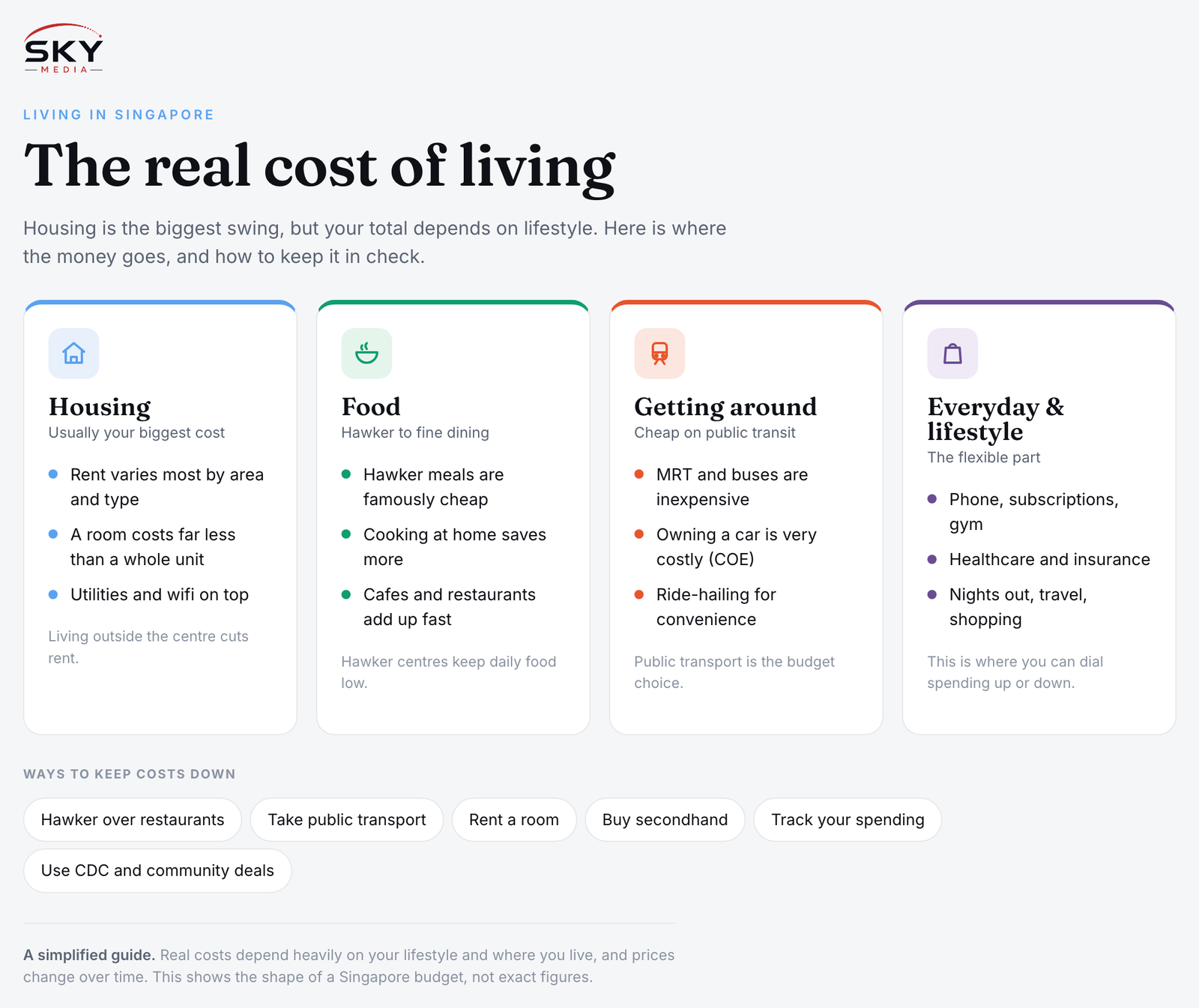
- Live a few stops from the centre and let the MRT do the commuting.
- Make hawker food your default and dining out the occasional treat.
- Choose a SIM-only mobile plan rather than a bundled handset contract.
- Skip the car unless you genuinely need one.
- Track spending for one month so you know your real numbers, not your guessed ones.
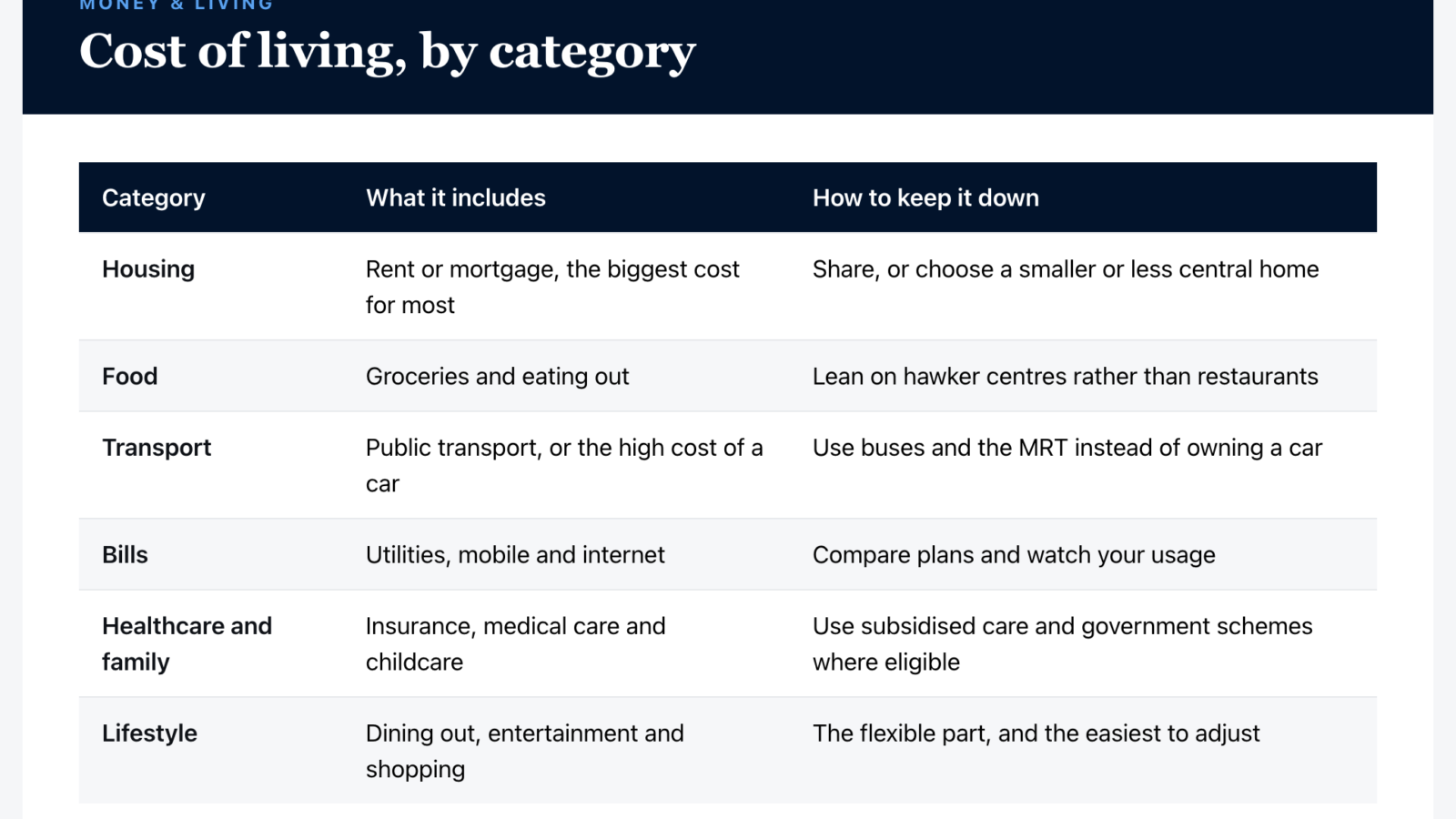
Here is how the main spending categories break down:
| Category | What it includes | How to keep it down |
|---|---|---|
| Housing | Rent or mortgage, the biggest cost for most | Share, or choose a smaller or less central home |
| Food | Groceries and eating out | Lean on hawker centres rather than restaurants |
| Transport | Public transport, or the high cost of a car | Use buses and the MRT instead of owning a car |
| Bills | Utilities, mobile and internet | Compare plans and watch your usage |
| Healthcare and family | Insurance, medical care and childcare | Use subsidised care and government schemes where eligible |
| Lifestyle | Dining out, entertainment and shopping | The flexible part, and the easiest to adjust |
A sample monthly budget (rough ranges only)
Everyone’s situation differs, so think of the pattern below rather than the exact figures. Roughly speaking, a single person living simply, sharing a room and eating mostly at hawker centres, might spend the largest share on rent, a moderate amount on food, a small amount on transport, and a little on bills and lifestyle. Scaling up, a couple in their own flat roughly doubles food and utilities and lifts rent well beyond a shared room. A family with young children adds childcare, which can become one of the biggest single items alongside rent.
A useful way to frame it:
- Lean single, sharing: low overall, dominated by rent and food.
- Comfortable single or couple, own flat: moderate, with rent still the largest slice.
- Family with children: high, with rent and childcare competing for the top spot.
The honest takeaway is that Singapore can be affordable or expensive depending almost entirely on your housing, your food habits, and whether you own a car. Get those three right and the rest of your monthly expenses in Singapore tend to fall into a manageable shape.
Whatever your situation, the best next step is to build your own budget with real numbers for your circumstances, then check current prices before you sign anything.
Explore more: Renting in Singapore: a complete guide · Budgeting in Singapore · Singapore public transport guide