
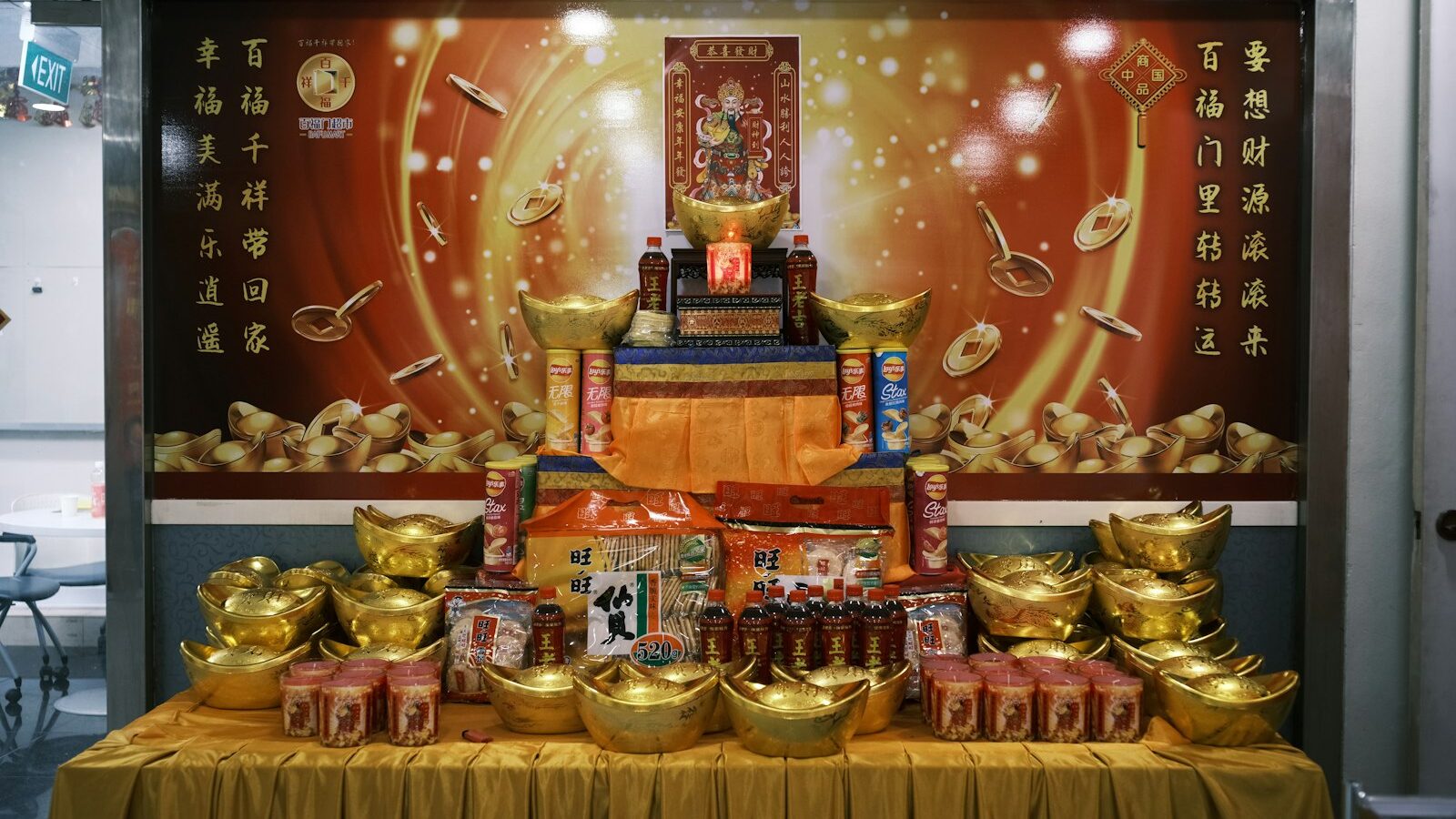
A prayer altar at home is a deeply personal space, and the way it is arranged varies widely across faiths, dialect groups and families. This guide offers general, respectful pointers on placement, essentials and safety. It is not a religious ruling. For anything specific to your tradition, please follow your own faith, your family elders or your temple, as their guidance always takes precedence over a general article.
Approaching the space with respect
Practices differ significantly between Chinese, Buddhist, Taoist, Hindu and other households, and even between families of the same faith. Some keep an altar for deities, some for ancestors, some for both, and the objects, offerings and rituals reflect those distinctions. Before you arrange anything, it helps to ask an elder in your family or a person at your temple how things are traditionally done for you. Treat this article as a starting framework that you adapt, never a fixed set of rules.
Whatever your tradition, an altar is a focal point of the home. Approaching it with cleanliness, care and intention matters more than any single decorative detail.
Choosing placement in the home
Many traditions favour a clean, quiet and elevated spot where the altar can be treated with dignity. Common preferences include placing it against a solid wall for a sense of support and positioning it so it is not directly facing a toilet, a bedroom door or the underside of a staircase. Some families avoid placing an altar directly beneath a beam or below an overhead toilet in the unit above. These preferences vary, so confirm what applies to your practice.
Height is a recurring theme. Deities are often placed higher, with ancestral tablets arranged according to family custom, and the whole altar raised off the floor on a suitable cabinet or table. In many homes the living room or a dedicated corner near the main door area is preferred, though households differ. Keep the area in front of the altar free so you have room to stand or kneel comfortably.
The essentials most altars share
While specifics vary, several elements appear across many home altars. Adapt this list to your own tradition rather than treating it as complete or required.
- An altar table or cabinet that raises everything to a respectful height.
- A statue, image or tablet appropriate to your faith and family.
- An incense holder or joss-stick urn filled with a suitable base such as ash or sand.
- An oil lamp or candles, where your tradition uses them.
- Offering vessels for water, tea, fruit or flowers.
- A clean cloth reserved only for wiping the altar.
Colours, numbers of items, the direction things face and the timing of offerings all carry meaning that differs between communities. When in doubt, ask rather than assume.
Comparing common altar setups
Households arrange altars in different formats depending on space and tradition. The table below is a general overview, not a prescription.
| Setup type | Space needed | Often chosen by | Notes |
|---|---|---|---|
| Floor-standing cabinet | A dedicated corner | Families with more room | Raised, storage below |
| Wall-mounted shelf altar | Vertical wall only | Compact flats | Keep well clear of flammables |
| Tabletop altar | A sideboard or table | Smaller or shared homes | Elevate on a mat or riser |
| Enclosed cabinet altar | A cabinet footprint | Those wanting doors | Ventilate before burning incense |
Choose the format that lets you keep the altar clean, elevated and safely away from anything that could catch fire.
Fire safety with incense, joss sticks and oil lamps
Because many altars involve open flame and burning incense, safety deserves real attention, especially in a flat. Please treat these points as essential.
- Never leave burning joss sticks, incense coils, candles or oil lamps unattended. Extinguish them fully before you leave home or sleep.
- Keep all flames well away from flammable items such as curtains, paper offerings, decorations, cabinets, plastic and cloth. Maintain a clear gap on every side.
- Use a stable, non-combustible holder filled with ash or sand so sticks cannot tip or fall onto the surface.
- Place a heat-resistant, non-flammable base under lamps and urns to protect the cabinet and wall.
- Mind children and pets. Keep lit items, lighters and matches out of their reach, and position the altar so small hands cannot grab a flame.
- Do not overload the urn with too many sticks at once, which creates excess heat and ash.
- Keep a means to extinguish nearby, and check that oil lamps are stable and not overfilled.
Ventilation is just as important. Burning incense in an enclosed HDB flat fills the air with smoke, so open a window or door and let the air move while incense burns. Good airflow protects your lungs, reduces smoke build-up on walls and clears the space afterwards. If a family member has asthma or breathing sensitivities, gentler options and shorter burning times can help.
Small-flat tips
In a compact home, a wall-mounted shelf altar or a slim tabletop arrangement keeps the floor clear while preserving height and dignity. Keep the immediate surroundings uncluttered, both for respect and for safety, since a clear zone around any flame reduces fire risk. Store spare joss sticks, matches and cloths in a nearby drawer so the surface stays tidy.
Position the altar away from air-conditioner drafts that scatter ash, and away from the kitchen’s grease and heat. If space is very tight, a cabinet altar with doors can keep things contained, but always open it and let the air circulate before and while burning anything.
A space that reflects your practice
A prayer altar at home is ultimately about devotion, memory and family, arranged in the way that is meaningful to you. Keep it clean, elevated and safe, ventilate when you burn incense, and never leave a flame unattended. For every question of ritual and placement specific to your faith, let your family elders and your temple guide you, and let this article simply help you set the space up thoughtfully.
Explore more: Small-Space Living in Singapore · Maximising Storage in a Small HDB · Space-Saving and Multifunctional Furniture