

Singapore roads are well maintained, but they are hard on suspension in quieter ways. Condo driveways and HDB carparks are full of speed humps and road strips, multi-storey carpark ramps twist and climb, and utility works leave patches and uneven joints. Over years of daily driving, the parts that soak up all of that wear out gradually, and because the change is slow, many drivers do not notice until something feels clearly wrong.
This guide covers the signs that point to worn shock absorbers and other suspension parts, what a workshop actually checks, and how to approach shock absorber replacement in Singapore sensibly. It is general information, not a substitute for an inspection by a qualified mechanic.
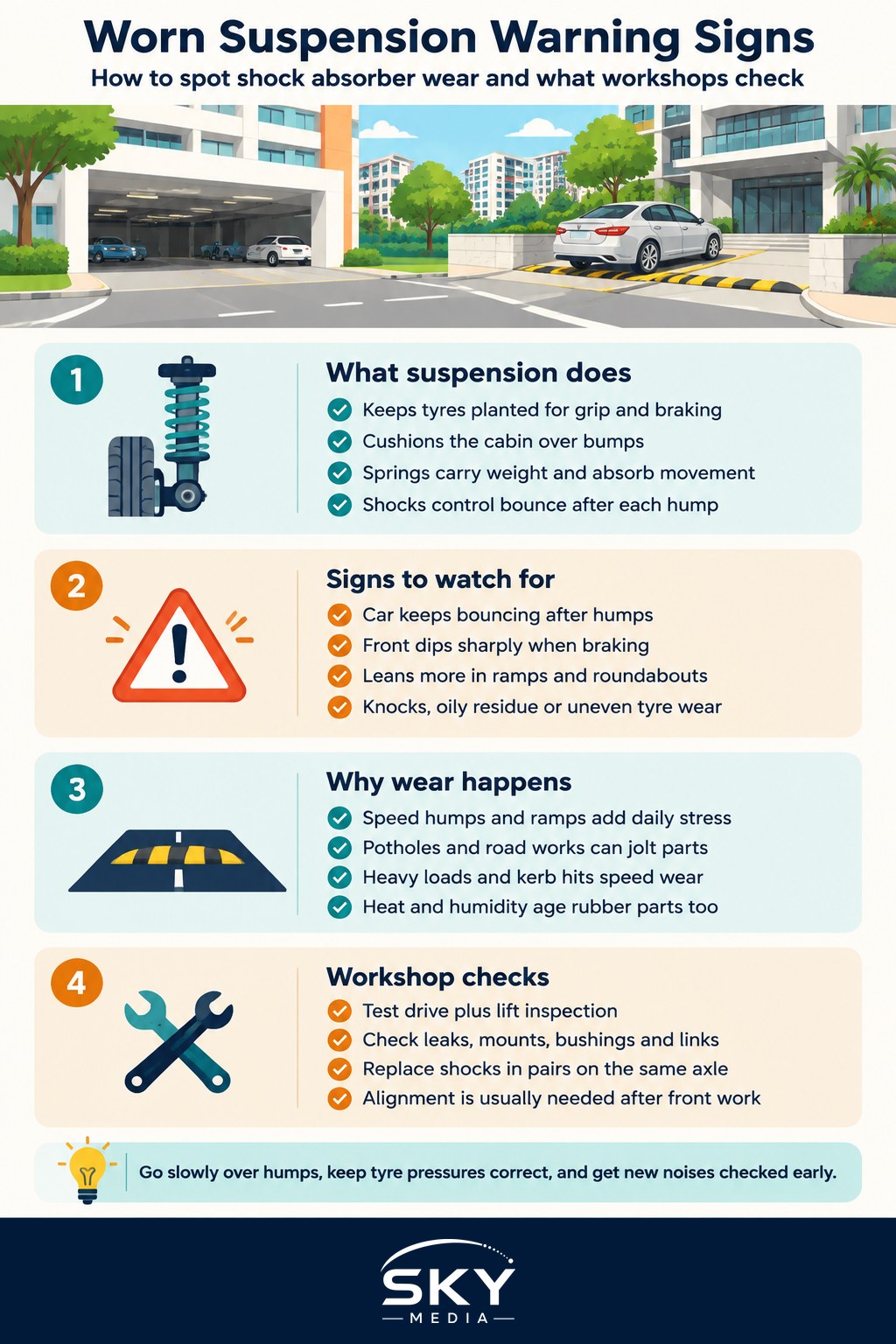
What Your Suspension Actually Does
The suspension connects the wheels to the body of the car. It has two broad jobs: keep the tyres pressed onto the road for grip and braking, and keep the cabin reasonably calm over bumps.
The main parts you will hear about:
- Springs (usually coil springs) carry the weight of the car and compress over bumps.
- Shock absorbers, or dampers, control how quickly the springs compress and rebound. Without them, the car would keep bouncing after every hump. On many cars the front shock and spring form one unit called a strut.
- Bushings are rubber or polyurethane sleeves that cushion the joints between metal parts.
- Strut mounts and bearings attach the top of the strut to the body and let the front wheels turn.
- Ball joints, control arms and stabiliser (anti-roll) bar links hold the wheel’s geometry and limit body roll in corners.
Shocks do not usually fail suddenly. The oil and gas inside them slowly lose their damping ability, and seals can start to leak. That is why the symptoms creep up on you.
Signs Your Shock Absorbers or Suspension Are Worn
Watch for these, especially on a car that has done many years of city driving:
- Floating or bouncing after humps. The car keeps bobbing once or twice after a speed hump instead of settling quickly.
- Nose dive when braking. The front dips sharply under firm braking, and the car may feel less stable as it stops.
- Body roll and wallowing. The car leans more in carpark ramps and roundabouts, or sways in crosswinds on the expressway.
- Clunks and knocks. A dull knock over humps or uneven joints often points to worn mounts, bushings or stabiliser links rather than the shock itself.
- Oily residue on the shock body. A damp, greasy coating on the shock suggests a leaking seal.
- Uneven tyre wear. Patchy, scalloped wear (called cupping) can be a sign the wheel is bouncing rather than staying planted.
- Steering that wanders or vibrates. Worn suspension joints can make the car feel vague or pull slightly.
- A harsher, crashier ride. Some worn parts make the ride feel stiff and jarring rather than soft.
A quick home check is the bounce test: push down firmly on one corner of a parked car and release. If it rebounds more than once or twice before settling, the damping on that corner may be weak. It is only a rough guide, and modern cars can pass this test while still having worn shocks, so do not rely on it alone.
Common Causes on Singapore Roads
A few local patterns put extra stress on suspension:
- Speed humps taken too fast. Condo and HDB carpark humps are designed to be crossed slowly. Hitting them at speed loads the shocks and mounts hard every time.
- Multi-storey carpark ramps. Tight, steep spiral ramps load one side of the car while turning, which wears bushings and mounts.
- Potholes and road works. Patched trenches and uneven joints after utility works can catch a wheel sharply.
- Kerbs. Mounting a kerb or striking one while parking can bend components or knock alignment out.
- Heavy loads. Regularly carrying a full family plus luggage, or heavy work equipment, accelerates wear.
- Lowered suspension. Aftermarket lowering reduces travel, so the car bottoms out more easily. Note that modifications must comply with LTA rules, so check before changing anything.
Heat and humidity also age rubber parts, so bushings and boots on older cars may crack even if the car is not driven hard.
What a Workshop Checks and What Replacement Involves
A good workshop will look beyond the shocks. Expect a test drive plus an inspection with the car raised, covering leaks, mounts, bushings, links, ball joints, tyre wear and steering play.
| Symptom | Likely culprit | Typical next step |
|---|---|---|
| Bouncing after humps, nose dive | Worn shock absorbers or struts | Replace in pairs on the same axle |
| Clunk over humps or joints | Stabiliser links, strut mounts or bushings | Replace the worn component, then recheck |
| Uneven or cupped tyre wear | Worn dampers or alignment out | Inspect suspension, then wheel alignment |
| Steering wander or pulling | Worn ball joints, tie rod ends or alignment | Inspect joints, then align |
Points worth knowing before you agree to any work:
- Shocks are replaced in pairs, both fronts or both rears, so the car behaves evenly side to side.
- Mounts and bump stops are often worth renewing at the same time on strut cars, since the labour overlaps. Ask the workshop to explain why.
- Wheel alignment is usually recommended after replacing front struts or steering parts.
- Parts choice ranges from original-equipment parts to aftermarket options with different ride characters. Ask what you are being quoted and whether there is a parts warranty.
- Get the old parts shown to you if you want reassurance about leaks or damage.
Costs vary widely by car model, parts brand and labour, so get an itemised written quote, and compare at least two workshops for larger jobs. Your authorised dealer is an option for cars still under warranty, as using outside workshops may affect warranty terms. Check your warranty booklet first.
Inspections, Safety and Insurance
Worn suspension is a safety issue, not only a comfort one. Weak dampers can lengthen braking distances on wet roads and make emergency manoeuvres less stable, which matters during Singapore’s sudden downpours.
Cars in Singapore must pass periodic inspections at LTA-authorised inspection centres once they reach a certain age, and suspension condition is among the items checked. The intervals and criteria are set by LTA, so check the current schedule on the LTA website rather than relying on hearsay. Fixing obvious leaks and clunks before your inspection saves a retest.
If a pothole or road defect caused sudden damage, take photos of the spot and the damage, note the time and location, and report the defect to the relevant authority. Whether any claim is possible depends on the circumstances and your motor insurance policy wording, so speak to your insurer before assuming coverage.
Habits That Make Suspension Last Longer
- Crawl over humps at walking pace, and cross them straight rather than at an angle unless the design suggests otherwise.
- Take carpark ramps gently and avoid scrubbing tyres against ramp kerbs.
- Keep tyre pressures correct. Under-inflated tyres transmit more impact into the suspension. Our tyre care guide covers pressure checks and wear signs.
- Ask for a suspension look at every routine service, especially once the car is several years old.
- Do not ignore new noises. A worn link is a modest fix; leaving it can stress other parts.
Suspension sits alongside batteries and tyres as wear items every owner should budget for. If you are reviewing your car’s running costs this year, our guide to car battery care and replacement is a useful companion read.