
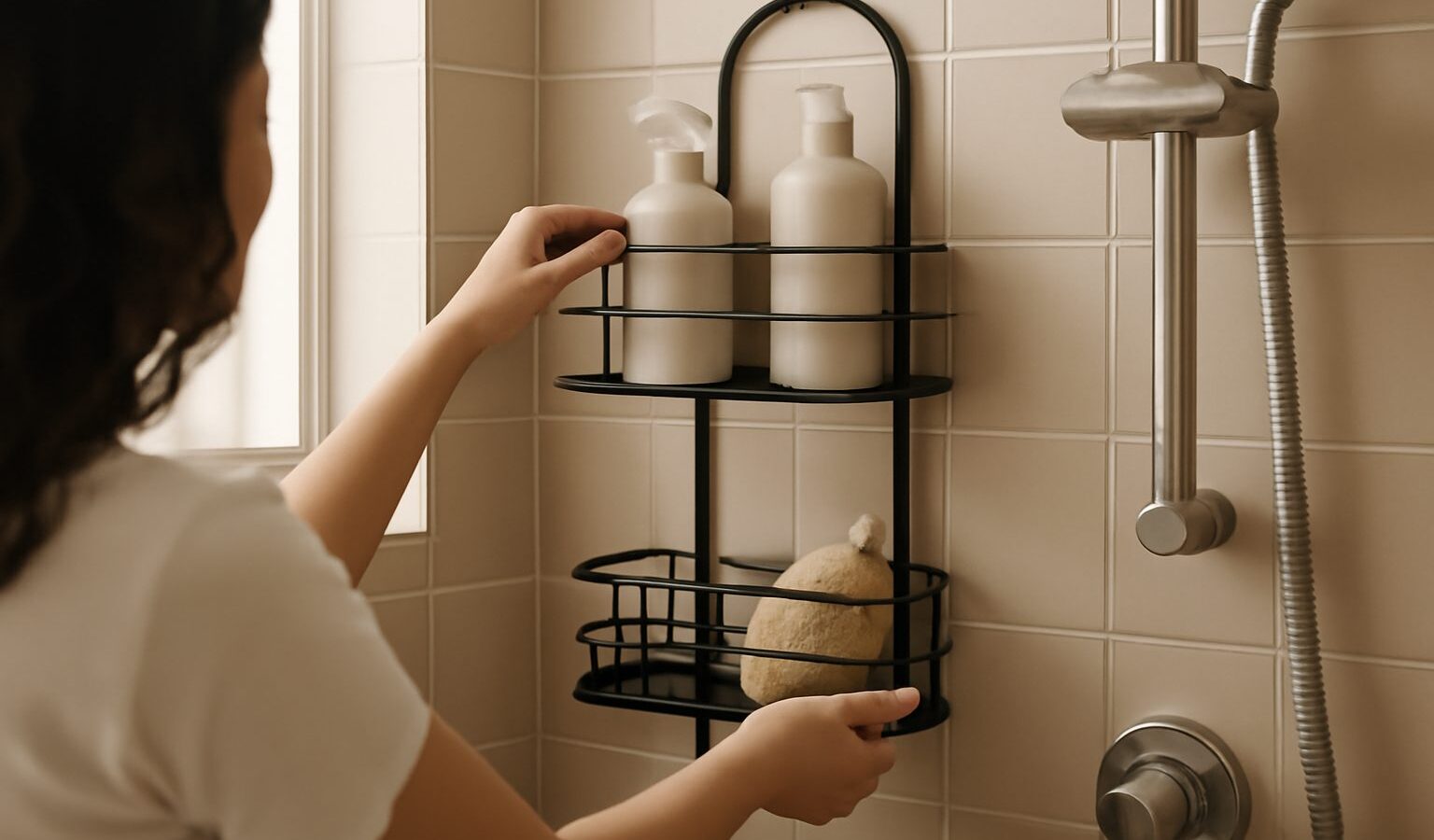
Most HDB flats and condos in Singapore have compact bathrooms where the shower area doubles as the main space for shampoo, body wash, razors and cleansers. Bottles end up on the floor, gather slime and get knocked over. A good shower caddy fixes this cheaply, but a poor choice rusts within months, falls off the wall or blocks the shower screen. This shower caddy Singapore buying guide focuses on the decisions that matter in small, humid bathrooms: type, material, fit and installation.
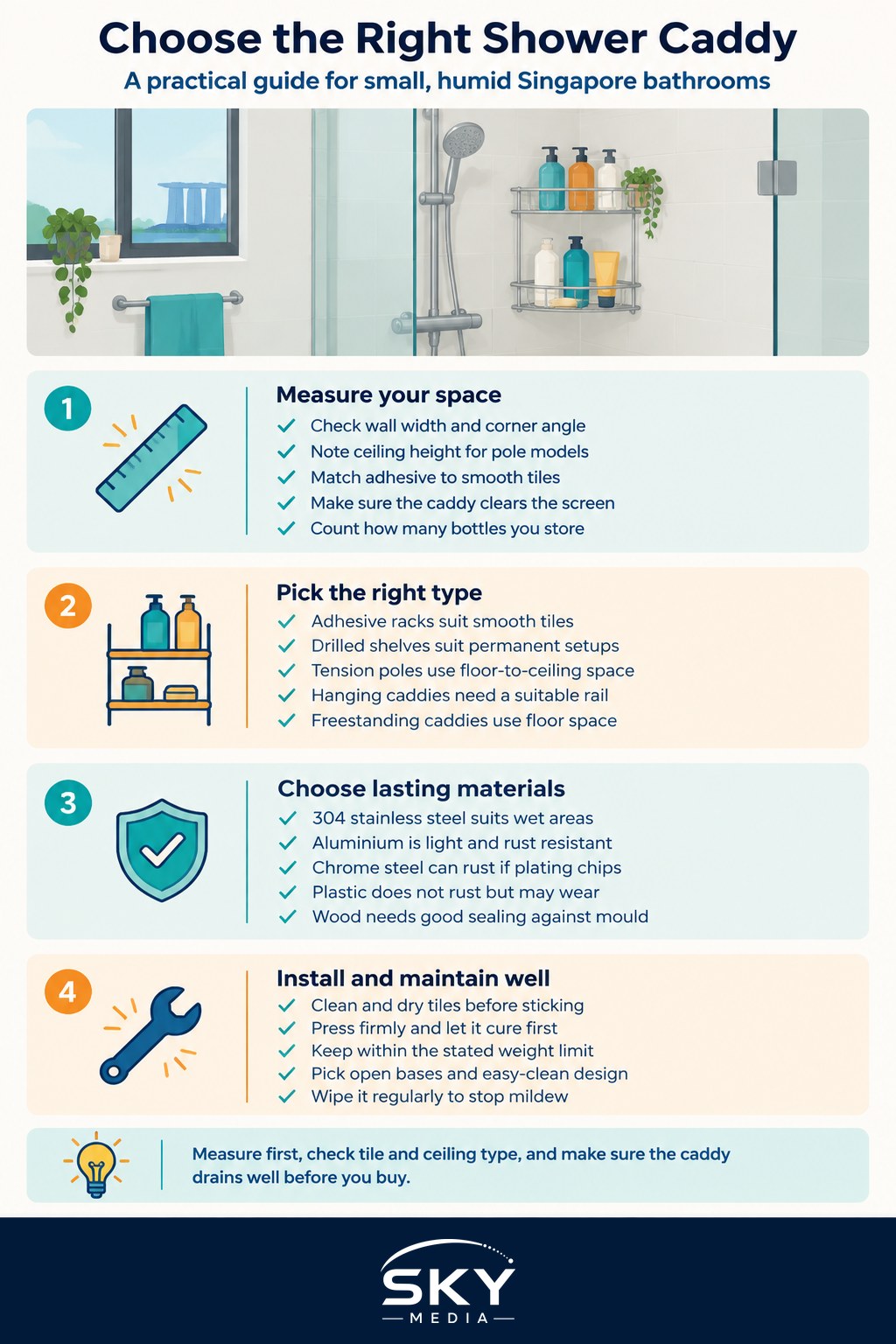
Measure Your Shower Space First
Before browsing, take a few measurements and notes. It saves returns and wasted adhesive.
- Wall width and corner angle. Measure the free wall area next to the shower head and check whether the corner is a true right angle. Many corner caddies assume a 90 degree corner.
- Floor to ceiling height if you are considering a tension pole caddy. Note whether the ceiling is a false ceiling, which may not take pressure well.
- Tile type and surface. Smooth glazed tiles suit adhesive mounts. Textured, matte or mosaic tiles often do not hold adhesive reliably.
- Shower screen or curtain clearance. If you have a swing door screen, check that a caddy will not block it. Our guide to choosing a shower screen for Singapore bathrooms explains how screen type affects the usable space inside.
- What you actually store. Count the bottles. Families with several shampoos need more shelf depth than one person with a single 2-in-1.
The Main Types of Shower Caddy
Each style suits a different bathroom layout and rental situation. The table below summarises the trade-offs.
| Type | Best for | Installation | Main drawbacks |
|---|---|---|---|
| Adhesive wall shelf or corner rack | Smooth tiles, renters who cannot drill | Peel-and-stick or adhesive hooks | Weight limits, fails on textured tiles, residue on removal |
| Drilled wall-mounted shelf | Owners wanting a permanent fix | Screws and wall plugs into tile | Needs drilling, risk of cracking tiles or hitting pipes |
| Tension pole caddy | Corners with floor-to-ceiling space, lots of bottles | Spring-loaded pole between floor and ceiling | Can slip if not tightened, false ceilings may not support it |
| Over-the-door or over-screen hanging caddy | Framed screens or doors with a top rail | Hooks over the top edge | Can swing, scratch glass, may stop door closing fully |
| Shower head hanging caddy | Very small showers, few items | Hangs from shower arm or riser rail | Low capacity, can tilt the shower head or slide down |
| Freestanding floor caddy | Wet areas with spare floor | No installation | Sits in water, collects grime, uses floor space |
For most small Singapore bathrooms, adhesive corner racks and tension pole caddies are the popular choices because they use vertical space and need no drilling.
Materials That Survive Singapore Humidity
The bathroom is the most humid room in an already humid country. Material decides whether your caddy lasts or leaves orange rust streaks on your tiles.
- Stainless steel. Look for a grade described as suitable for wet areas, often listed as 304 stainless steel. Lower grades or “stainless finish” items may still rust, especially at welds and screws.
- Aluminium. Light and naturally rust resistant, a good option for adhesive shelves since it adds less load.
- Chrome-plated steel. Shiny when new, but once the plating chips, the steel underneath can rust. Check reviews for long-term rust complaints.
- Plastic and ABS. Will not rust, cheap and light, but can yellow, crack in sunlight or look tired over time.
- Bamboo and wood. Attractive, but prone to mould in constant moisture unless well sealed and allowed to dry.
Check the small parts too. A rust-proof frame with steel screws or hooks will still rust at the joints.
Drainage and Cleaning Design
A caddy that holds water becomes a breeding ground for soap scum and mildew. Look for:
- Open wire or slotted bases so water drains straight through.
- Gaps between shelves large enough to wipe or brush.
- Removable baskets or trays that can be soaked or scrubbed separately.
- Hooks for razors and loofahs so these hang to dry rather than sit in puddles.
- Rounded edges that do not trap grime in sharp corners.
Plan to wipe your caddy weekly and give it a proper clean during your regular bathroom wash. A quick spray with a bathroom cleaner and rinse is usually enough.
Getting Adhesive Caddies to Stay Up
Adhesive models are the most common source of disappointment, usually because of installation rather than the product.
- Clean the tile thoroughly. Remove soap residue with a bathroom cleaner, then wipe with rubbing alcohol if the manufacturer recommends it.
- Let the surface dry completely. In a humid bathroom, this may mean leaving the window open or fan on for a while.
- Press firmly for the stated time, then leave it unloaded for the curing period the instructions give, often 24 hours or more. Do not shower straight away.
- Respect the weight limit. Full bottles are heavier than they look. Spread heavy items across shelves rather than loading one.
- Avoid grout lines. Adhesive should sit on a flat tile, not straddle grout.
If a caddy keeps falling, consider switching to a tension pole or, for owners, a drilled shelf.
Renters and HDB Owners: Drilling Considerations
If you rent, check your tenancy agreement and ask your landlord before drilling into tiles. Many landlords prefer no-drill solutions, and repairing cracked tiles can be costly. Adhesive and tension designs are usually the safer option.
Owners who want to drill should be careful about concealed water pipes and electrical wiring in bathroom walls, particularly near the shower mixer and water heater. If unsure, ask a qualified handyman or contractor. For HDB flats, renovation rules around wet areas and waterproofing exist, so check HDB’s guidelines if your plans go beyond simple fixtures.
Matching Capacity to Your Household
A shower caddy that is too small leads to bottles creeping back onto the floor; one that is too big crowds a tight space.
- Singles and couples: a two-tier adhesive corner rack or a shower head hanger is often enough.
- Families: a tension pole caddy with three or four shelves, or two separate corner racks at different heights, one low enough for children.
- Shared flats: separate small shelves per person reduce mix-ups and arguments over whose bottle is whose.
Consider decanting bulky bottles into smaller pump dispensers, which take up less shelf depth and look tidier.
Pre-Purchase Checklist
Before you buy a shower caddy in Singapore, run through these points:
- Does the type suit your tiles, ceiling and screen?
- Is the material and every screw or hook rated for wet areas?
- Will it drain well and be easy to clean?
- What is the stated weight limit, and does it cover your bottles?
- Can it be removed without damaging tiles, if you rent or may move?
- Is there a return policy if it does not fit?
The same measure-first, check-the-specs approach applies to other small-space buys, such as a shoe bench for small entryways or a foldable dining table. A few minutes of planning means your caddy stays up, stays clean and actually clears your bathroom floor.
Frequently Asked Questions
Will an adhesive shower caddy damage my tiles when I remove it? It can leave sticky residue, but it usually does not harm smooth glazed tiles if removed carefully. Warming the adhesive gently with a hairdryer softens it so you can peel it slowly, then wipe off leftovers with a suitable cleaner. Pulling it off quickly risks chipping the tile surface.
How do I stop razors from rusting in the shower? Keep them out of standing water and let them dry between uses. Hanging a razor from a hook so air can reach it works better than leaving it on a shelf. If rust keeps appearing, store the razor outside the humid shower area.
How do I know how many bottles an adhesive caddy can hold? Look at the weight limit stated on the packaging or product page rather than guessing from the size. Remember that full bottles are heavier than they look, so spread them across shelves and put the heaviest ones lowest. Decanting into smaller pump bottles reduces the load.
Can I remove mould from a bamboo or wooden shower caddy? Light surface mould can often be scrubbed off with a mild cleaner and a brush, followed by thorough drying in a ventilated spot. If the mould has sunk deep into the grain or the wood is soft, replacing the caddy is the safer choice, since constant moisture will bring it back.