
Taking up Singapore citizenship is one of the biggest decisions a newcomer can make, so it helps to understand what the journey involves before you begin. Whether you have lived here for years as a Permanent Resident or you are simply curious about the road ahead, this guide walks you through how naturalisation works, the benefits and responsibilities that come with becoming a Singapore citizen, and where to confirm the official details. Think of it as a friendly orientation, not immigration advice.
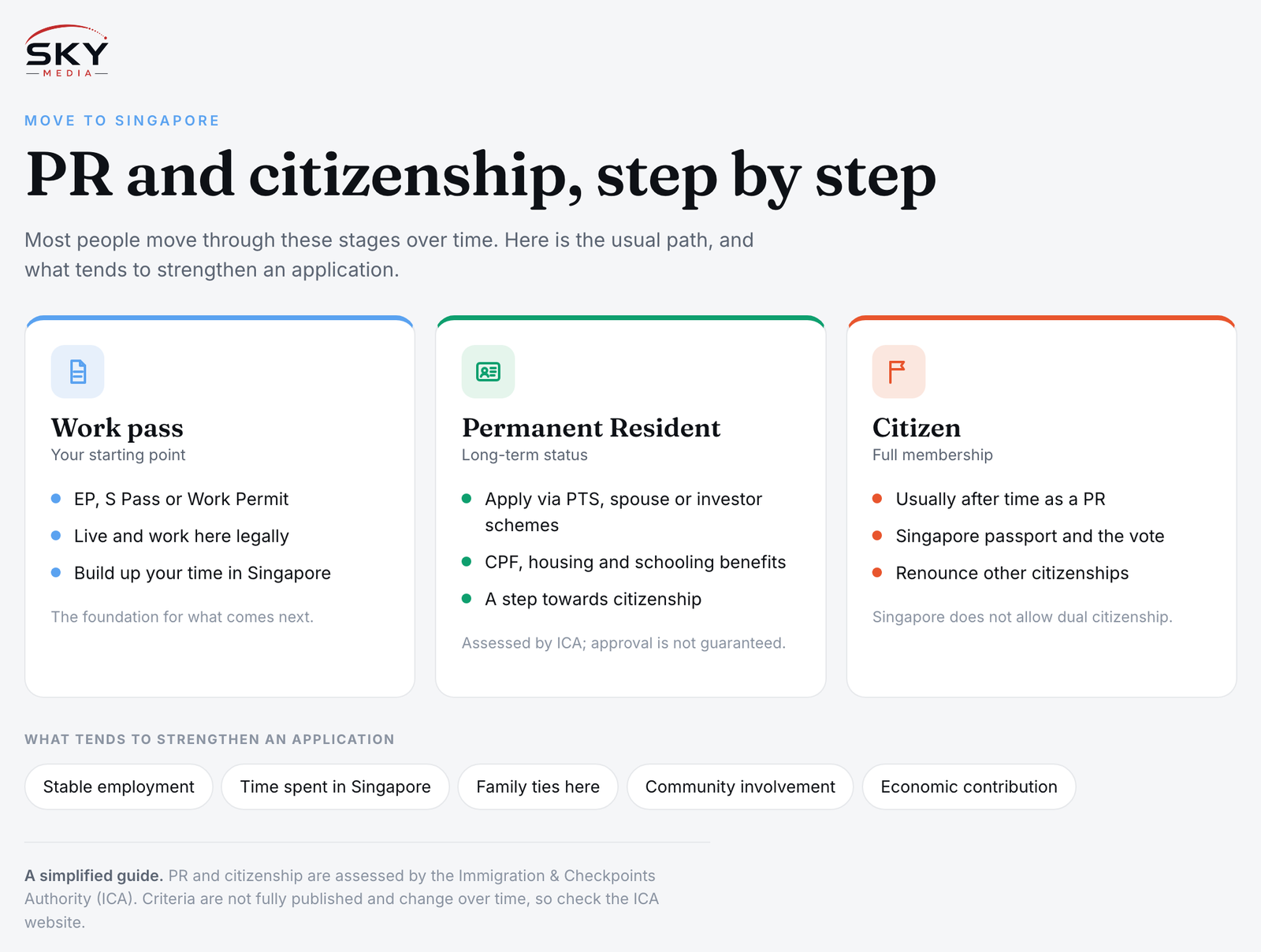
The usual path: PR first, then citizenship
For most people, citizenship does not happen straight away. The common route is to become a Permanent Resident (PR) first, live and contribute here for a period of time, and then apply for citizenship later.
Being a PR gives you a chance to settle in, work, and get a feel for whether Singapore is where you want to plant long-term roots. Only after you have held PR status for a while, and can show a genuine connection to the country, would you typically consider the next step.
There are limited exceptions, such as certain spouses and children of citizens, but the PR-then-citizen path is the one most newcomers follow. The Immigration and Checkpoints Authority (ICA) is the government body that manages both PR and citizenship, so it is always your first port of call for eligibility questions.
A quick reminder: nothing here guarantees approval. Both PR and citizenship applications are assessed case by case, and the final decision rests with ICA.
What you gain as a Singapore citizen
Becoming a Singapore citizen unlocks rights and privileges that PRs and pass holders do not have. The headline benefits include:
- A Singapore passport, one of the world’s most travel-friendly documents, letting you enter many countries without a visa.
- The right to vote in national elections and to stand for public office.
- Greater housing access, including eligibility for certain HDB grants and schemes reserved for citizens.
- Priority and subsidies in areas such as healthcare, education, and government support schemes.
- Security of status: unlike a pass or PR, citizenship is not something you need to keep renewing.
For many, the deeper draw is simply belonging. Citizenship signals that Singapore is home, not just a place you happen to live.
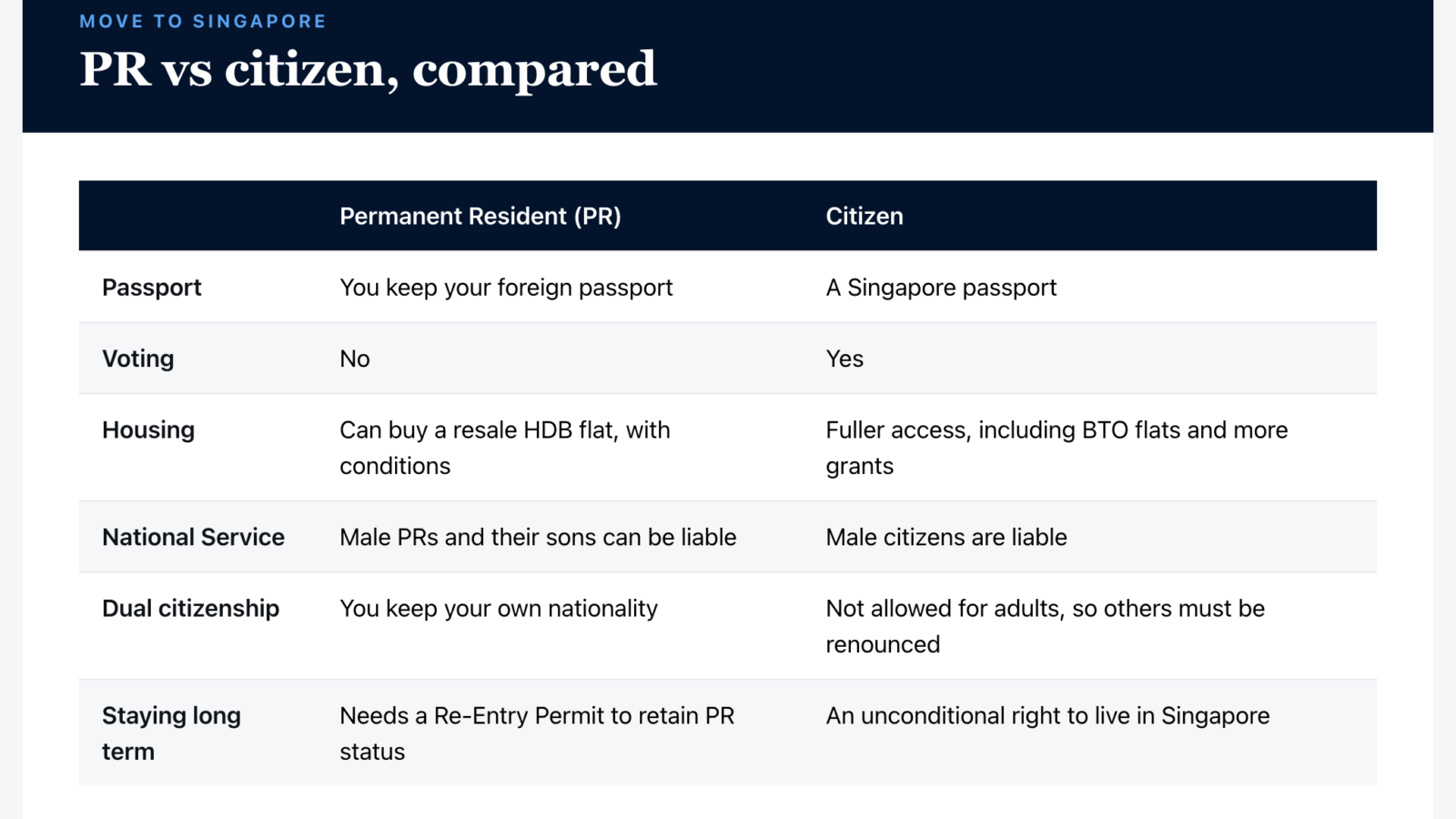
Here is how permanent residence and citizenship compare at a glance:
| Permanent Resident (PR) | Citizen | |
|---|---|---|
| Passport | You keep your foreign passport | A Singapore passport |
| Voting | No | Yes |
| Housing | Can buy a resale HDB flat, with conditions | Fuller access, including BTO flats and more grants |
| National Service | Male PRs and their sons can be liable | Male citizens are liable |
| Dual citizenship | You keep your own nationality | Not allowed for adults, so others must be renounced |
| Staying long term | Needs a Re-Entry Permit to retain PR status | An unconditional right to live in Singapore |
The responsibilities that come with it
Citizenship is a two-way street. Alongside the benefits sit real obligations, and it is worth understanding them fully before you commit.
National Service (NS)
Male citizens (and male PRs) are generally liable for National Service. This means full-time service followed by years of part-time reservist duties. If you are naturalising with sons, or your son becomes a citizen, NS obligations will apply to them. Families weighing citizenship often think this point through carefully, so read up on how NS works and confirm the specifics with the relevant authorities.
Civic duties
As a citizen you are expected to take part in national life, from voting in elections to contributing to the community. These are the everyday responsibilities of being part of the Singapore family.
No dual citizenship for adults
This is the single most important point to grasp, and it surprises many newcomers.
Singapore does not allow dual citizenship for adults. If you become a Singapore citizen through naturalisation, you are expected to renounce your previous citizenship. In practice this means giving up the passport and nationality you were born with or previously held.
Children born to Singaporean parents may sometimes hold more than one citizenship for a time, but they are generally required to choose one nationality once they reach adulthood. Because these rules directly affect your legal status in Singapore and in your country of origin, do not rely on hearsay. Verify the current position with ICA, and consider checking with the authorities of your existing country too, since renouncing one citizenship can have consequences elsewhere.
Renouncing your prior citizenship
If you decide to proceed, part of becoming a Singapore citizen involves formally giving up your existing nationality. The exact steps depend on which country you are renouncing, as each has its own process, paperwork, and sometimes fees.
A few things to keep in mind:
- Renunciation is usually a required step, not an optional one, to complete Singapore naturalisation.
- Some countries make renouncing straightforward; others make it slow or complicated.
- Once done, returning to your former citizenship later can be difficult or impossible.
Because this is a serious and often irreversible move, take your time, gather the correct documents, and confirm the sequence of steps with both ICA and your home country’s authorities.
The Singapore Citizenship Journey
Approved applicants go through the Singapore Citizenship Journey, a programme designed to help new citizens understand the nation’s history, values, and way of life before they formally become citizens.
It typically blends online learning with community activities and a visit or experience that connects you to local life. The idea is that citizenship is more than a passport; it is an understanding of the shared story you are joining. Completing this journey is part of the process, so factor it into your timeline.
How the application works, in broad strokes
While ICA publishes the full and current requirements, the general shape of the process looks like this:
- Check your eligibility. Confirm you meet the criteria, usually as a PR who has been here for a qualifying period.
- Prepare your documents. Identity papers, proof of residence, employment or income records, and family details are commonly needed.
- Submit your application through ICA’s official channels.
- Wait for assessment. Processing takes time, and ICA may request more information.
- Complete the Singapore Citizenship Journey if you are approved.
- Renounce your prior citizenship and take the Oath of Renunciation, Allegiance and Loyalty to finalise your status.
Quick tips before you apply
- Keep your records tidy. Clear, complete documents make everything smoother.
- Start understanding NS and renunciation early, especially if you have sons.
- Do not book anything irreversible in your home country until Singapore approval is confirmed.
- Always use ICA’s official website for forms, fees, and timelines, and treat everything else, including this article, as background reading.
A final word
Becoming a Singapore citizen is a meaningful commitment that brings a passport, a vote, and a genuine sense of home, balanced by duties such as National Service and the requirement to hold only one nationality. Take it step by step, keep your expectations realistic, and let the official source guide the details.
This guide is general information for newcomers and not immigration or legal advice. For anything that affects your status, confirm the current rules directly with ICA.
Explore more: Your guide to Singapore PR application and The moving to Singapore checklist.