

A supplier who delivered late, a customer who will not pay the last invoice, a partner who wants out of a joint venture: commercial disputes eat time, money and relationships. Before you head to court, it is worth asking whether mediation could resolve things faster. For many SMEs facing a Singapore Mediation Centre business dispute, mediation offers a structured, confidential way to reach a deal you both can live with, while keeping control of the outcome.
This guide explains when mediation makes sense, how a typical case runs at the Singapore Mediation Centre (SMC), what drives the cost and how a settlement can be made enforceable. It is general information, not legal advice. For your specific dispute, speak to a lawyer and check current procedures and fees directly with SMC.
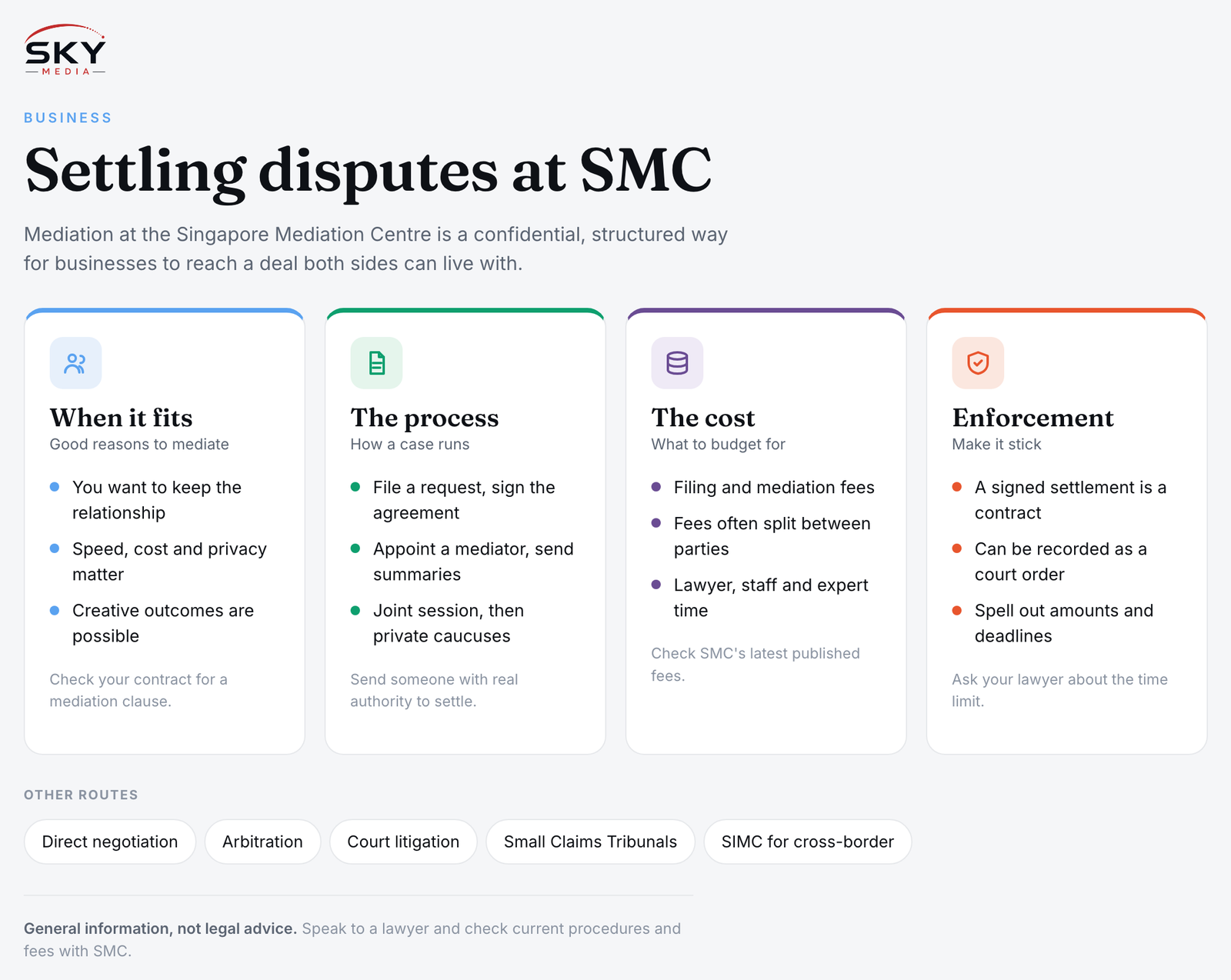
What the Singapore Mediation Centre Does
SMC is a not-for-profit organisation that provides mediation and other dispute resolution services for commercial and civil matters. It keeps a panel of trained mediators, many of whom are senior lawyers, retired judges or industry professionals, and it administers cases from the first request to the final settlement.
In mediation, a neutral mediator helps the parties talk, understand each other’s positions and explore options. The mediator does not decide who is right and cannot impose a result. Any outcome has to be agreed by both sides. That is the key difference from going to court or arbitration, where a judge or arbitrator makes a binding decision.
SMC is different from community mediation, which deals with neighbour and family-style disputes between individuals. If your issue is a noise complaint or a quarrel with the flat upstairs, our guide to using community mediation to resolve disputes is the better starting point. For cross-border commercial disputes, the Singapore International Mediation Centre (SIMC) is another option.
When Mediation Makes Sense for Your Business
Mediation tends to work well when:
- You want to keep the relationship. Long-term suppliers, distributors, landlords and partners often matter more than one disputed invoice.
- The facts are not wildly disputed, but the parties disagree on what is fair.
- Speed and cost matter. A mediation is usually scheduled and completed far sooner than a trial.
- Confidentiality matters. What is said in mediation is generally kept confidential and is not normally used later in court, which protects your reputation and commercial information.
- Creative solutions are possible. Payment plans, future orders, discounts, revised contract terms or a joint public statement are outcomes a court cannot usually order.
It may be less suitable when you urgently need an injunction, when the other side is acting in clear bad faith or simply refuses to engage, or when you need a public court ruling to set a precedent. Where the other party is a debtor who simply will not pay an undisputed sum, other tools may fit better. Our guide to statutory demands for debt recovery explains one such route.
Many contracts already contain a mediation clause requiring the parties to try mediation before going to court or arbitration. Check your contract first. If it does, skipping mediation could cause problems later.
Mediation vs Other Ways to Resolve a Dispute
| Option | Who decides | Typical features |
|---|---|---|
| Direct negotiation | The parties themselves | Cheapest and fastest if it works, but no neutral help when talks stall |
| Mediation at SMC | The parties, with a neutral mediator’s help | Voluntary, confidential, flexible outcomes; settlement only if both agree |
| Arbitration | An arbitrator | Private and binding; decision can be enforced; usually costlier than mediation |
| Court litigation | A judge | Public, binding, with appeal routes; usually the longest and most expensive |
| Small Claims Tribunals | A tribunal magistrate | For smaller claims within set limits and types; simpler procedures without lawyers |
Under Singapore’s court rules, parties are expected to consider amicable resolution before and during litigation. A judge may ask whether you tried mediation, and an unreasonable refusal to mediate can sometimes affect costs. So even if you expect to end up in court, a genuine attempt at mediation is worth considering.
How the SMC Process Typically Works
Exact steps can vary, so check SMC’s website for its current procedure and forms. A typical commercial case looks like this:
- Request for mediation. One party, or both together, files a request with SMC with a short description of the dispute and the amount involved. If only one side files, SMC will usually contact the other party to invite them to take part.
- Agreement to mediate. Both parties sign an agreement setting out the ground rules, including confidentiality and how fees are shared.
- Appointing a mediator. The parties can agree on a mediator from SMC’s panel, or SMC can propose one with suitable experience in the industry or type of dispute.
- Case preparation. Each side usually submits a short case summary and key documents before the session. Keep these focused: the mediator needs the main issues, not every email.
- The mediation session. Many commercial mediations are completed in a single day. The mediator often starts with a joint session, then meets each side privately (caucuses) to explore options and test positions in confidence.
- Settlement or no settlement. If you reach a deal, it is written up and signed as a settlement agreement. If not, you remain free to pursue other routes, and sometimes the talks narrow the issues for later.
Who should attend. Send someone with real authority to settle, such as a director or owner. A mediation stalls quickly if the person in the room must “check with the boss”. Lawyers can attend and often help, but you can also mediate without one.
What Affects the Cost
SMC charges fees that usually include a filing or administrative fee and a mediation fee. The fees are generally scaled to the amount in dispute and the length of the session, and are commonly split between the parties. Fee schedules change, so check SMC’s latest published fees before you file.
Other cost factors to budget for:
- Your own lawyer’s fees, if you use one, for preparation and attendance.
- Time spent by your staff gathering documents.
- Expert input, such as a quantity surveyor or accountant, for technical disputes.
Even with these costs, mediation is often far cheaper than taking a case through trial. Government schemes and support for SMEs change over time, so ask SMC or your trade association whether any subsidised mediation programmes currently apply to your sector.
Making the Settlement Enforceable
A signed settlement agreement is a binding contract. If the other side breaks it, you can sue on the agreement itself, which is usually simpler than suing on the original dispute.
Singapore’s Mediation Act provides a further option. Where a mediation is administered by a designated mediation service provider or conducted by a certified mediator, the parties can, with everyone’s consent, apply to court to have the settlement agreement recorded as an order of court. Once recorded, it can be enforced like a court order. There is a time limit for making this application, so ask your lawyer about it as soon as the agreement is signed.
For international commercial settlements, the Singapore Convention on Mediation provides a framework for enforcing mediated settlement agreements across participating countries. If the other party is overseas, ask your lawyer whether this applies.
Tips for a settlement that sticks:
- Spell out exact amounts, deadlines and payment methods.
- State what happens if a payment is missed.
- Include who pays the mediation costs.
- Say clearly that the agreement settles all claims covered by the dispute.
Getting Ready to Mediate
- Collect the contract, purchase orders, invoices, delivery records and key correspondence.
- Work out your best realistic alternative if mediation fails, including the cost and time of going to court.
- Decide your walk-away point before the session, but stay open to options you had not considered.
Mediation is not a sign of weakness. For many Singapore businesses, it is the quickest way to stop a dispute from draining the company. For personal matters that end up in mediation, see our guide on mediation for divorcing couples.
Frequently Asked Questions
What if the other side refuses to take part in mediation? Mediation is voluntary, so the other party cannot be forced to settle. If only one side files, SMC usually contacts the other to invite them. If they decline, you can still try direct negotiation or other routes, though an unreasonable refusal to mediate can sometimes affect costs in litigation.
Is a mediation settlement binding? Only once both sides sign a settlement agreement, which then works as a binding contract. Under the Mediation Act you can also apply to court, within a time limit, to have it recorded as a court order. Ask your lawyer about this as soon as you sign.
What happens if mediation fails? You remain free to pursue other options, such as arbitration or court, and what was said in mediation is generally kept confidential and not normally used later. Sometimes even a failed session narrows the issues. Work out your best alternative, including time and cost, before you start.
Who should I send to represent my company at mediation? Send someone with real authority to settle, such as a director or owner, as a session stalls quickly if the attendee must keep checking with the boss. Lawyers can attend and often help, but you can also mediate without one.
Do I need to check my contract before going to mediation? Yes. Many contracts contain a mediation clause requiring the parties to try mediation before court or arbitration, and skipping it could cause problems later. Read the clause, then collect your contract, invoices and delivery records, and speak to a lawyer if unsure.