
Every August, red and white bunting appears on flats and offices across the island, and school halls echo with the national anthem. Behind these familiar sights sits a small, carefully chosen set of singapore national symbols, each one holding a piece of the country’s identity and values. This guide explains the flag and what its elements mean, the state crest, the anthem Majulah Singapura, the national pledge, the Lion Head symbol, the national flower, and the Merlion as a tourism icon. It also covers the basic etiquette for displaying the flag and singing the anthem, so you can treat each symbol with the respect it is meant to carry.
The National Flag and What It Means
The national flag is the most visible symbol of all, divided into two horizontal bands, red above white. In the upper left corner sit a white crescent moon and five white stars arranged in a circle. Each element carries a meaning. The red band represents universal brotherhood and the equality of all people, and the white band stands for pervading and everlasting purity and virtue. The crescent moon represents a young nation on the rise, while the five stars stand for the nation’s ideals of democracy, peace, progress, justice and equality.
The flag was adopted when Singapore attained self-government, and it has remained the country’s flag through independence. Because the flag stands for the whole nation and not any one group, it is treated with care in how it is flown, handled and displayed, which is covered later in this guide.
The State Crest and the Lion Head
Alongside the flag, Singapore has a state crest, also called the coat of arms or the national coat of arms. It features a shield bearing the same white crescent moon and five stars from the flag, supported on one side by a lion and on the other by a tiger. The lion represents Singapore itself, tying back to the name’s traditional meaning of “Lion City,” while the tiger recalls the country’s historical links to the region. Below the shield, a blue banner carries the words “Majulah Singapura,” the same phrase that names the anthem. The state crest appears on official documents and government materials rather than in everyday use.
The Lion Head symbol is a simpler, more accessible emblem introduced so that people and organisations could show national identity without using the state crest, which is reserved for official purposes. The Lion Head is a stylised red lion’s face, and it can be used more freely by individuals, community groups and companies to express pride in Singapore, subject to the guidelines that govern how national symbols may be reproduced.
Majulah Singapura and the National Pledge
The national anthem is Majulah Singapura, which means “Onward Singapore.” It is sung in Malay, the national language, and its words call on Singaporeans to move forward together towards happiness and success. The anthem is performed at official ceremonies, in schools and at national events, and it is one of the moments when the whole country shares a single voice.
The national pledge sits beside the anthem as a statement of shared aspiration. Recited with the right fist held over the heart, it expresses the aim to build “one united people, regardless of race, language or religion,” and to achieve happiness, prosperity and progress for the nation. The pledge was written to capture the spirit of a young, diverse country choosing unity over division. It is recited in schools and at community and national occasions, and its words are a reminder that Singapore’s harmony is something to be actively built rather than taken for granted.
The National Flower and the Merlion
Singapore’s national flower is the Vanda Miss Joaquim, an orchid hybrid chosen for its vibrant, hardy and free-blooming nature, qualities meant to reflect the resilience and character of the nation. It was selected as the national flower to represent Singapore’s identity and its love of orchids, and it remains a proud botanical emblem of the country.
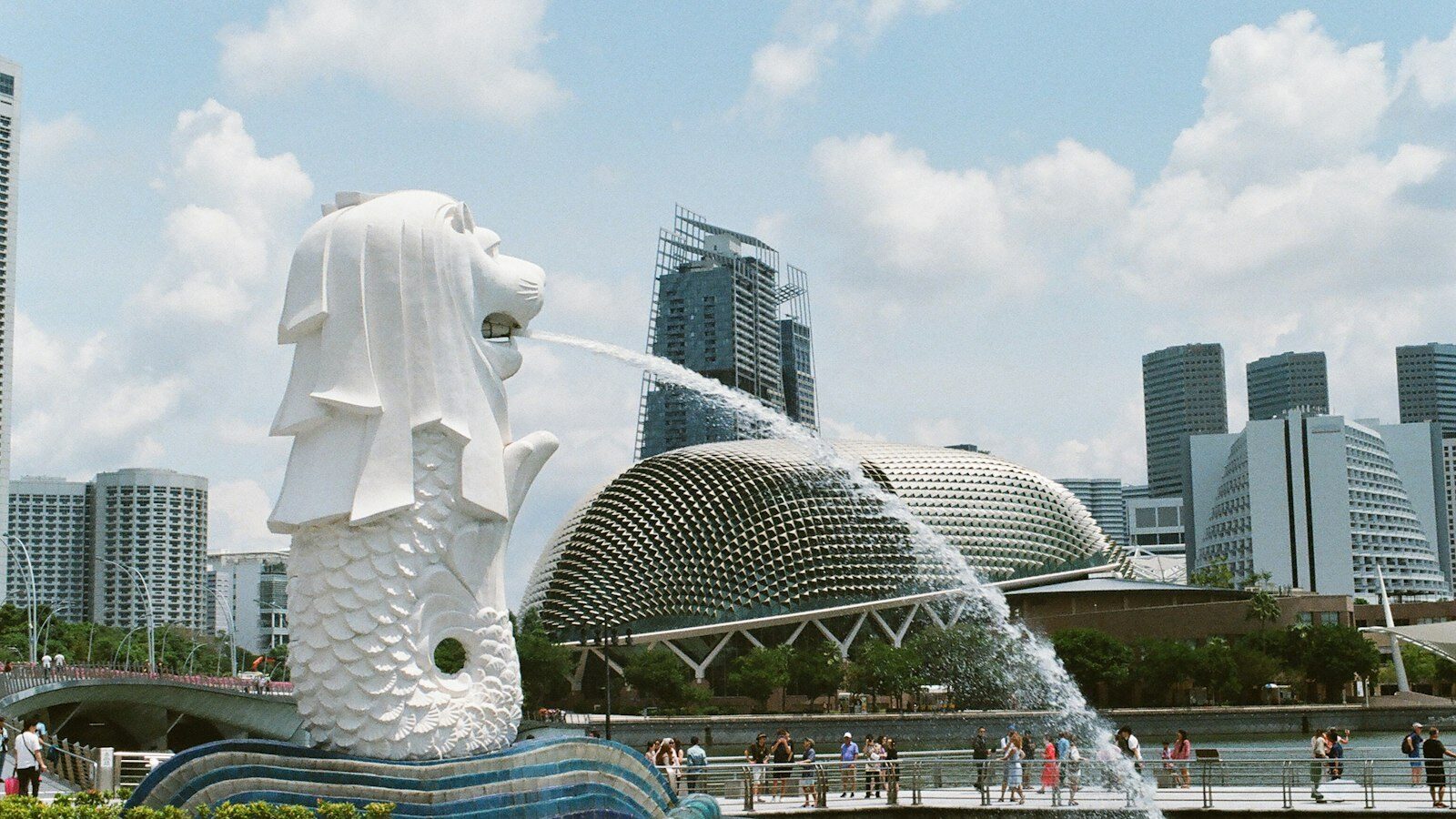
The Merlion, a creature with the head of a lion and the body of a fish, is often assumed to be an official national symbol, but it is best understood as a tourism icon. It was designed as an emblem for tourism, combining the lion of the city’s name with the fish that recalls its origins as a fishing settlement. The Merlion statue by the waterfront is one of Singapore’s most photographed landmarks. It is a beloved and recognisable mascot, though it sits in a different category from the flag, crest, anthem, pledge and national flower, which carry official standing.
Comparing the Symbols at a Glance
The table below summarises the main symbols and what each one represents, so you can see how they fit together.
| Symbol | What it is | What it represents |
|---|---|---|
| National flag | Red and white bands with crescent and five stars | Brotherhood, purity, a rising young nation and its ideals |
| State crest | Shield with lion and tiger supporters | Official emblem of the state and the nation |
| Lion Head | Stylised red lion’s face | National identity for wider, non-official use |
| Majulah Singapura | The national anthem in Malay | The call to move onward together |
| National pledge | A recited statement of unity | One united people regardless of race, language or religion |
| Vanda Miss Joaquim | The national flower, an orchid | Resilience and the nation’s character |
| Merlion | Lion-fish figure | Tourism icon and city mascot |
Displaying the Flag and Singing the Anthem
Because these symbols represent the whole nation, there are rules and courtesies around how they are used, and the flag in particular has clear guidelines. In general terms, the flag should be displayed with dignity, kept clean and in good condition, and not defaced, altered or used in ways that would show disrespect. There are conventions on how it is flown, including the period when residents may display it on their homes around National Day, and on how it should be handled when it is worn out and needs to be disposed of properly.
The anthem carries its own simple etiquette. When Majulah Singapura is sung or played at an official occasion, people are expected to stand and observe it respectfully, and it is sung in its original Malay words rather than a translation. The pledge is likewise recited in full and with the standard gesture of the fist over the heart.
A few points capture the spirit of using national symbols well:
- Treat the flag, crest, anthem and pledge with dignity and avoid using them for jokes or commercial gimmicks.
- Display the flag correctly and only during the permitted periods where rules apply, then take it down and store it properly.
- Stand and pay attention when the anthem is played at formal events.
- Follow the official guidelines when reproducing any national symbol on merchandise or in designs.
Because the detailed rules on flag display and the use of national symbols are set out by the authorities and can be updated, always check the current official guidelines before flying a flag outside the usual period or using a symbol for an event or product. Doing so keeps a shared set of symbols meaningful for everyone.
Explore more
To see how these symbols connect to the way the country is run, read our explainer on how the Singapore government works. And because the pledge’s promise of “one united people, regardless of race, language or religion” is lived out in daily policy, our guide to racial and religious harmony in Singapore is a natural next read.