

If you are planning to work here, the first thing to understand is which Singapore work pass fits your situation. There is no single “work visa.” Instead, the Ministry of Manpower (MOM) runs a family of passes, each aimed at a different kind of worker, from senior professionals to skilled staff to entrepreneurs. This guide walks you through the main options in plain terms so you know roughly what exists and where each one points. It is an overview to orient you, not immigration or legal advice, so always confirm the current details on MOM’s official website before you rely on anything.
Who actually applies (usually not you)
Here is a point that surprises many newcomers: for most passes, your employer applies on your behalf, not you. If a Singapore company hires you, their HR team or an appointed agent submits the application to MOM, and you help by supplying documents such as your passport, qualifications and photo. A few passes are self-sponsored, meaning you apply yourself without a specific employer, but those are the exception rather than the rule.
Because the employer usually drives the process, one of the most useful things you can do early is ask your prospective employer which pass they intend to apply for and whether you are likely to qualify. That single question saves a lot of guesswork.
The main passes at a glance
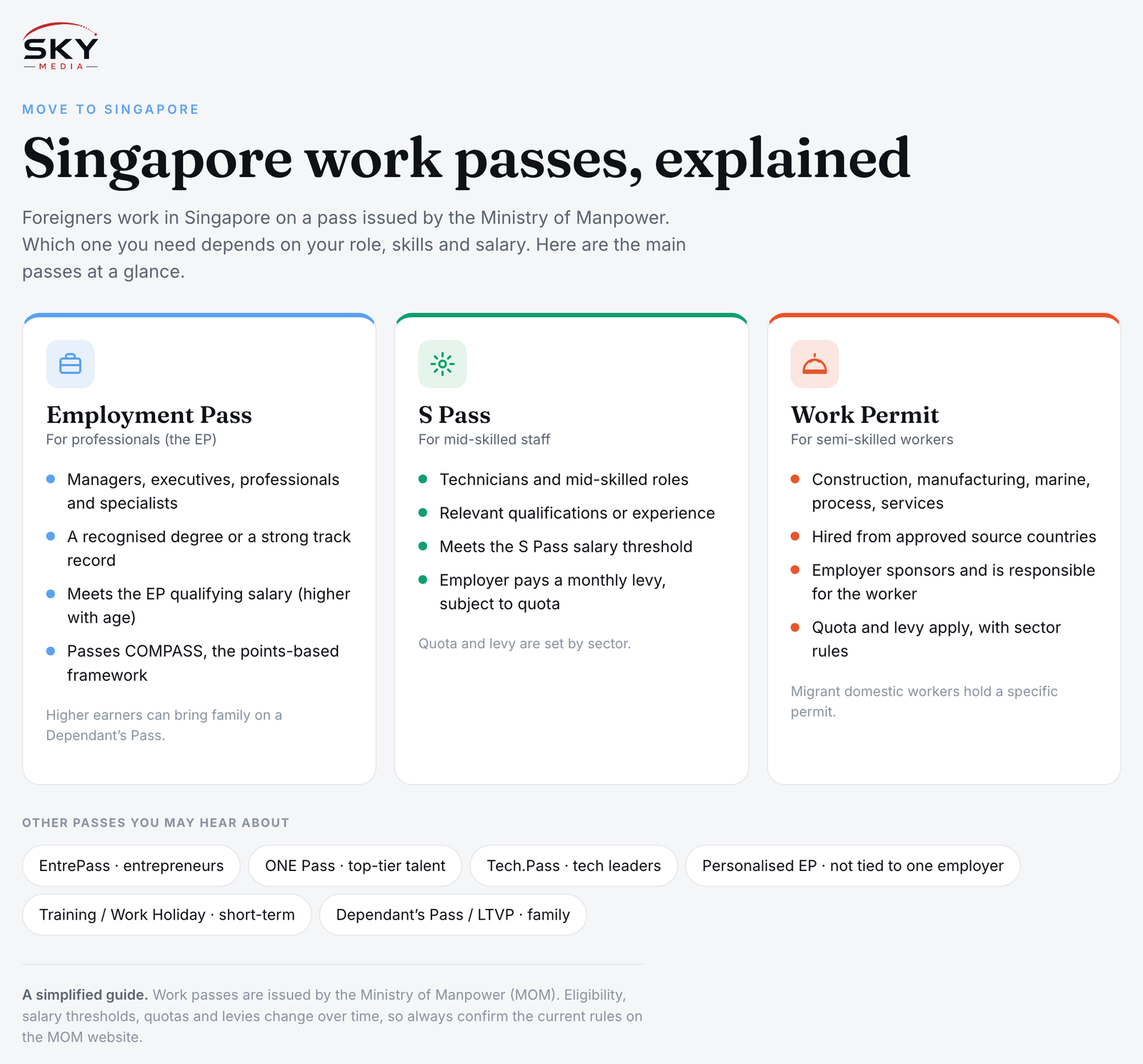
Think of the passes as sitting on a rough ladder of role and seniority. Salaries, points and criteria change over time, so treat the descriptions below as “broadly who this is for” rather than a checklist.
- Employment Pass (EP) is for professionals, managers and executives, typically in higher-skilled roles. It is one of the most common routes for degree-holding foreign professionals.
- S Pass is for skilled and mid-level staff whose roles sit below the EP tier. Employers are subject to quotas and levies for S Pass holders.
- Work Permit covers semi-skilled workers in sectors such as construction, manufacturing, marine, process and services, as well as domestic helpers under a separate scheme. This is the pass many people mean when they search for “work permit singapore.”
- Personalised Employment Pass (PEP) is a more flexible, self-sponsored pass for high-earning professionals. It is not tied to one employer, but it comes with stricter eligibility and conditions, and it cannot be renewed.
- EntrePass is for foreign entrepreneurs who want to start and run a venture-backed or innovative business in Singapore.
- Tech.Pass targets established tech founders, leaders and experts, giving them room to start companies, invest and work across the ecosystem.
- Overseas Networks & Expertise Pass (ONE Pass) is a premium, personalised pass for top talent across fields, offering a longer validity and more flexibility than a standard EP.
A simple way to remember it: EP and S Pass are the workhorses tied to a job offer, Work Permit covers hands-on roles, and PEP, EntrePass, Tech.Pass and the ONE Pass are the flexible or specialist routes for entrepreneurs and high-end talent.
Here is how the main passes compare at a glance:
| Pass | Who it is for | Key points |
|---|---|---|
| Employment Pass (EP) | Foreign professionals, managers and executives | Minimum qualifying salary and eligibility criteria apply, assessed partly through the COMPASS framework |
| S Pass | Mid-skilled staff in eligible roles | Salary threshold, quota and levy apply to the employer |
| Work Permit | Migrant workers in sectors such as construction, manufacturing and services | Sector-based, with quotas and levies, tied to the employer |
| EntrePass | Foreign entrepreneurs starting an eligible business | For innovative or funded ventures, not conventional small trades |
| Personalised Employment Pass (PEP) | High-earning EP holders wanting more flexibility | Not tied to a single employer, with strict eligibility and conditions |
Qualifying salary and COMPASS, without the numbers
For the Employment Pass in particular, two ideas come up again and again, and it helps to understand the concept even though the exact figures shift.
Qualifying salary
MOM sets a minimum “qualifying salary” that a candidate must be paid to be eligible for certain passes. It is not a flat figure for everyone: it generally rises with the candidate’s age and can vary by sector, on the logic that an experienced professional should command more than a fresh graduate. The headline point for you is simple: there is a salary floor, it changes periodically, and older or more senior candidates usually face a higher one.
COMPASS points
For the Employment Pass, MOM also uses a points-based framework called COMPASS (the Complementarity Assessment Framework). Rather than looking at salary alone, it scores an application across several areas, which broadly include things like the candidate’s salary relative to the market, their qualifications, and how diverse and locally supportive the employer’s workforce is. An application needs to reach a passing score.
You do not need to memorise how COMPASS is weighted. What matters is knowing it exists, that it is mostly the employer’s job to meet it, and that both the qualifying salary and the COMPASS criteria are updated by MOM from time to time.
Passes for your family
If you are moving with loved ones, the good news is that some passes let you bring family members on their own related passes. Higher-tier pass holders who meet the income requirements may be able to sponsor a spouse and children, and in some cases parents, through dependant-type passes. The exact eligibility depends on which pass you hold and how much you earn, so it is worth checking early if family is part of your plan. We cover the options in detail in our companion guide, linked at the end.
A newcomer’s quick checklist
Use this as a starting point, not the final word:
- Ask your employer which pass they will apply for and whether you meet the current criteria.
- Check MOM’s official website for the latest qualifying salary, COMPASS rules and eligibility, since these change.
- Get your documents ready early: passport, educational certificates, references and a recent photo.
- Confirm the family angle if relevant, so you know whether your pass supports dependants.
- Keep copies of your in-principle approval and pass details once issued.
Why “check MOM” is more than a disclaimer
Work pass rules in Singapore are reviewed regularly. Salary floors are adjusted, frameworks like COMPASS are refined, and sector rules evolve. An article can give you the shape of the system, but only MOM publishes the current, binding criteria. Before you accept an offer, sign a tenancy or book flights, verify the specifics for your exact pass on the official MOM site or with a qualified professional. Treat every figure and rule you read elsewhere, including here, as a rough guide to be confirmed.
With that mindset, the landscape becomes far less intimidating. You are really just matching your role and situation to the right pass, letting your employer handle most of the paperwork, and double-checking the numbers at the source.
Explore more: Moving to Singapore checklist · Dependants Pass and family guide · CPF explained