

If your child keeps interrupting every time you talk to your partner, a neighbour at the void deck or a teacher at pick-up, you are in very good company. Interrupting is one of the most common complaints parents have, and it is also one of the most fixable. The trick is to treat it as a skill your child has not learned yet, rather than as rudeness that needs punishing.
This guide focuses on one specific behaviour: cutting into adult conversations. It walks through why children do it, a simple routine that teaches them to wait, what to say in the moment, and how to adjust the approach for different ages.
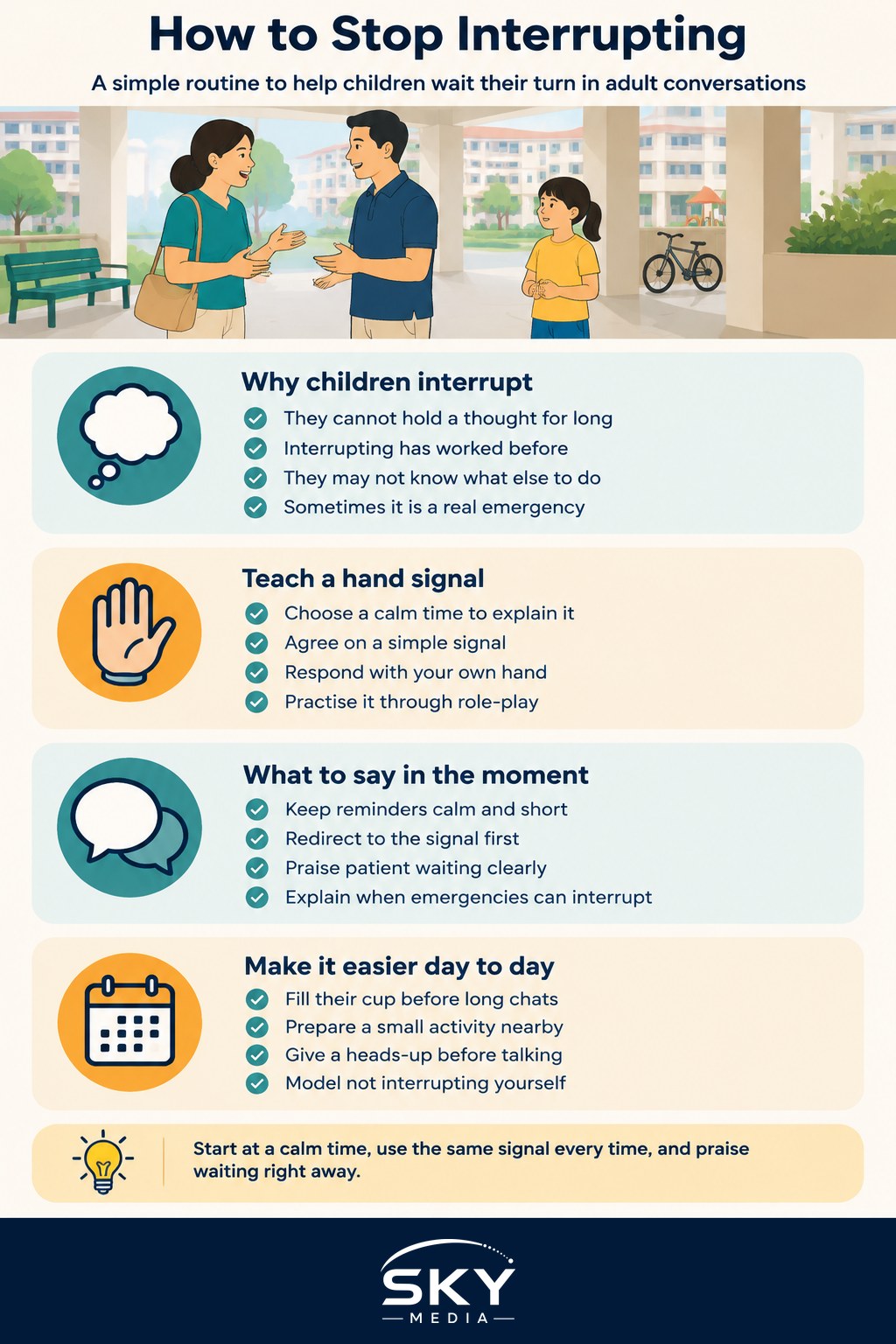
Why Children Interrupt in the First Place
Before changing the behaviour, it helps to understand what is driving it. Most interrupting comes from one of a handful of causes:
- Young brains struggle to hold a thought. A four-year-old who has something to tell you genuinely worries that the idea will vanish if they wait. Their working memory is still developing.
- Interrupting has worked before. If breaking in usually gets your attention within seconds, your child has learned that it is the fastest route to you.
- Adult conversations feel like competition. When your attention moves to another person, some children feel left out and try to pull it back.
- They do not know the alternative. Many children have heard “don’t interrupt” hundreds of times but have never been taught what to do instead.
- Genuine urgency. Sometimes a sibling really is climbing the shoe rack. Children need to know that real emergencies are always allowed.
Once you see interrupting as a gap in skills plus a habit that has been rewarded, the solution becomes clearer: teach a replacement behaviour, then make sure the replacement works better than interrupting does.
The Hand Signal Routine That Teaches Waiting
Many families use a quiet signal system, sometimes called the interrupt rule. It gives your child a polite way to say “I need you” without breaking into the conversation. Here is how to set it up.
- Pick a calm time to explain it. Do not introduce the rule in the middle of a frustrating moment. Choose a relaxed time, such as after dinner, and keep the explanation short.
- Agree on the signal. The most common version is for your child to place a hand gently on your arm or shoulder. Some families use a raised hand or a squeeze of the hand instead.
- Agree on your response. When you feel the hand, you place your own hand over theirs. This tells your child “I know you are there and I will come to you soon.” You keep talking briefly, then finish your sentence and turn to them.
- Practise it as a game. Role-play a few times. You pretend to chat with your partner or a soft toy, and your child practises the signal. Children usually enjoy this and learn faster through play than through lectures.
- Keep the wait short at first. In the early weeks, respond within a few seconds. As your child gets better, you can stretch the waiting time gradually.
The key promise is that the signal must actually work. If your child places a hand on your arm and you carry on talking for ten minutes, the routine collapses and interrupting returns.
What to Say in the Moment
Even with a routine in place, your child will slip up, especially in the first few weeks. How you respond decides whether the new habit sticks.
- Stay calm and brief. A short, neutral reminder works better than a long scolding in front of other adults. Something like “Hand on my arm, please” is enough.
- Do not answer the interruption itself. If you reply to the question your child shouted over the conversation, you are teaching them that interrupting still works. Redirect to the signal first, then respond.
- Name the waiting when it happens. When your child uses the signal and waits, thank them specifically: “You waited so patiently while I finished talking to Auntie. Thank you. What did you want to tell me?”
- Explain the exception for emergencies. Make it clear that if someone is hurt, in danger or about to break something, they should interrupt straight away. Children are reassured to know this.
Specific praise matters more than most parents expect. Children repeat what earns attention, so make sure patient waiting earns more warmth than interrupting ever did.
Comparing Common Responses to Interrupting
Not every response to interrupting helps. The table below compares the approaches parents commonly reach for.
| Response | What your child learns | Better alternative |
|---|---|---|
| Answering immediately | Interrupting is the fastest way to get attention | Redirect to the signal, then answer |
| Shouting “Stop interrupting!” | Adults interrupt too when they are annoyed | Calm, short reminder of the signal |
| Ignoring them completely | Their needs do not matter, so they get louder | Acknowledge with a hand, then respond soon |
| Long lecture afterwards | Manners are boring and confusing | Short practice session at a calm time |
| Praising patient waiting | Waiting works and feels good | Keep doing it consistently |
Adjusting the Approach for Different Ages
What you can expect depends a great deal on your child’s age and temperament.
Toddlers and preschoolers. Expect only a few seconds of waiting. Keep conversations short when your child is with you, and respond quickly to the signal. At this age, you are planting the idea, not perfecting it.
Lower primary. Children around six to nine can usually wait longer and understand the reasons behind the rule. You can talk about how it feels when someone cuts into their own story, which builds empathy alongside the habit.
Upper primary and beyond. Older children tend to interrupt less with their bodies and more with their phones or with constant comments. Here the conversation shifts to reading social cues: noticing when adults are talking about something serious, and judging whether their news can wait.
Children who are naturally impulsive, or who have attention differences, may need more practice, shorter waiting times and more frequent praise. If interrupting comes with wider difficulties at school or at home, the class teacher, school counsellor or your family doctor can help you think through next steps.
Setting Up Your Day to Reduce Interruptions
Some interruptions can be prevented before they start.
- Fill their cup before a long conversation. Before a phone call or a visit from relatives, spend a few minutes giving your child your full attention. A child who feels connected is more able to wait.
- Prepare an activity. For predictable situations, such as a video call or a parent-teacher meeting, bring a small activity, a book or a drawing pad.
- Give a heads-up. Tell your child what is about to happen: “I am going to talk to Uncle for a few minutes. If you need me, use the hand signal.”
- Model it yourself. Children notice when adults cut each other off. Try not to interrupt your partner, your helper or your child when they are speaking.
Breaking any habit takes repetition, whether it is a child’s habit or an adult’s. If you have worked through helping your child stop thumb-sucking, you will recognise the same pattern here: replace the behaviour, reward the replacement and stay patient through setbacks. Adults wrestling with their own habits, such as nail biting, know how long a routine takes to stick.
How Long It Takes and When to Expect Setbacks
Most families see a real improvement within a few weeks of consistent practice, though every child is different. Expect setbacks when your child is tired, hungry, unwell or excited, and around big changes such as a new sibling, a house move or the start of the school year. These are normal and do not mean the routine has failed.
Keep the signal, keep your responses calm and keep praising patience. Over time, waiting for a gap in the conversation becomes something your child does without thinking, and that is a social skill that will serve them well in the classroom, with friends and eventually at work.