

For something so ordinary, money is one of the hardest things for couples to discuss openly. We can share a bed, a bathroom, and our deepest fears, then freeze up at the thought of asking, “So, how much do you actually save each month?” Money talks for couples Singapore find themselves needing sooner or later, especially as costs rise, yet many of us were raised to treat the topic as private or even a little shameful.
The good news is that talking about money well is a skill, not a personality trait. It is less about spreadsheets and more about honesty, curiosity, and teamwork. This is general guidance to help you start those conversations warmly, not financial advice, so treat it as a way to understand each other rather than a plan for your specific numbers.
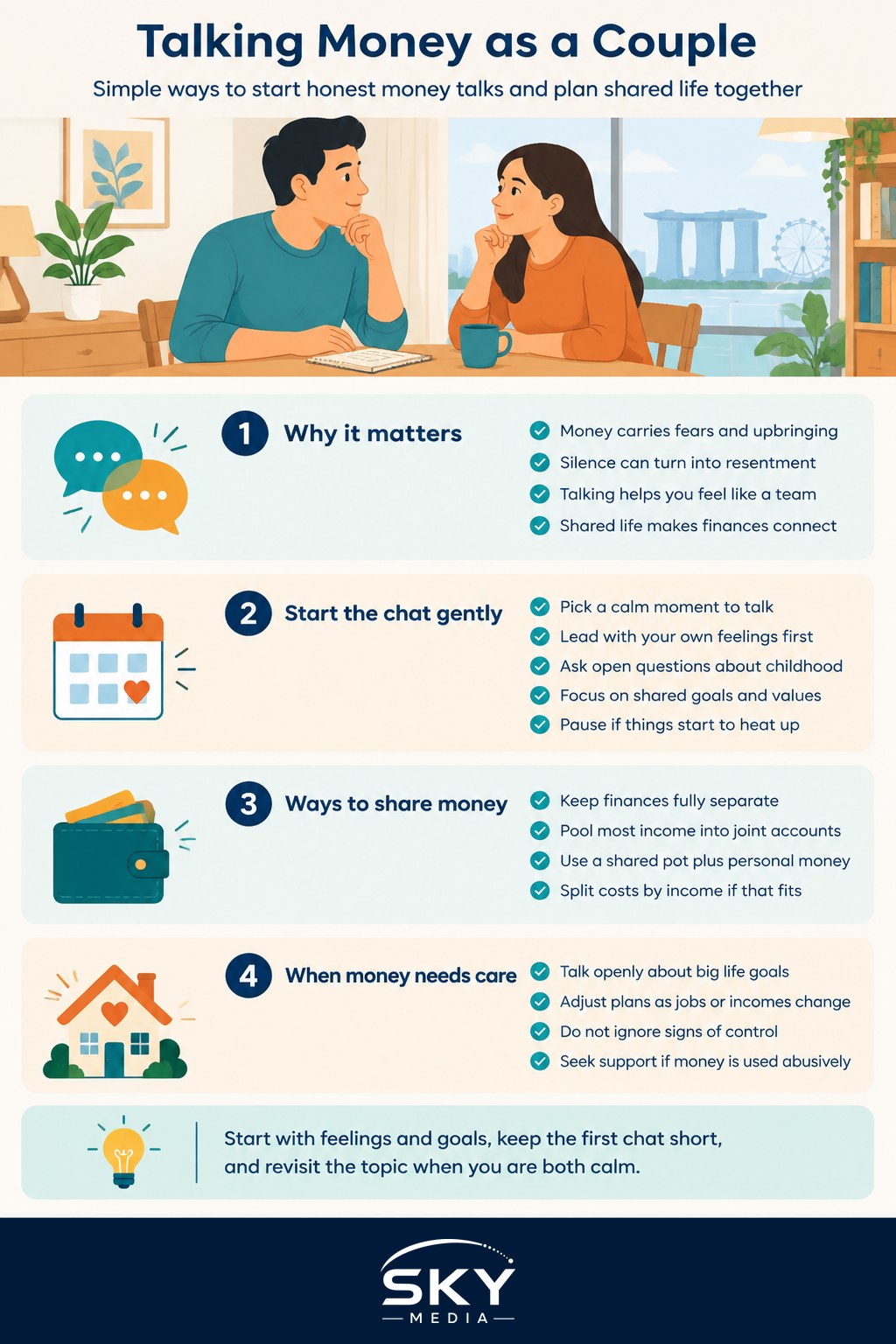
Why Money Talks Matter More Than We Admit
Money is rarely just money. It carries our upbringing, our fears, and our sense of safety. Someone who grew up watching their family stretch every dollar may hold on tightly, while someone raised more comfortably might spend freely without a second thought. Neither is wrong, but without conversation those differences can quietly breed resentment.
Avoiding the topic does not make it disappear. It simply pushes the tension underground, where it shows up as sniping over a dinner bill or a silent grudge about a big purchase. Couples who talk about money regularly tend to feel more like a team, because they are making decisions together rather than discovering each other’s habits by accident.
There is also a practical side. As two lives intertwine, through shared outings, travel, a home, or a future together, your finances start to touch each other whether you plan for it or not. Naming that early, gently, means fewer nasty surprises down the road and a lot more trust.
How to Start the Conversation Without a Fight
Timing and tone do most of the work. Springing a money interrogation on your partner after a stressful day rarely ends well. Instead, pick a calm moment, name that the topic feels a bit awkward, and frame it as curiosity rather than criticism. Something like, “I would love for us to be more open about money so we are on the same page,” lands far softer than “We need to talk about your spending.”
A few gentle habits help these chats go well:
- Lead with your own situation and feelings first, so it feels like sharing rather than auditing.
- Ask open questions about how money felt in each other’s childhood, which often explains a lot.
- Focus on shared goals and values, not on scoring points about past purchases.
- Keep the first conversation short and kind, and agree to revisit it, since one talk rarely covers everything.
If a discussion starts heating up, it is fine to pause and come back later. The aim is understanding, not winning. Money conversations are ongoing, not a single summit you conquer once.
Ways Couples Handle Shared Money
There is no single correct way to organise money as a couple, and what suits you may change over time. Broadly, couples land somewhere on a spectrum from keeping everything separate to pooling everything together, with plenty of blends in between. The best system is simply the one you both understand and feel is fair.
Here is a look at common approaches and what each tends to ask of a couple.
| Approach | How it works | Worth thinking about |
|---|---|---|
| Fully separate | Each keeps their own money, splits bills | Simple and independent, but can feel less shared |
| Fully joint | Most income pooled into shared accounts | Very united, needs deep trust and openness |
| Partial pool | A shared pot for joint costs, personal money kept | Balances teamwork with autonomy for many |
| Proportional split | Contribute in line with what each earns | Feels fair across incomes, needs honest disclosure |
Whatever you choose, the mechanics matter less than the honesty behind them. Agree on how shared costs are covered, keep each other in the loop on big decisions, and revisit the arrangement as jobs, incomes, or responsibilities shift. Flexibility is a feature, not a failure.
When You Earn or Spend Very Differently
Gaps in income or spending style are completely normal, and they need not be a source of friction if you handle them openly. Trouble usually comes not from the gap itself but from unspoken expectations, like one person quietly assuming the higher earner should always pay, or the saver silently judging the spender.
Talk about what feels fair to both of you rather than defaulting to an even split that might strain the person who earns less. Some couples find that contributing in proportion to income feels kinder, so that shared life does not quietly become a burden for one. Others are happy with an even split. The point is to decide together, out loud, rather than letting resentment fill the silence.
Different money personalities can actually balance each other beautifully. A natural saver and a natural spender can help one another find a middle path, where there is both security and room to enjoy life. Approach it with curiosity instead of trying to convert your partner, and you may both soften towards a healthier middle.
Big Goals and the Cost of Living in Singapore
At some point, many couples turn to bigger shared plans, whether that is a home, travel, further study, supporting family, or a future together. In Singapore, the cost of living and the price of housing loom large over these conversations, and pretending otherwise helps no one. Big commitments here often require years of coordinated saving, so talking early gives you time to plan calmly rather than under pressure.
Rather than fixating on exact figures, which shift constantly and differ for every couple, focus first on shared priorities. What kind of life do you both want, what are you each willing to trade for it, and what timeline feels realistic? Once your values line up, the numbers become a practical exercise rather than a source of conflict. If you want tailored figures, a qualified financial adviser is the right person to see, since this guide is general information rather than advice for your circumstances.
When Money Becomes About Control
Healthy money conversations leave both people feeling respected and informed. Occasionally, though, money is used as a tool of control, and that is a different and serious matter. If a partner stops you from accessing your own money, hides shared finances from you, runs up debts in your name, or uses money to monitor or restrict you, that is a form of abuse, and it is never your fault.
Please take such patterns seriously. You can look up current support such as PAVE or the National Anti-Violence and Sexual Harassment Helpline, and in an emergency call the Police. If money worries or relationship strain are affecting your wellbeing, a counsellor or a Family Service Centre can offer support, and reaching out is a sign of strength rather than weakness.
Explore More
Money and commitment are deeply linked, so it may help to read about knowing if you are ready to commit and, when a shared home is on the horizon, our guide to moving in together, where finances really come to the fore. If your relationship is still finding its footing, defining the relationship first can make these bigger money talks feel far more natural.
Related across Sky Media: Managing Money as a Couple in Singapore · How to Talk About Money With Your Family in Singapore
Frequently Asked Questions
How soon in a relationship should we talk about debt? Raise it once things are getting serious, well before you share big financial commitments such as a home or a loan. You do not need exact figures on a first date. A calm, honest chat about what each of you owes and how you feel about it prevents unwelcome surprises later.
Should we share our salaries before we are married? There is no rule, but openness grows with commitment. Many couples share rough income levels once they plan shared costs or a future together. Sharing is easier when both feel safe from judgement, so start with general ranges and goals rather than demanding payslips.
Is it a good idea for unmarried couples to open a joint bank account? It can work for shared bills, but it carries risk because either person may be able to withdraw the money. Many couples prefer a small joint account for household costs and keep their own savings separate. Ask your bank about its terms, and think about what happens if you part ways.
How do we talk about money when one of us supports our parents? Treat it as a shared reality rather than a hidden burden. In many Singaporean families, supporting parents is an important value, so explain how much that matters to you and what it means for your budget. Agreeing early on what is comfortable for both of you avoids resentment.
How can we budget for dates and outings without feeling stingy? Decide together how much you both want to spend on fun, then treat it as a normal part of your plans rather than a guilty extra. Alternating who plans or pays, and mixing free or low-cost activities with occasional treats, keeps dates enjoyable. Being open about limits is more romantic than quietly overspending.